
Wholesale Curtain Quotes: Compare Price per Panel or Pair
Convert every offer to panels, then compare the exact dimensions, header, hardware and packing for each completed window pair.
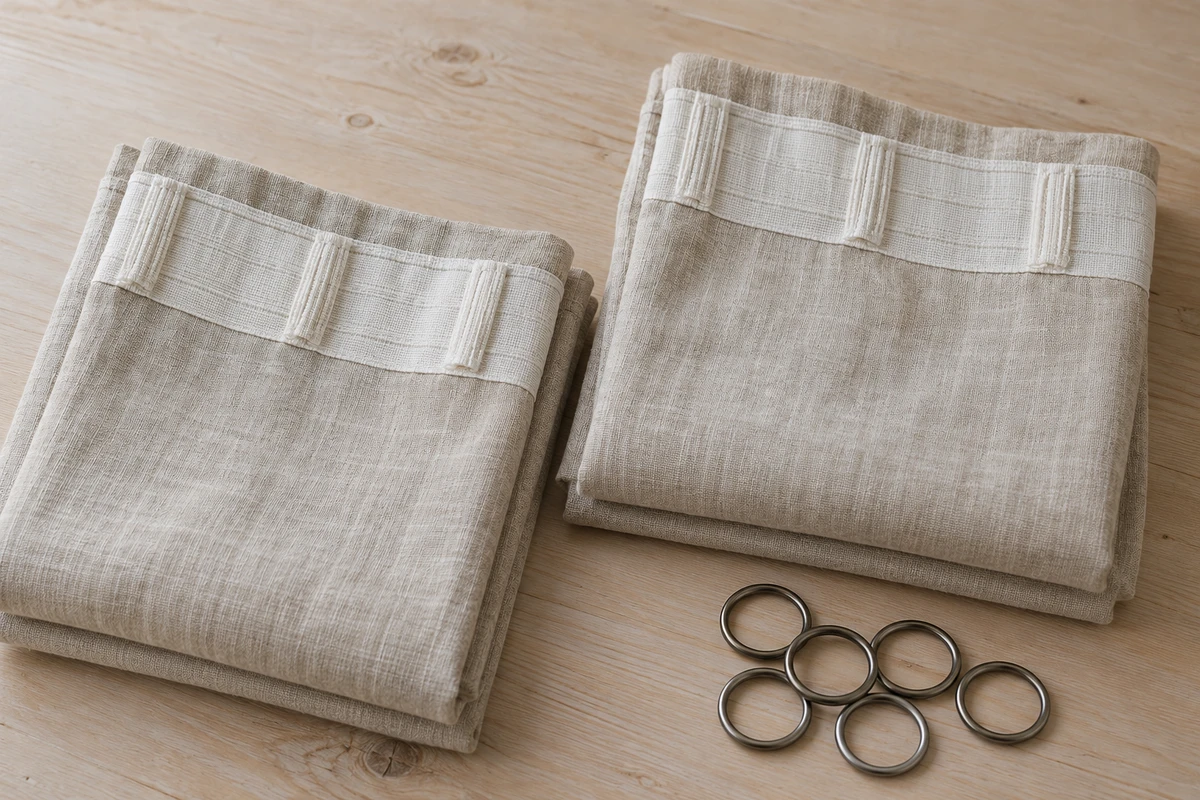
A curtain quote needs to say how many panels the price buys, what each panel measures and which header arrangement is supplied. “One set, 140 × 240” leaves all three open. Before comparing prices, ask the seller to describe one orderable unit in words and return the dimensions against that unit.
The useful result is a curtain schedule that connects the commercial quantity to the project’s chosen header and hanging arrangement. It should let the buyer distinguish four individual panels from four pairs, and a finished heading from a package that also includes the required loose accessories.
Define the panel inside the selling unit
Ask whether the price is for one panel, two panels sold together, or another stated combination. If the answer is a pair, record the size of each member and whether the two panels are identical or intentionally different. Keep decorative tiebacks, liners and loose hardware outside the panel count, even when a listing calls the whole bundle a set.
Write both quantities on the request: the number of selling units and the corresponding number of curtain panels. Preserve the seller’s original unit beside the buyer’s requirement. If a quotation changes from per panel to per pair, revise the conversion explicitly rather than replacing the unit label while leaving the quantity unchanged.
IKEA’s page for DYTÅG 606.078.02 provides a concrete example: it states that a pair is included, lists width per curtain and describes heading-tape options separately. Those fields explain the named IKEA product; they do not establish the contents of another seller’s offer. IKEA DYTÅG product details and measurements
Put the measuring points next to the numbers
For width, ask what has been measured: one panel laid flat, a completed pleated heading, or a claimed installed span. Record the seller’s definition. If two offers give different width bases, ask for the same requested basis before treating their figures as equal. Adding two flat-panel widths does not by itself establish the width the pair will cover in the agreed installed arrangement.
Length needs its own reference. A figure measured from the top fabric edge is not necessarily the same description as a drop measured from an attachment point. Supply a simple marked sketch showing the project’s required start and end points, then ask the seller to identify its measurement on that sketch. State the finished-product condition to which the dimension applies, using the project’s existing specification rather than inventing a washing procedure.
Keep the design owner’s installed-coverage requirement separate from the supplier’s panel dimensions. The design owner should settle fullness, overlap and the intended hanging configuration. This purchasing comparison supplies no universal fullness multiplier and does not determine fixings or installation suitability.
Describe the header as a supplied construction
“Suitable for a rail” leaves the physical top of the curtain unspecified. Ask for the header type, an identified close-up or drawing of the offered variant, and the intended rod or rail interface. If the supplier offers heading tape, eyelets or another construction, put each alternative on its own response line. A photograph showing one header should not silently stand in for a differently priced option.
Then ask what is sewn into the panel and what arrives loose. List the proposed hooks, rings or gliders by description and quantity where they are part of the supply. Record separately supplied items as separate quote lines. An accessory shown beside the curtain in a styled image should remain unconfirmed until the seller identifies it in the offer.
For an existing hanging system, give the responsible project owner’s system reference and ask for a documented response to that requirement. Do not ask the buyer to choose a component by appearance. A response can be commercially complete while the proposed interface still awaits the appropriate review.
Use a panel and header comparison sheet
Complete one sheet per curtain variant. Add the supplier quote reference, selected listing option and project drawing reference above these rows. This worksheet is an editorial purchasing aid; fill it with the actual replies.
| Field | Buyer requirement | Supplier response to retain | What prevents comparison |
|---|---|---|---|
| Selling unit | Single panel, pair or defined combination | Exact quoted unit and panels per unit | “Set” without a count |
| Width per panel | Required value and measurement basis | Value, unit and flat or completed-header basis | Pair width substituted for panel width |
| Length | Required drop and marked measuring points | Value and stated start/end points | Number supplied without a reference |
| Installed coverage | Project owner’s approved requirement | Supplier assumptions, if any | Flat width presented as installed coverage |
| Header | Specified construction and reference | Offered construction and matching detail | Family photo instead of quoted header |
| Loose accessories | Required items or expressly excluded scope | Included and separately priced quantities | “Hardware included” without contents |
| Purchase quantity | Required panels and permitted pair composition | Selling units needed on the stated basis | Conversion uses an unconfirmed pack count |
Resolve a blank field with a targeted question. A missing header detail calls for the offered construction; an unclear length calls for its measuring points. Sending the same broad “please confirm specifications” request to both suppliers can produce another pair of incomparable answers.
Work through a fictional four-panel request
Imagine a buyer whose project owner has already specified four panels with header reference H1. Each panel is requested at 140 cm flat width and 240 cm length from the top fabric edge to the bottom hem. These dimensions, references and supplier replies are invented for this example, not recommended dimensions or an installation design.
Offer A quotes individual panels against that dimension description and identifies H1. Offer B quotes a pair and writes “140 × 240, header included,” without saying whether 140 cm applies to each panel or the pair. Neither offer includes enough information about loose accessories.
| Fictional response | Selling units for four panels | Dimension status | Header and accessory status |
|---|---|---|---|
| A: one panel per unit | 4 | Requested per-panel basis acknowledged | H1 identified; loose accessories unanswered |
| B: two panels per unit | 2 | Width basis and length reference unanswered | Header unspecified; loose accessories unanswered |
The count conversion is four A units or two B units. That is the only equivalence established so far. Ask B to confirm each panel’s dimensions and H1, and ask both suppliers to state the loose-accessory scope.
Suppose B’s fictional revised reply confirms the same per-panel measurements but offers a different header H2. Its two pairs still provide four panels, yet the offer remains an alternative to the H1 requirement. The buyer can request H1 or send H2 to the project owner for a decision. A correct panel total cannot close the header difference. No prices or delivered-cost advantage are assumed.
Return the quotation on the agreed curtain basis
Ask the supplier’s final reply to repeat the selling unit, panels per unit, per-panel measurement basis, header reference and included loose items. Retain any separately priced accessory line next to the relevant curtain. If the supplier changes the header or length convention, reopen those fields before using the earlier comparison.
The Home textiles page provides broader category context. Start a Homeware sourcing request with the selected product link or a concise description of the required panel unit and header. Use an image preview for a marked measurement sketch; agree a separate route for original documents. The inquiry form’s image field should not be treated as a PDF or spreadsheet upload channel.
Worked quote: 24 panels for twelve rooms
Assume a fictional order for twelve paired windows with two panels each. The RFQ names the same header H1, one lining, and finished measurements of 140 × 260 cm per panel. Ask if the quoted dimensions are per panel and which hooks or rings are included.
The single-panel quote returns 24 × 29 plus 36 for matched packing and labels. The pair quote returns 12 × 59 plus 24 for the agreed hardware. Both examples total CNY 732, or 61 per window pair, when each includes the same required hardware, correct pair labelling and receiving point. Hold any different header or panel size as a distinct option for approval.
| Comparison field | Single-panel offer | Pair offer |
|---|---|---|
| Selling units | 24 × one panel | 12 × two panels |
| Goods subtotal | 24 × 29 = 696 | 12 × 59 = 708 |
| Additional scope | 36 for matched packing and labels; hardware included | 24 for the required hardware; matched packing included |
| Subtotal per complete pair | 732 ÷ 12 = 61 | 732 ÷ 12 = 61 |
| Before release | Count and check by pair label, per-panel dimensions and header. | Count both panels and verify their header and hardware match. |
Frequently asked questions
Does “one pair” always give the same width as two single-panel offers?
Only if the panel dimensions and their measurement bases match. Confirm that each member of the pair has the requested width, then check whether the figure describes flat fabric or a completed header. Keep installed coverage as a separate project requirement; the number of panels alone does not settle it.
What should I ask when a supplier gives only a finished curtain length?
Ask it to mark the start and end points on a sketch of the offered header and panel. Preserve the stated condition of the finished item as well. Compare that response with the project’s required drop; do not adjust the figure by an assumed allowance for hooks, rings or another attachment.
Are hooks included when the quote says heading tape?
Ask explicitly. Record the sewn-in header and loose components separately, with descriptions and quantities for anything included. If the project requires items supplied elsewhere, retain those exclusions beside the curtain quote so a complete-looking product photograph does not conceal a purchasing gap.
Can I compare prices while the hanging-system choice is unresolved?
You can collect prices for clearly named alternatives, but keep their header and accessory differences visible. Avoid ranking them as interchangeable curtain packages until the project owner decides the relevant arrangement and the suppliers price that scope. This quote review does not approve installation or select wall fixings.
Sources
Discuss a sourcing request related to this article.Wholesale Curtain Quotes: Compare Price per Panel or Pair