
Cutting-Board Multipacks: Compare the Actual Face Order
Show grooves, feet and handle edges in a cutting-board bundle before choosing its face order or asking for contact-material review.
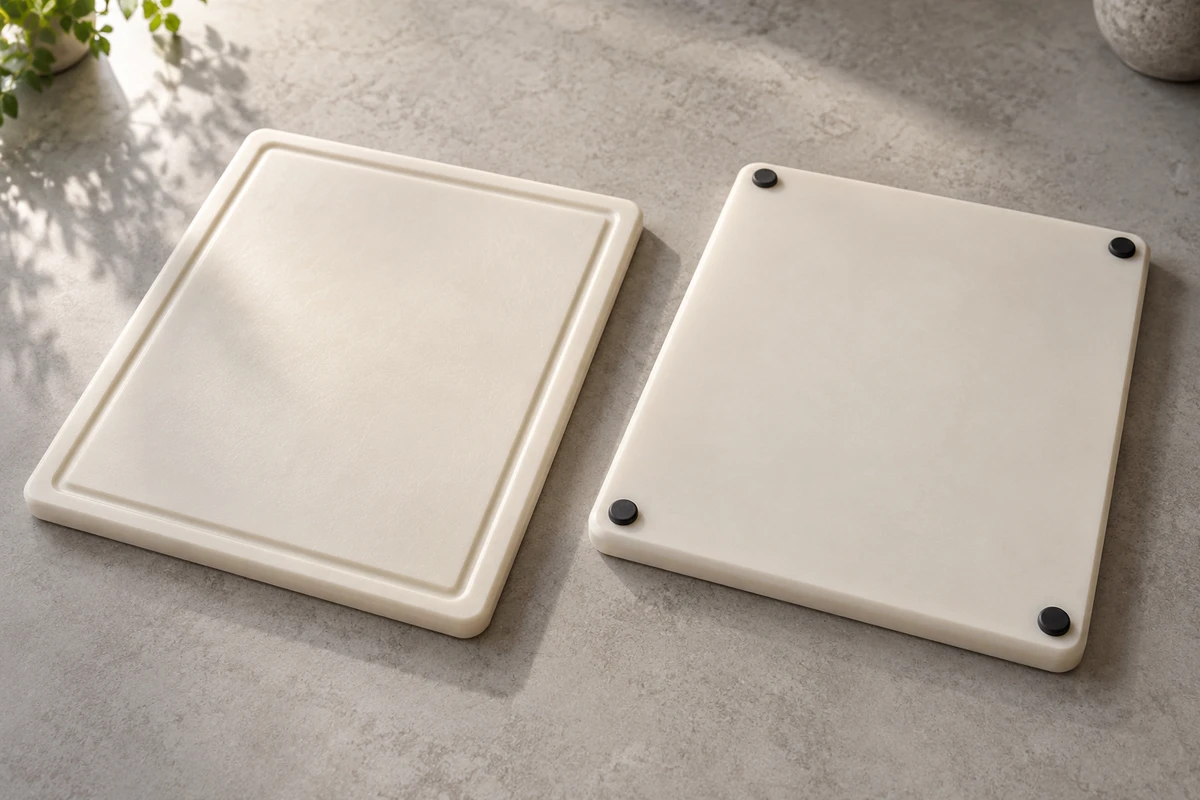
Choose a cutting-board multipack’s face order from the actual board features. Two boards with the same outside dimensions may still present different faces, feet, grooves and handle edges to each other. A pair of blank rectangles hides those relationships.
Start with approved boards and quantities. The packing decision is which permitted face sequence is proposed and which interfaces need review. It does not reopen the buyer’s required preparation area or assess the received boards for flatness or damage.
Name both faces before drawing the bundle
Give each face a plain reference drawn from the exact product information, such as “grooved face” and “solid face.” Identify feet, raised features and handle edges separately. Do not assume that a feature appears on only one side unless the actual product reference establishes it.
OXO’s named Carving and Cutting Board has different solid and grooved faces, tapered handle edges and feet. That example shows why an outline alone is insufficient; it does not supply the geometry or packing permission for another board. OXO board product details
Use the offered board revision and size. If a supplier sends a face photograph from another variant, keep the missing view open. A detail that looks minor in a product catalogue can change the interface between two packed pieces.
Draw a sequence, not a silhouette
List the boards in the proposed order and show which identified face points toward the next board. Add an edge or profile view where the main view conceals a projecting foot or handle edge. Include any required existing protective layer in the represented state.
A two-board proposal has an outer face, an inner interface and another outer face. The inner interface needs both sides identified. “Grooves inward” is incomplete when the other board has feet or an unshown feature in that same relationship.
For a larger multipack, give each board a position rather than assuming every interface repeats. A mixed-size bundle can change which edge, foot or face lies opposite the next item. Do not derive clearances from perspective images or invent a preferred gap.
Compare alternative orders without declaring a winner too early
Ask the supplier to present the permitted candidates for the exact assortment. Changing face order may move an unresolved interface; it does not necessarily remove it. The packaging owner needs to see what changes before assessing support and contact.
| Proposed order | What the buyer can compare | What still needs responsible review |
|---|---|---|
| Same named face toward the same direction | Which underside features face the adjacent working face | Actual contact regions and support in that sequence |
| Alternating named faces where permitted | How groove, foot and edge relationships change | Any new interface created by the reversal |
| Different sizes in one approved multipack | Whether every board position remains fully represented | Mixed outlines, edge relationships and required restraint |
These are comparison headings, not universal packing instructions. Do not remove feet, flatten a feature or apply tape directly to a board to make a candidate resemble its sketch. Keep any band, sleeve or other restraint as a separately identified proposal with its own contact questions.
Use an interface worksheet that stays specific to boards
Record a row for every different board-to-board relationship. If two interfaces truly repeat, cite the same exact configuration rather than writing “all protected” across the pack.
| Board positions | Faces toward each other | Features at the interface | Evidence to request |
|---|---|---|---|
| First and second board | Actual face references | Feet, groove edges, handles or other confirmed features | Matching edge/profile view and owner’s support/contact proposal |
| Next different pair, if present | Actual face references for that pair | Differences caused by size or orientation | Updated view rather than assumed repetition |
| Outer board and proposed restraint | Actual outer face/edge reference | Band or sleeve relationship as proposed | Exact restraint identity, placement and contact basis |
Keep “feature represented” separate from “interface approved.” The worksheet is useful when it reveals a missing underside view; it does not become a material-approval register simply because the supplier names a separator.
A fictional two-board bundle
Imagine fictional boards B-L and B-S, each already selected for the buyer’s assortment. Proposal A draws two flat rectangles and labels the bundle complete. A later underside view shows feet on B-L facing the working surface of B-S. This scenario and its references are invented; no actual damage has been observed.
The first decision is to return A for a complete face-order drawing. Its original representation omitted a relevant feature. Do not conclude from that omission alone that the board surface will be marked, and do not approve it because the supplier offers a “soft sheet.”
Proposal B reverses one board within an owner-permitted configuration and shows the resulting feet, grooves and handle edges. The revised arrangement moves one interface and creates another near an outer restraint. The buyer can now compare complete proposals rather than assuming B has eliminated every contact question.
Ask the packaging owner to identify the support and contact basis for B’s actual interfaces. If the buyer prefers B’s supplied order, record that preference with the precise drawing revision and pending material/protection decisions. Keep the original product assortment unchanged.
This produces an actionable handover: “Develop sequence B as shown; resolve these named interfaces.” It does not produce a tested pack or a claim that either board is food-safe, non-slip or resistant to surface marking.
Keep later substitutions visible
A different foot design, changed board thickness, altered handle edge or new size can reopen the face-order review. So can a different restraint position. The point is not to demand a new process for every harmless editorial change; it is to avoid treating a different physical relationship as the one previously reviewed.
Keep the selected drawing beside the product references and the owner’s unresolved questions. A packer who cannot follow that sequence should return the difference for a decision rather than substitute a convenient orientation.
Use Homeware kitchenware for category context. Through the Homeware sourcing enquiry, send the product reference and a concise description of the face-order question, with supported images where useful. Ask for the actual review scope; do not assume a packing engineer, test or protective result is included. The form does not offer PDF/CAD/ZIP uploads.
Frequently asked questions
Why is a cutting-board bundle more than a stack of rectangles?
The two faces and their edges can have different features. A grooved face, feet or a tapered handle edge may create a different relationship with the next board than a flat placeholder suggests. Use the exact approved board and show each interface in the proposed sequence rather than inferring it from overall length and width.
Is putting an unnamed soft sheet between boards enough?
No. A sheet does not answer which features face each other, whether the proposed support is appropriate, or whether the exact material is compatible with the actual surfaces and conditions. Resolve the face order first, then give the packaging owner the identified interfaces and material questions. Do not assume softness proves suitability.
Can I reverse a board to improve the proposed bundle?
Compare an alternative orientation in the proposal only within the exact product owner’s permitted handling and packing basis. Reversing a face can move feet, grooves and handle edges to different interfaces. Update the whole bundle drawing; do not alter the board or carry forward approval from a different sequence.
Does the face-order review establish food-contact suitability?
No. It describes the supplied geometry and the packaging contacts that need review. Food-contact, hygiene, knife performance and slip claims require their own applicable product evidence. A visually orderly bundle does not establish any of those properties or prove that its surfaces will remain unmarked in transit.
Sources
Discuss a sourcing request related to this article.Cutting-Board Multipacks: Compare the Actual Face Order