
Replenish Jar Seals Without Rebuying Every Band and Jar
Separate fresh seals or caps from retained outer bands, and compare replacement packs for each exact jar family and documented opening.
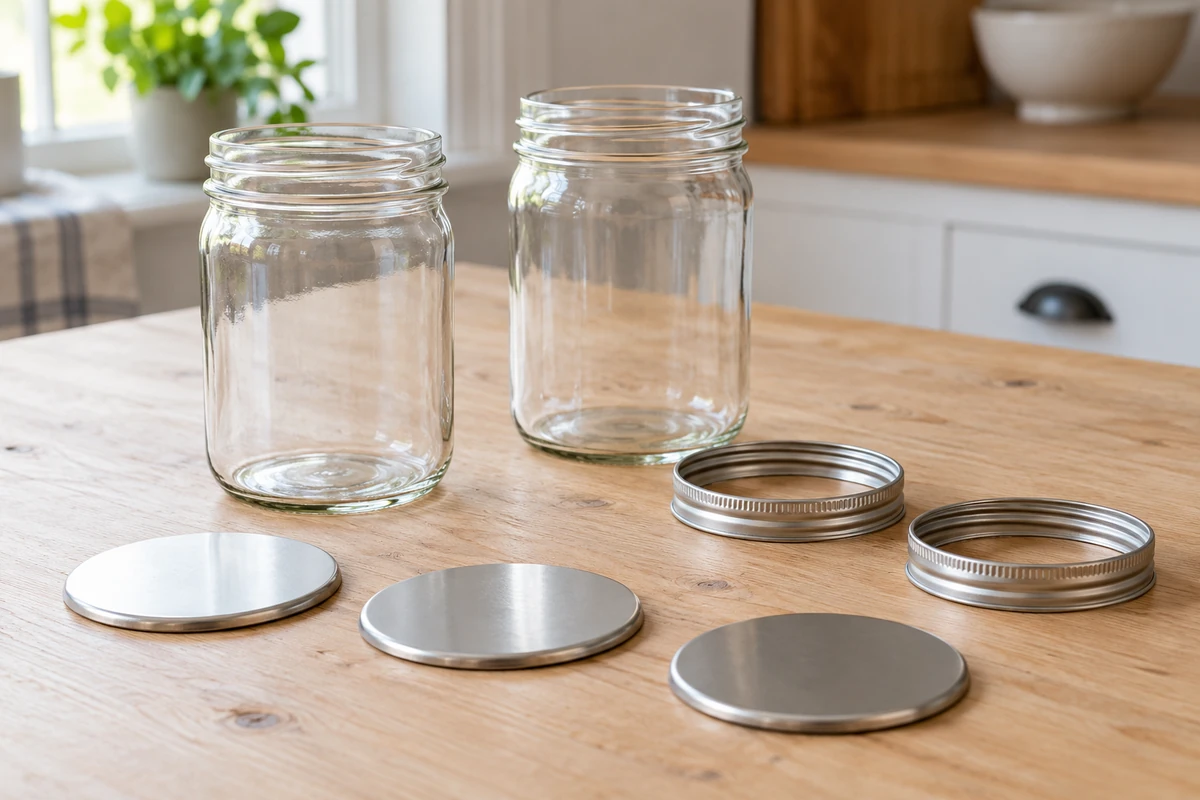
Choosing replacement jar seals and bands starts with separating the component that needs renewing from the hardware that may remain in service. An order for complete jars can add unnecessary glass and outer bands when the actual requirement is a matched sealing component. An order for generic lids can be just as unhelpful when the retained jars use different closure systems.
Begin with the jar family, its documented opening and the particular part required. A capacity such as 1 litre describes the jar’s volume; it does not always select the closure. This article compares replacement purchasing options. It does not give preserving procedures or decide that any retained jar or band is suitable for use.
Describe the closure system before counting its parts
Use the manufacturer’s names for the identified jar and closure. A rubber seal, flat sealing cap and outer screw band perform different roles within their respective systems. Keep those names separate in the request rather than combining them under lid.
Le Parfait’s replacement guide distinguishes the Super family’s rubber seals from Familia Wiss flat sealing caps and reusable outer screw bands. It also identifies both 100 mm and 110 mm openings among designated 1 L Familia Wiss jars. Those manufacturer-specific distinctions show why neither appearance nor litres alone is a reliable replacement order description. Le Parfait replacement parts guide
For the actual household, retrieve the model or existing part reference and the applicable current guidance. An old order can help identify a candidate but may not describe every jar now in the cupboard. Keep jars with a different origin or unresolved opening in another group until the manufacturer or responsible supplier answers the identity question.
Do not improvise a closure match by pressing a cap into place, altering a band or swapping parts between uncertain jars. A purchasing record should preserve an established pairing, not create one through an informal experiment.
Keep fresh sealing demand separate from retained hardware
For an identified system, establish which component the current intended task requires to be fresh. Keep that answer linked to the actual guidance. Le Parfait’s Familia Wiss guidance distinguishes fresh caps for heat-processing projects from outer bands that may be retained subject to condition. This is a limited example, not a universal reuse rule for every closure.
The number of fresh caps required need not equal the number of new bands required. Some bands may be retained under the applicable guidance, some may be missing, and others may await a condition decision. Each circumstance creates a different purchase question.
Avoid declaring all existing bands reusable simply because their part name includes reusable. Have the responsible person establish the eligible retained quantity under current instructions. An uncertain band cannot be counted as covered supply, but neither does uncertainty authorize disposal or imply a need to buy another glass jar.
Keep jar eligibility distinct too. The replenishment calculation assumes identified jars already accepted for the intended task. It cannot establish their condition, food safety or suitability for preserving.
Partition jars that share the same capacity
Make a row for each exact closure family and opening reference. If two one-litre groups have different documented openings, they remain two purchase rows even when the sealing components look similar in a catalogue.
The same approach prevents a second error: ordering both a seal and a cap for one jar because both appear in a replacement-parts category. The part list must follow the actual closure system. A rubber-seal requirement does not become a flat-cap requirement just because a seller has a larger cap pack available.
Identify the unmatched group in useful terms: known jar marking, existing product record and the specific missing reference. Ask for clarification rather than making that row absorb whichever components remain after the other jars are covered. Surplus parts are not evidence of a match.
Build a closure-specific replenishment worksheet
Use this original worksheet after the product identity and intended-use basis are established. It separates sealing consumption, missing hardware and commercial pack contents without deciding how the jars should be used.
| Worksheet field | Record for each jar group | Purchasing consequence |
|---|---|---|
| Jar and closure family | Exact model and closure type | Select the correct kind of replacement component |
| Opening reference | Documented size or matched part reference | Separate same-capacity jars with different openings |
| Fresh sealing components | Required count under applicable guidance | Cap or seal quantity to request |
| Eligible retained outer bands | Confirmed count for this group only | Avoid purchasing bands already covered |
| Missing or unresolved hardware | Separate band count and open decisions | Request hardware where needed; preserve uncertainty |
| Pack contents | Exact component types and pieces per pack | Calculate coverage and extras by component |
| Unmatched jar group | Identity question and affected count | Leave outside the completed comparison |
Ask whether the seller offers sealing parts alone, bands alone or a combined cap-and-band pack. Do not assume a photograph showing both establishes the priced contents. Record the answer and pack quantity before multiplying an order.
A combined pack may be acceptable even when some bands are surplus. The important point is to show that surplus rather than counting every purchased component as a current need. No resale credit, storage value or future replacement rate is assumed.
Fictional decision for two one-litre jar groups
Suppose a household plans a task using eight already approved jars from fictional group J100 and four from J110. Both groups are labelled 1 L, but their established closure records call for different sealing-cap references. The current task requires a fresh cap for each jar. All numbers, part references and offers in this example are invented.
For J100, eight eligible matched outer bands are already retained. For J110, three eligible bands remain and one is missing. The purchase requirement is eight J100 caps, four J110 caps and one J110 band. It is not twelve unspecified one-litre lids or twelve new jars.
Imagine offer S supplies J100 caps in packs of ten, J110 caps in packs of six and J110 bands individually. One of each cap pack plus one band answers the specified requirement. It creates two extra J100 caps and two extra J110 caps, with no surplus band. Keep the two cap remainders distinct.
Offer C instead supplies matched cap-and-band pairs in packs of six for each group. Two J100 packs and one J110 pack provide twelve J100 pairs and six J110 pairs. Relative to this fictional purchase requirement, that means four extra J100 caps, two extra J110 caps, twelve unneeded J100 bands and five unneeded J110 bands. The existing eligible bands still exist; they have not been consumed by the comparison.
The buyer chooses S as the preferred assortment to price because its additional hardware is limited to the one missing band. There is no claim that S is cheaper or presently available from a real supplier. If its separate band offer remains unconfirmed, the one-band requirement stays open.
A single pack of twelve J100 caps would not be an alternative covering all twelve jars. It would leave the four J110 jars without their required sealing components even though the headline cap count equals the jar count. This is why the opening split must survive through the final order.
Carry the component distinction into the next request
Retain the chosen cap or seal reference, pack contents and related jar group. Also retain the decision that supported keeping the outer hardware. On the next purchase, refresh the actual need rather than automatically repeating every pack purchased this time.
An extra band may later answer a newly missing band of the same approved group, but it should not produce an assumed replacement schedule. The applicable product instructions and actual household requirement determine the next question.
Explore Homeware kitchenware for broader buying context. Through the Homeware sourcing enquiry, describe the jar families, documented openings and separately required sealing parts and bands. Use eligible links, text or permitted images; PDF, CAD and ZIP files are not supported by the image field. Confirm the available coordination scope. A clear replenishment request does not commission preserving advice or establish food-use approval.
Frequently asked questions
Should I buy new jar bands whenever I buy sealing caps?
Not automatically. The actual closure system and current guidance determine whether an outer band may be retained and whether a fresh sealing component is required for the task. Record eligible retained bands, missing bands and unresolved condition decisions separately. A cap shortage does not by itself establish a matching shortage of bands or glass jars.
Can two one-litre jars need different replacement seals or caps?
Yes. The named Le Parfait Familia Wiss guide identifies different openings among designated one-litre jars. For your own jars, preserve the exact family and documented opening or matched part reference. Capacity alone cannot settle the closure selection, and a part from another family is not interchangeable merely because its stated diameter looks similar.
How do I compare a cap-only pack with a cap-and-band pack?
Expand each real offer into caps and bands for the exact jar group. Compare the number of required sealing components covered, the separately missing bands covered and the extra hardware purchased. Keep pack rounding visible. Use complete actual offers for the financial comparison rather than giving unused bands an invented resale or future-use value.
What should I do with jars whose closure reference is unknown?
Keep them in an unmatched group with the identification question and count. Seek model-specific information from the responsible supplier or manufacturer before ordering for them. Do not force a similar closure or treat spare parts from another row as a solution. The worksheet does not establish preserving instructions, jar condition or food-safety approval.
Sources
Discuss a sourcing request related to this article.Replenish Jar Seals Without Rebuying Every Band and Jar