
Check Fitted-Sheet Corners Against the Intended Mattress
Record all four fitted-sheet corners and adjoining edges on the ordered mattress-and-topper arrangement before accepting an apparent fit.
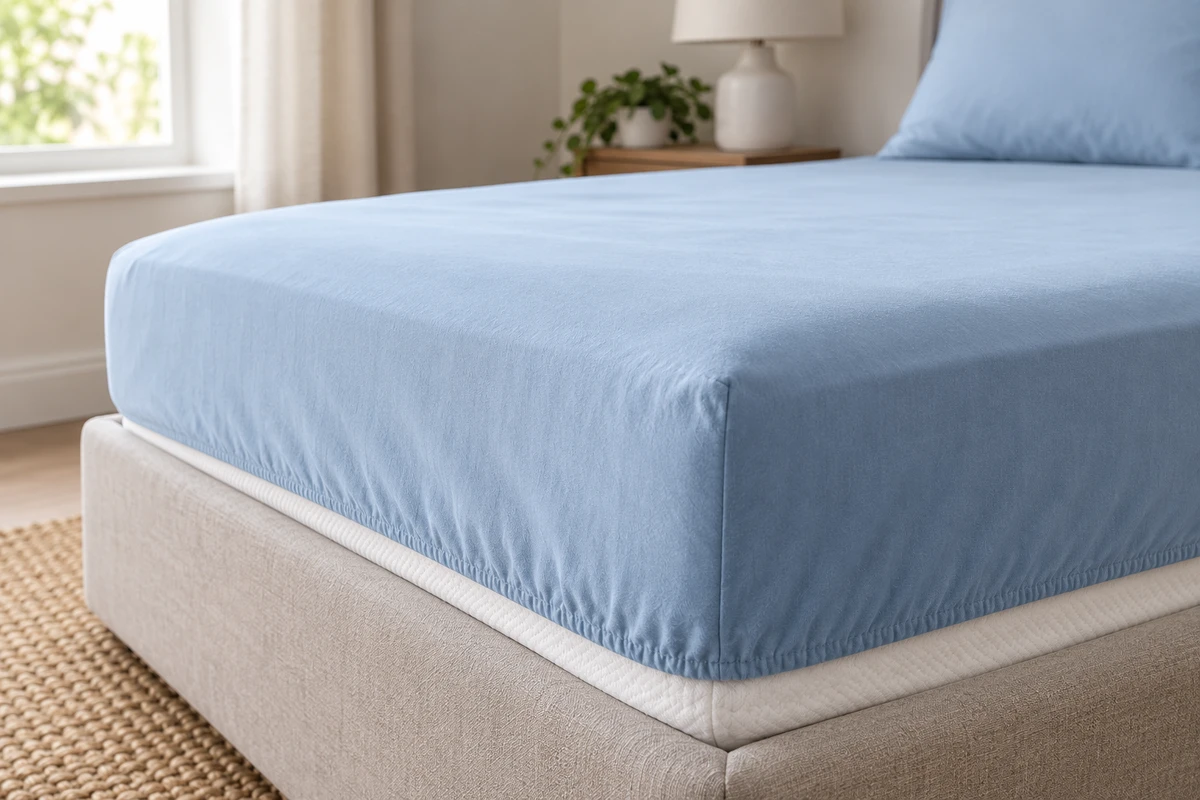
A received fitted sheet should be assessed on the mattress arrangement it was bought to cover. If the order includes a topper, a neat fit on the bare mattress leaves the important question unanswered. The useful receiving decision is whether this identified, unwashed sheet seats at all four corners of the intended arrangement under ordinary handling, without forcing it or changing the bed to obtain a better result.
A size label is the starting reference. It is not the observation. Record what happens at the corners and adjoining edges together, so a photograph of one tidy corner cannot conceal another that remains unseated.
Bring the approved bed arrangement into the comparison
Use the mattress and topper references already agreed for the purchase. Confirm that the available bed is that arrangement, including any specified layer beneath the sheet. Keep the recorded length, width and covered depth with the observation. This is a receipt check against an existing requirement, rather than an exercise in choosing a new pocket depth.
If the intended arrangement is unavailable, say so. Reviewing the sheet on a different bed can produce a useful, explicitly limited observation, but it cannot establish the requested fit. Similarly, do not omit the topper because the bed becomes easier to dress without it.
IKEA’s DVALA 704.824.63 product information distinguishes nominal sheet dimensions from a stated maximum mattress thickness and describes elastic around the edge. Those are separate fields even on a named product page. They do not establish how an unknown supplier’s sheet will seat on the buyer’s bed. IKEA DVALA product details
Locate the approved fit reference, if one exists: for example, an identified sample on the same bed configuration, with its condition recorded. If the reference was reviewed after care and the receipt is unwashed, retain that difference. Do not invent a shrinkage result to make the two conditions comparable.
Keep the received sheet recognizable before fitting
Connect the sheet to its packaging, order variant and receiving reference before separating similar-looking pieces. Note that it is unwashed and whether any prior treatment or alteration is known. If a sheet has already been used or laundered, it is no longer an unchanged arrival specimen; keep that limitation visible.
Look at accessible seams and the elastic edge during normal unpacking. An open corner seam, detached elastic or other visible damage is a separate observation from fit. Do not pull the edge to investigate its strength or keep fitting a visibly compromised item. Stop where damage, resistance or access makes ordinary handling uncertain.
Use only handling permitted by the product instructions and the agreed receiving scope. This guide supplies no mattress-lifting procedure, stretch allowance or strength test. If the available setup requires unsafe access or moving a heavy mattress, have the responsible person arrange an appropriate review instead.
Read the four corners as one fit
Choose a consistent orientation, such as head and foot of the bed with left and right defined on a simple sketch. Record where the sheet’s own orientation markers are, if provided. Without that convention, “right corner” can refer to different places in the receiver’s and buyer’s photographs.
Observe whether each corner occupies its intended position and how the edge lies along the adjoining sides. Note a corner that remains above the intended position, a seam sitting away from its reference position, or an edge that has moved when another corner is seated. Describe what is visible without attributing it to incorrect cutting, weak elastic or a particular production fault.
The completed arrangement matters more than a sequence of isolated successes. If the first corner looks seated at the start but is displaced by the time the opposite corner is positioned, the record should show the final state. Do not pull repeatedly, recruit extra tension or add clips or straps to turn an unresolved sheet-only fit into an apparently successful one.
Compare the edge position with the approved reference where that reference is applicable. This article does not require a universal amount of fabric beneath every mattress. An accessible edge can be photographed; an inaccessible edge should be recorded as unobserved rather than inferred from a smooth top surface.
Use a corner and edge map
Complete the header with the actual sheet ID, package reference, mattress ID, topper/layer arrangement, unwashed condition, observer and approved reference. Then use the map below for one unchanged arrangement. Start a separate map if the configuration changes.
| Position on the defined bed sketch | Corner observation in the final arrangement | Adjoining edge observation | Reference difference or unanswered question |
|---|---|---|---|
| Head left | Intended seat reached, not reached or not observed | Head edge and left edge as accessible | Describe the actual difference |
| Head right | Record separately | Head edge and right edge as accessible | Include any displacement seen after other corners were positioned |
| Foot left | Record separately | Foot edge and left edge as accessible | Identify the matching photo or sketch location |
| Foot right | Record separately | Foot edge and right edge as accessible | State why observation stopped, if applicable |
Below the map, write the configuration-specific decision still needed and its owner. This is an original editorial worksheet for ordinary receiving observations. It is not a test method, a sampling plan or a universal fit standard.
Use plain descriptions such as “foot-right corner remains above the position shown in reference R2.” “Too small” may be the eventual finding, but it leaves the supplier guessing which combination and location were actually observed. A photo showing the whole arrangement plus identifiable corner views is more useful than four close-ups that cannot be placed on the bed.
A fictional sheet that fits only after the topper is removed
Consider a fictional received sheet S7, ordered for mattress M2 with topper T2. The purchase identifies that complete arrangement. During the agreed ordinary review, the receiver records three seated corners and an unseated foot-right corner, with the adjacent foot edge sitting differently from the approved reference. Handling stops without stretching the sheet further. The identifiers and events in this example are invented.
A separate, permitted observation is later made on M2 without T2. All four corners appear seated in that arrangement. The receiver keeps both maps: “M2 plus T2, fit unresolved” and “M2 alone, four corners observed seated.” The second result does not replace the first, because removing T2 changed the requirement being examined.
The supplier replies that the sheet is the correct nominal size. That answers neither the observed corner difference nor the topper requirement. The buyer returns the S7 identification, intended arrangement and corner map, asking the supplier to address that exact combination. A general photograph of another bed is not a response to the recorded difference.
If the supplier offers another sheet variant, identify it as a proposed replacement and review its own fit evidence. If the buyer instead considers using S7 only on bare mattresses, that is a separate allocation decision requiring approval; it does not demonstrate conformity with the original topper arrangement.
Nothing in this example establishes the condition of other sheets in the delivery. The receiver observed S7. Any wider review or disposition needs an expressly defined scope rather than a batch conclusion extrapolated from this one item.
Close the fit question without altering the evidence
Return a concise description of the unresolved corner, the final edge positions and the exact bed arrangement. Ask whether the supplier disputes the supplied variant, the reference arrangement or the observation itself. These are different questions and call for different evidence.
Do not wash the sheet, replace elastic or change the mattress setup as an informal remedy before the buyer decides how the issue should be handled. A later authorized change needs its own record and cannot erase the as-received observation. Agreement on this initial fit also does not establish post-care fit, fibre identity or durability.
For an inquiry, the Homeware textile category provides the relevant product context. Use the Homeware sourcing page to describe the sheet and intended bed arrangement. Any buying coordination, physical review and reporting scope must be agreed for the actual order. The form supports an 8–1200-character description or supported images; it is not a technical-document upload channel.
Frequently asked questions
What if the first three corners seat but the last one does not?
Record the final state of all four corners and the adjoining edges on the intended bed arrangement, then stop without forcing the remaining corner. Do not preserve three favorable close-ups while omitting the displaced or unseated area. Return the identified sheet, configuration and observed difference to the decision owner; this observation alone does not establish the manufacturing cause.
Can a supplier photo on a different mattress close the fit issue?
It can show that other arrangement, but it does not settle the received sheet on the bed specified in the order. Ask which sheet and mattress appear in the image, whether the specified topper is present, and what condition the sheet is in. Keep the intended combination open until the available evidence actually addresses it.
What if the corners cannot be observed without moving a heavy mattress?
Do not improvise a lifting procedure or record inaccessible areas as acceptable. State which positions could not be observed and why, and have the responsible person arrange a safe review within the product instructions and agreed scope. A smooth upper surface is not evidence of the unobserved edge position.
Can I keep a sheet for shallower beds instead of returning it?
That may be a separate buyer-approved allocation if the actual alternative use is acceptable and the commercial terms allow it. Identify the sheets and the new bed arrangement explicitly. Using an item elsewhere does not prove that it met the original topper requirement, and it should not silently authorize the same substitution on later orders.
Sources
Discuss a sourcing request related to this article.Check Fitted-Sheet Corners Against the Intended Mattress