
Dinnerware Pack Groups: Retail Sets or Household Settings?
Choose dinnerware handling groups around the actual handover: intact retail sets, individual settings or piece-type bulk packs.
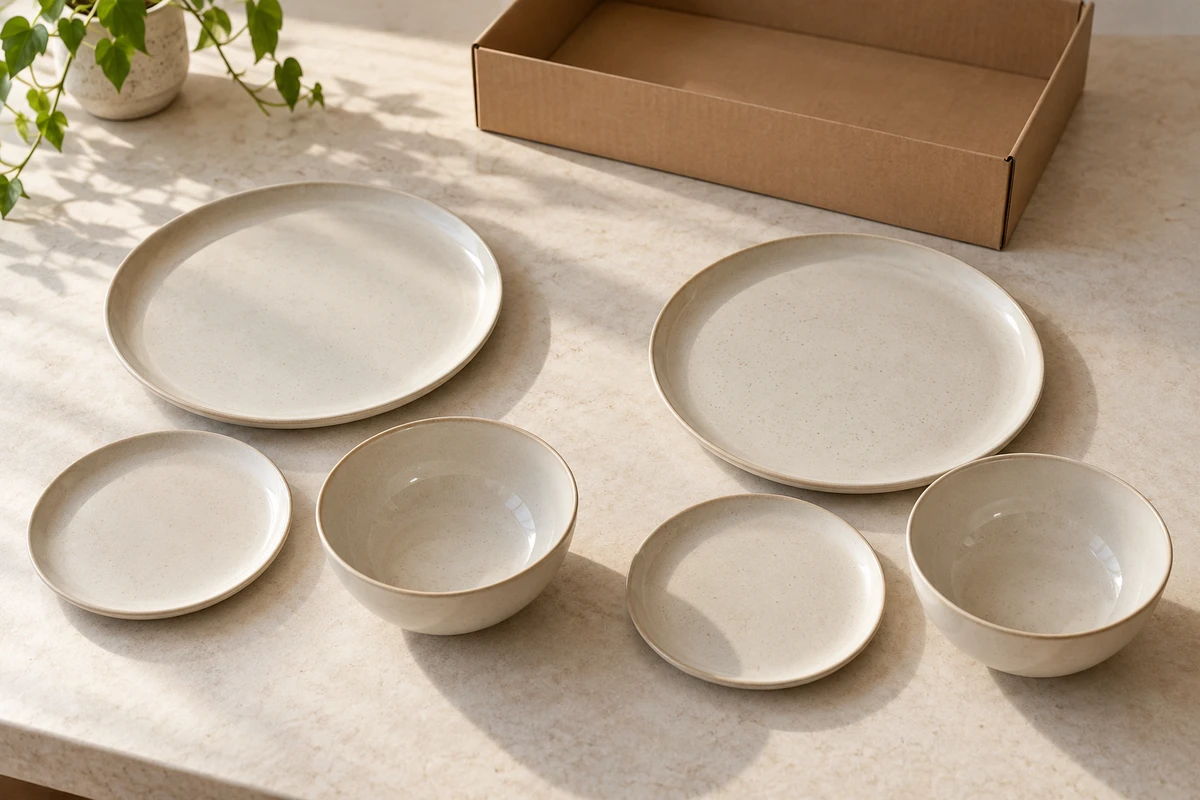
Choose dinnerware packaging groups according to the unit the buyer will hand over. A retailer selling an intact six-setting set has a different opening pattern from an operator distributing one setting to each household. Start with that difference while keeping the approved dinnerware assortment unchanged.
A complete piece count is necessary but does not decide the group. Eighteen approved pieces can still arrive in an arrangement that requires the recipient to open three different inner packs before making one intended handover. The useful packing decision is where that opening and allocation work belongs.
Freeze the assortment before regrouping it
Name the already approved dinner plate, side plate and bowl references and their quantities. Keep any excluded mugs, serving dishes or optional extras outside the grouping exercise. Changing the pack should not silently change what the customer buys.
IKEA’s named FÄRGKLAR 18-piece set contains six dinner plates, six side plates and six bowls. This is a concrete composition example, not a packing recommendation or evidence of food-contact properties for another product. FÄRGKLAR set contents
Your own approved set might have different components. Copy its actual assortment into the packing brief, then define the required handover unit in ordinary language: one intact retail set, one household setting, or an approved replenishment group of a particular piece type.
Follow the first real opening event
For an intact retail-set route, ask whether the retail group stays closed through storage and customer handover. Piece-type inner groups may sit inside that complete retail group, but the whole set still needs a clear boundary. A warehouse worker should not have to borrow bowls from a neighbouring retail unit to finish it.
For household allocation, identify who opens the larger supply group and assembles each handover. The buyer might receive setting groups directly, or deliberately accept bulk piece groups and perform allocation at a controlled location. Record that choice before asking the supplier to optimize the presentation.
For replenishment, the receiver may need only one approved piece type. A complete-setting arrangement could create unnecessary opening work for that purpose. Do not change the approved order to suit an imagined replacement programme; compare only the handover the buyer actually intends.
Compare three grouping proposals
Use the same fictional six-setting assortment to expose the differences. These group descriptions concern association and opening, not how ceramics should touch or be cushioned.
| Proposed handling group | Intended handover | What must be opened for one handover | Main decision |
|---|---|---|---|
| One complete six-setting retail group | One retail customer receives the whole approved set | The complete retail group remains intact until its planned recipient opens it | Preserve the retail-unit boundary |
| Six complete setting groups | Six recipients each receive one approved setting | One identified setting group | Decide whether direct setting-level handover is wanted |
| Three piece-type groups | A buyer allocates dinner plates, side plates and bowls | Each relevant piece-type group | Accept and plan the allocation step and remaining open groups |
“Set pack” is too imprecise to distinguish these options. State whether “set” means the sellable retail assortment or one place setting. Keep that meaning beside the quantity on the supplier’s proposal.
Make the remaining pieces visible
Bulk groups can be a deliberate choice. The weakness is leaving their opening consequences unexplained. After one dinner plate, one side plate and one bowl have been allocated, the remaining three groups still need identifiable references and the packaging owner’s applicable handling arrangements.
Do not use this step to count damaged usable settings; that is a receiving decision based on actual condition. Here, assume the approved assortment is present and describe only the planned movement from supply groups to handover groups.
The buyer worksheet can be completed before any physical rearrangement:
| Worksheet field | Information to enter |
|---|---|
| Approved assortment | Exact piece roles, references and counts |
| Handover unit | Whole retail set, single setting or approved piece-type group |
| Supplied groups | Contents and identity of each proposed group |
| First opening owner | Who opens which group, at what stage in the intended handover |
| Allocation consequence | Pieces needed for one handover and what remains outside it |
| Pending packaging review | Actual ceramic contacts, proposed materials and protection evidence owner |
A desk comparison can reveal an unsuitable grouping without unpacking or restacking a ceramic sample. Where an actual mockup is reviewed, follow the responsible owner’s permitted handling and preserve required protective elements.
A fictional six-household decision
Imagine a buyer supplying six households, each with one approved dinner plate, one side plate and one bowl. The fictional total is six of each type. Supplier proposal P groups all dinner plates together, all side plates together and all bowls together. Proposal S represents six complete setting groups. No prices or performance results are assumed.
If the buyer wants each household to receive a closed, identified setting group directly, S answers the grouping intent more closely. P would add an allocation step that the current handover plan has not assigned. The buyer can request S for further development without claiming P’s ceramics are damaged or its packaging is technically inadequate.
If the buyer instead has an agreed allocation station and wants to distribute selected piece types separately, P may answer that different plan. The decision depends on the real handover. “Fewer groups” and “more complete groups” are not universal quality rankings.
In either case, the selected arrangement still needs an actual protective design. Do not place a bowl against a plate, choose a divider thickness or promise survival from the grouping table. Ask the packaging owner to resolve the interfaces and evidence appropriate to the exact products and route.
Keep the approved group attached to its revision
The final brief should state the chosen meaning of a group, the included piece references, the stage where it may be opened and the remaining decisions. If the supplier changes from setting groups to piece-type groups later, treat that as a handover change even when the total count stays the same.
Use Homeware kitchenware for category context. In a Homeware sourcing enquiry, describe the approved assortment and who receives each group. Include a supported image or eligible marketplace link when useful, and ask for the proposed review scope. Do not upload PDF/CAD/ZIP files through the image field or treat the enquiry as shipment approval.
Frequently asked questions
Should dinnerware always be packed as complete place settings?
No. Choose the group the next recipient actually needs. A shop selling intact six-setting retail sets may need the complete retail unit preserved, while a household allocator may need one setting at a time. The approved assortment stays fixed; packaging groups should reflect the authorized handover rather than a universal preference.
Can the same approved assortment use different packaging groups?
Yes, as a proposal for review. Six dinner plates, six side plates and six bowls can be represented as six three-piece setting groups or three piece-type groups without changing the assortment. Each arrangement creates different opening and allocation work. Its ceramic contacts and protective design still require a separate applicable review.
How do I compare bulk piece packs with setting groups?
Map the first real opening event. Identify which groups are opened, the approved pieces taken for one handover, and the remaining pieces that need to stay identifiable. Compare that work with the intact-set route. Do not fill the comparison with invented labour times, breakage rates or cost savings.
Does a complete setting group establish ceramic protection?
No. A grouping can make the intended dinner plate, side plate and bowl easy to identify while leaving all protection questions open. Ask the responsible packaging owner to review the actual contacts, materials and distribution conditions. The grouping worksheet is neither a cushioning specification nor a transit-test result.
Sources
Discuss a sourcing request related to this article.Dinnerware Pack Groups: Retail Sets or Household Settings?