
Flat-pack shelving from 1688: inspect the assembly sample
Check instructions, hardware, wall-fixing scope and matching carton pairs before placing a wholesale shelving order.
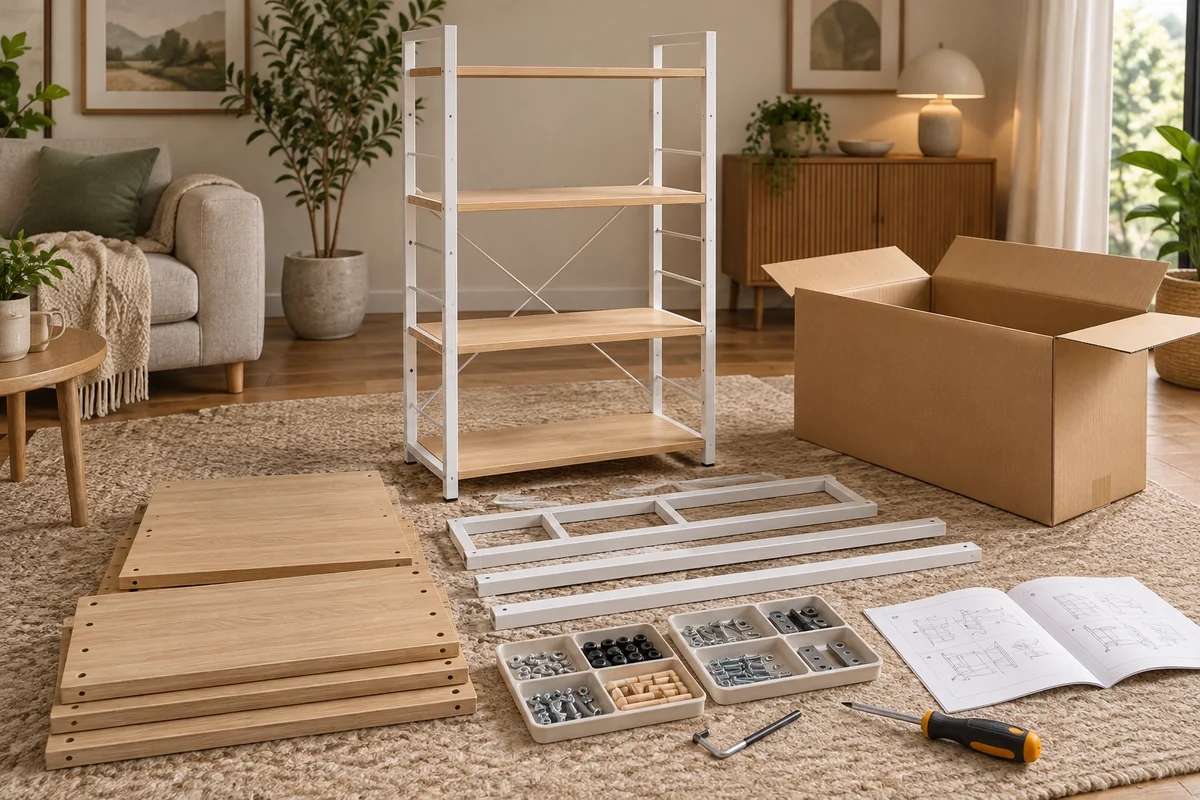
Before buying flat-pack shelving from a 1688 supplier, approve an assembly sample taken from the proposed retail pack and connect every panel, fitting and instruction to the same product revision. A photograph of an assembled display unit cannot show that customers will receive complete parts or usable instructions.
Specify a particular shelving product and its intended destination. Get supplier quotes for a complete unit ready for the specified assembly and installation process, including how missing or damaged parts will be handled.
Write the assembled product and packing specification together
Note the product code, revision, intended use, assembled dimensions, panel or frame materials, surface finish, shelf layout and required installation. Request a component drawing and a hardware bill of materials with part codes, quantities and specifications.
List the number of cartons per unit and the contents of each carton. The quote should state the unit price, hardware contents, instructions, protective packaging and items the customer must obtain separately. Use separate quantity lines for different colours and sizes.
For any load claims, request the supporting assessment and conditions, including how the load is spread. A visual sample check does not prove shelf capacity or long-term performance. Get a competent reviewer to determine which tests are relevant to the intended use.
Assemble a sample from a production-intent carton
Get a complete proposed retail pack, with its normal labels and instruction sheet, from the supplier. Give the sample and pack a reference number. Inventory the contents against the bill of materials before assembly.
Have the assembler follow the instructions provided and note anything that needs clarification. Record actual time, tools used, missing parts, unclear orientation, misaligned holes and any step requiring an unspecified adjustment. Do not drill new holes or change fittings and then call the original pack acceptable.
Check the final assembled dimensions, visible edges, shelf placement and finish against the agreed criteria. Photograph any issues, referencing the appropriate part code. Keep assembly observations separate from formal load, stability or material test reports.
For the wider supplier evidence record, use the site's home-decor sourcing guide.
Separate the wall attachment device from wall-specific fixings
As a concrete product example, IKEA's BILLY instructions require its wall attachment devices and specify suitable wall screws and plugs, which are not included. See the IKEA assembly instructions. This is evidence about that IKEA model, not your supplier's shelf.
For your own product, request its exact installation design and instructions. Establish what is included, what depends on the destination wall and what professional installation advice is needed. Avoid a vague “all hardware included” statement when essential wall fixings are outside the pack.
Document installation assumptions in the product description and customer instructions. A furniture assembly check without the intended installation does not constitute full stability approval.
Check the product category and materials for the destination
For US imports, CPSC's clothing-storage-unit guidance lists bookcases outside that particular rule's scope. A drawer-based clothing organizer may require a different assessment. See CPSC's scope guidance. Being outside one rule does not resolve all furniture obligations; have the actual design and intended use reviewed.
If the shelving contains regulated composite wood for the US market, EPA explains that finished goods must be fabricated with compliant panels and have applicable documentation and labeling. See the EPA stakeholder FAQs. Obtain the product's material identity and relevant records; easy assembly does not establish emissions compliance.
Other destinations have their own requirements. Complete the review before printing sales claims or approving production. Do not treat a generic supplier certificate as a universal answer.
Count complete carton pairs, not just total boxes
Hypothetical example: one shelf unit requires carton A and carton B of the same model, colour and revision. An order for 80 units needs 80 A cartons and 80 B cartons.
If receiving records show 80 A cartons and 77 B cartons, the total is 157 boxes but the maximum complete-unit count is 77, assuming all pairs are compatible and their contents acceptable. Three extra A cartons cannot substitute for the missing B cartons. The final accepted-unit count can be lower after contents and assembly checks.
Specify carton labels with product revision and “A” or “B” identifiers, then reconcile pairs by variant. Record what happens when a carton is damaged or lost. Agree whether the remedy is a replacement part, replacement carton or whole unit, and who pays transport.
Compare delivered cost with the after-sales work included
Use the actual packed dimensions and gross mass of every carton type for the homeware shipping-cost comparison. Include inspection, paired-carton labeling, destination handling and any planned assembly labour.
Inquire about how spare hardware and replacement panels are identified, priced, stocked and dispatched. Document the stated lead time for the actual spare-part request. The cost benefit of a low shelf price can disappear if an inexpensive missing fitting leaves the customer’s whole unit unusable.
Keep the approved drawing, hardware list, assembly instructions, sample record and pack revision together. If panel thickness, holes, fittings, finish or carton layout change, complete the relevant review before shipment.
Reusable shelving RFQ
Quote [quantity by model/colour] shelving units to [destination], required by [date]. Attach assembled dimensions, materials, component drawing, coded hardware list, current assembly/installation instructions and carton contents. Identify excluded tools and wall fixings. Quote sample assembly checks, applicable product evidence, protective packing, freight and replacement parts separately. Confirm how carton pairs and production revisions will be controlled.
Send the brief through the homeware sourcing page, then release production against the agreed complete-unit specification.
Put this guide to work
Working notes to adapt to your order. Keep the approved specification and the cited guidance alongside this sheet.
Use this issue sheet when an assembler stops, substitutes a fitting or needs clarification on the proposed retail pack. It connects the observation to a coded part and revision so the supplier can correct the pack and the receiving team can identify what must be rechecked.
Before closing an assembly issue
| Check | Record to keep | If unresolved |
|---|---|---|
| Connect the inspected pack to the intended product variant. | Sample reference, carton identifiers, product revision, component list and instruction revision. | Ask the supplier to identify the pack before treating the observation as evidence for the ordered unit. |
| Separate the original assembly observation from any attempted adjustment. | The instruction step, part code, photographs, tools used and a record of anything changed by the assembler. | Keep the issue open and document what prevented assembly according to the supplied instructions. |
| Identify what the proposed correction changes. | The supplier's explanation linked to the affected panel, fitting, instruction or carton revision. | Do not carry the old sample approval forward; ask for the changed item and the relevant review scope. |
| Connect the correction to receiving and replacement handling. | A revised part or carton reference, the agreed remedy and the record of the follow-up check. | Leave the affected unit decision pending until the receiving team can identify the corrected contents. |
Assembly issue and correction record
Keep observations factual and tied to the inspected retail pack. Record the assembly decision separately from any specialist review of load, stability or materials.
| Field | What to enter | Decision or handover |
|---|---|---|
| Pack identity | [Model and variant] · [Product revision] · [Sample reference] · [Carton identifiers] · [Instruction revision] | Does the issue belong to the pack proposed for this order? |
| Stopped or unclear step | [Instruction step] · [Part code] · [Observed issue] · [Photo reference] · [Adjustment attempted, if any] | Was the original pack usable as instructed, or is clarification or correction still required? |
| Supplier correction | [Proposed correction] · [Changed part, instruction or packing revision] · [Follow-up sample or record] | Which observations and approvals must be revisited for the changed pack? |
| Receiving and remedy | [Complete carton grouping] · [Replacement part or carton code] · [Agreed remedy and transport responsibility] · [Decision owner] | Can receiving distinguish a corrected complete unit from an unresolved pack? |
Copy an assembly issue follow-up
For [model, variant and revision], sample [reference] from [carton identifiers] stopped or needed clarification at [instruction step]. The observation concerns [part code] and is shown in [photo reference]. Please explain [proposed correction], identify the affected part, instruction and packing revisions, and state what will be supplied for the follow-up check. Confirm the identification and agreed handling of [replacement part or carton]. [Decision owner] will keep the affected assembly decision pending until [open issue] is resolved; any separate product assessment remains in its own review record.
Sources
Discuss a sourcing request related to this article.Flat-pack shelving from 1688: inspect the assembly sample