
Bulk or Retail-Ready Textiles: Compare the Cost of the Finished Assortment
Price home textiles to the same retail-ready endpoint, including confirmed local sorting, labels and repacking when comparing bulk-grouped delivery.
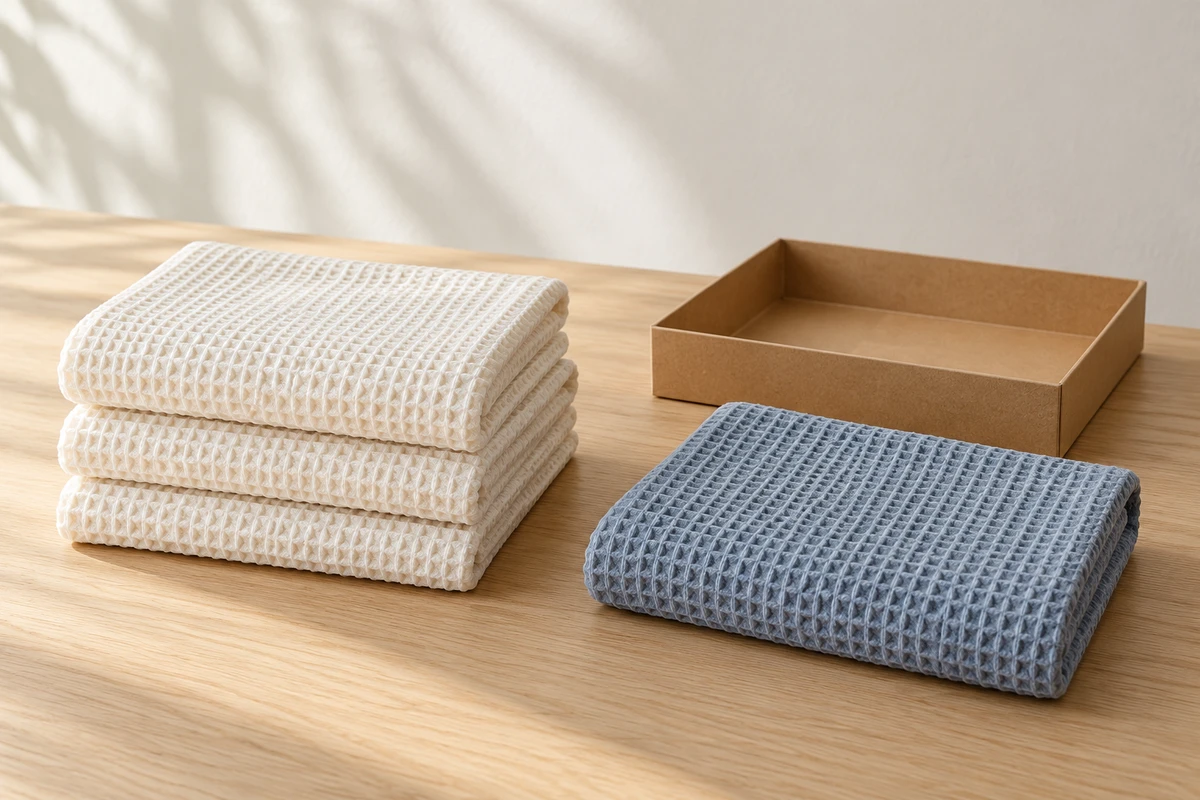
A carton of bulk-grouped cushion covers and a carton of individually retail-ready covers can contain the same textiles but leave different work for the buyer. Compare them at the point where the required assortment is prepared for sale. Otherwise the bulk option’s lower transport subtotal may simply omit local work.
Start with approved textile variants and permitted packing states. The decision here is where authorized sorting and retail preparation occur and what the complete task costs. It does not establish a new fold, permit compression or judge how an appearance mark should be treated.
Define one finished retail unit
Name the exact article, size, colour and quantity in each customer-facing unit. A cushion cover sold individually is one unit; a specified curtain pair or duvet-cover set has its own component count. Do not compare all three through an unexplained “per piece” labour rate.
Describe the approved retail state: the required wrapping or container, the information that stays with the product, and any approved stock tag or other customer-facing material. Distinguish existing product labels from new presentation material. The responsible owner must establish applicable label requirements; this budget supplies no compliance determination.
Use the same retail endpoint for both proposals. If the origin-ready option excludes a required stock tag, it has a remaining preparation task too. A supplier’s phrase “retail packing included” is not a complete description of what arrives.
Separate bulk grouping from the assortment sold
Ask how the bulk shipment groups the articles. They may be separated by size, colour or another approved variant, but the actual grouping must be confirmed. Record the units in each inner pack and master carton, including mixed or partial packs.
Then ask the local provider what it receives and what it returns. Opening transport groups, separating sizes, identifying variants, adding approved retail packaging and reconciling finished quantities are distinct possible tasks. Obtain the provider’s actual scope instead of assuming a generic bagging price covers all of them.
Preserve the product-to-variant connection during any authorized preparation. A shared carton label cannot identify every loose cover once groups are separated. Request a workable identity and count method from the responsible provider without inventing new fibre, origin or care wording.
Price two permitted transport arrangements
Obtain the final packed data for origin retail-ready goods and for the approved bulk grouping. Include outer dimensions, gross weights, carton counts and the actual units represented. A bulk carton should not inherit the retail-ready carton’s measurements simply because the sewn articles match.
UPS discusses dimensions and actual package weight, with the relevant service determining its billing treatment. Use that bounded measurement principle; request a quote for each actual textile arrangement instead of predicting savings from loose fabric volume. UPS dimensions and weight guidance
Keep any new compression or fold proposal outside the cost comparison until its product-specific review is complete. Removing approved layers or pressing a velvet cover flatter is not a valid way to manufacture a favourable freight input. Both options need real, permitted packed states.
If bulk goods go to a local preparation provider before the shop, price that actual destination and any required onward movement. Do not compare a shipment ending at that provider’s premises with a retail-ready offer ending at the shop and call them the same endpoint.
Ask for an output-based local offer
Give the provider the incoming pack description and the required finished assortment. Request prices for the actual quantity and ask which materials are supplied by whom. If the offer includes a setup charge or minimum, retain its stated basis; do not invent one or assume a simple per-unit multiplication covers it.
Clarify what happens to shortages, unclear variants or articles whose condition is unresolved at opening. Such goods should remain identifiable rather than being counted as finished retail output. Any additional work needs its own authorization and actual commercial response, not a guessed rework allowance.
| Comparison worksheet | Entry for each proposal |
|---|---|
| Approved assortment | Article references, sizes, colours and quantities |
| Retail unit | One cover, matched pair or defined set; exact component count |
| Incoming transport groups | Pack references, contents and measured shipping data |
| Information retained | Approved product labels and other required information |
| Retail preparation | Actual provider, permitted scope, materials and charge unit |
| Physical endpoint | Receiving location, preparation location and shop handover |
| Completion record | Required finished counts by variant and unresolved-unit treatment |
| Cost boundary | Included charges, separate offers and unpriced tasks |
The worksheet is a commercial decision aid. A photograph of a neatly wrapped sample does not establish batch completeness, label compliance or transport performance.
Work through sixty fictional cushion covers
Imagine an approved assortment of 60 covers: 20 small cream, 20 large cream and 20 large blue. Each is to be sold individually in the same approved sleeve with its existing required information retained. These quantities and configurations are fictional.
Proposal R supplies the identified retail-ready units from origin. Proposal B supplies the same covers in size-and-colour bulk groups. B’s transport quote looks lower, but its scope ends before local sorting and sleeving. The comparison therefore has a named gap rather than a demonstrated saving.
Let CR be R’s complete quoted cost to the required endpoint. Let CB cover B’s goods and transport to the preparation provider, L its actual local preparation offer, and O any separately quoted onward delivery. Compare CR with CB plus L plus O, adding any other required nonduplicated costs to the appropriate side. If an amount is unknown, leave the total conditional; do not enter zero.
If L is quoted per incoming bulk pack, confirm what the charge includes for all 60 individual sleeves. If the provider offers a per-cover charge, check its actual scope and any stated additional terms. A “per set” response remains ambiguous until the unit is defined.
Once both routes cover the same 60 planned retail units, dividing their complete totals by 60 can support the purchase decision. It is not a measured cost per accepted saleable cover. The actual completion record must still reconcile 20 of each specified variant and identify any unresolved units separately.
Choose where the work will really happen
Select the route whose complete, available scope meets the buyer’s assortment and budget. If local preparation cannot be confirmed, retain origin retail-ready supply as a candidate rather than assigning the unowned task to shop staff by default. If the buyer accepts staff preparation, record that responsibility and its known resource demands explicitly.
The Homeware textiles category provides broader context. Through the Homeware sourcing page, describe the final retail unit and request bulk-grouped and origin-ready alternatives using supported links, text or images. The useful answer identifies both the packed goods and the work needed to deliver the same finished assortment.
Frequently asked questions
Is bulk-grouped textile delivery cheaper than retail-ready supply?
It can only be compared after the bulk route includes the actual work needed to reach the same final assortment. Obtain separate measured packing and complete quotes for both routes, including any confirmed local sorting, materials and repacking. A lower transport subtotal alone does not establish a lower retail-ready cost.
What must a local textile repacking quotation describe?
Name the exact articles and variants, incoming grouping, quantity, finished retail unit and approved packaging references. Ask the provider to define receiving, sorting, label or tag handling, packing materials, output counts and exclusions. Confirm whether its charge is per piece, retail set, incoming pack or another stated unit.
Can required textile labels be removed to simplify repacking?
Do not remove, replace or cover required information as an improvised packing shortcut. Have the responsible owner establish what must remain with the actual product and approve any new customer-facing information. This cost comparison does not determine label compliance, and a locally added stock tag does not automatically replace a product label.
How do I compare mixed textile sizes without overstating ready-to-sell stock?
Reconcile each size and colour from incoming bulk groups to the approved retail unit. If a unit is a pair or set, count complete matched units rather than loose pieces. Report unresolved, missing or unprepared goods separately; before actual completion, the denominator is planned retail-ready units, not observed saleable output.
Sources
Discuss a sourcing request related to this article.Bulk or Retail-Ready Textiles: Compare the Cost of the Finished Assortment