
Frame Handover: Confirm the Selected View and Display Mode
Resolve a frame’s chosen portrait or landscape view and standing or wall presentation, keeping unresolved location-specific support work clear to the recipient.
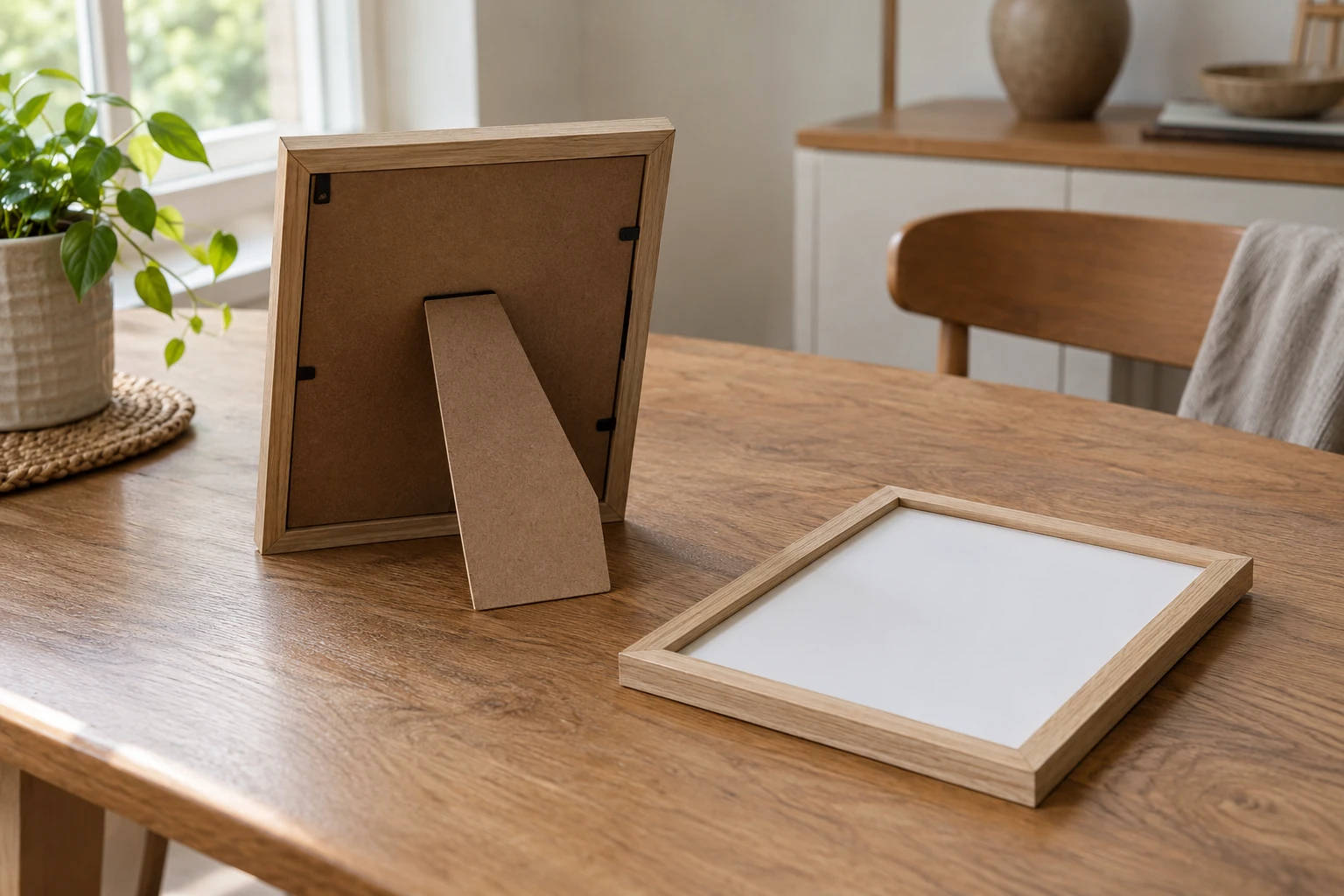
An approved print inside an approved frame still needs a display decision. Before handing it to a shop team or room recipient, specify whether it is intended to stand or hang and whether the selected view is portrait or landscape. A frame that permits several modes does not tell the recipient which one the buyer chose.
This handover begins after the print, crop and frame components have been selected. Its purpose is to make the intended presentation usable without silently adding wall installation, changing the artwork or assuming that an available support suits every location.
Choose one presentation from the permitted possibilities
Connect the frame reference to the already approved print reference. Then describe the selected presentation in plain language: standing portrait, standing landscape, wall portrait or wall landscape. Include the intended location and a reference showing which edge of the picture is the top.
These choices answer two different questions. Orientation concerns how the picture is viewed. Standing or hanging concerns how the frame is supported. A note that says only “portrait” leaves the support mode open; a note that says only “wall display” leaves the viewing orientation open.
IKEA’s UK RÖDALM 005.488.63 provides a bounded example. The named frame permits standing or hanging in horizontal and vertical orientations. Its page separately states that wall-mounting screws are not included and that fixings must suit the wall. These are descriptions of that exact frame, not permission to use any frame in all four modes. IKEA UK RÖDALM display details
For the supplied product, retain its own permitted modes. If the recipient requests an option absent from the applicable instructions, ask for a product-specific answer. Do not change a rear support, bend a fitting or improvise a new arrangement to reproduce a preferred photograph.
A standing frame needs a named place to stand
For a standing presentation, identify the surface or intended display position and the actual supplied support arrangement. The receiver should know which frame and support the instruction concerns, including any difference between sizes in the same range.
Check the proposed location against the product information and the already agreed display-space requirement. A broad sales description such as “table or wall” does not resolve a particular narrow shelf or crowded counter. If the standing arrangement remains unclear for that location, keep the placement decision open and ask for the appropriate review.
A front-view image is useful for orientation but may hide the support. Supply a manufacturer reference or an authorized view that establishes the intended arrangement without asking the recipient to experiment. Do not perform a push, tilt or loading exercise to turn a documentary handover into a stability claim.
If standing support is absent from the delivered contents but was promised, identify that supply discrepancy. If this size was never offered with a standing mode, the problem is a product-selection mismatch. Those cases require different buyer decisions; neither is fixed by writing “place on desk” on the same card.
A wall presentation can remain uninstalled
For wall display, separate the buyer’s selected view from the completion of wall-specific work. The handover can establish that print P belongs in frame F in landscape orientation while mounting at the intended location is still outstanding.
Record whether the supplied components include the relevant frame-side fittings, using the exact product description. Do not interpret a supplied hanger as a complete fixing solution for an unknown wall. The mounting arrangement and any required competent installation need their own scope and applicable instructions.
Use precise language when transferring the item. “Landscape wall presentation selected; location-specific mounting unresolved” is more useful than “ready to hang” when nobody has established the wall requirements. It prevents a recipient from treating a display preference as an instruction to choose fixings.
If the team wants to stand the frame temporarily while waiting, assess that as a separate requested mode for the actual product and location. The outstanding wall work does not automatically authorize an alternative standing arrangement. A frame may simply remain outside the completed display until the intended setup is resolved.
Build a selected-view worksheet
The following original worksheet ties one visual decision to one support mode. Copy it for each intended presentation; do not fill it by combining views from different variants.
| Selected-view field | Record to carry to the recipient |
|---|---|
| Approved frame and print | Exact frame size/variant, print version and existing crop approval |
| Viewing direction | Portrait or landscape, with an unambiguous top-edge reference |
| Display mode | Standing or wall display as actually selected |
| Supplied support state | Identified support or frame-side fittings, and applicable product instruction |
| Intended position | Named surface or wall location; unresolved suitability questions kept visible |
| Mounting still outstanding | Location-specific work, responsible arrangement and present limitation, if applicable |
| Recipient reference view | The selected front view paired with the correct support-mode description |
| Decision after a change | Keep the chosen mode, obtain a different approved arrangement, or leave display pending |
This worksheet preserves a choice; it does not approve structural support, select wall fixings or recheck the print crop. The crop record remains useful background, but it cannot answer a new support question.
A fictional portrait frame sent with a landscape wall card
Suppose a retailer has approved print P4 inside frame F4 for a standing portrait display on an identified counter. The crop and backing arrangement were already resolved. A later handover card instead shows the same frame hanging horizontally. These references and events are fictional.
The recipient now has two contradictions: the picture’s orientation and the support mode. The buyer first restores the selected standing portrait view on the handover card and connects it to the applicable F4 instructions and the agreed counter location. There is no reason to reopen the print dimensions merely because the wrong display photograph was used.
Assume the fictional product records confirm standing portrait as an available mode, but the supplier’s latest contents description omits the expected support information. The buyer cannot yet mark the display complete. Ask whether this delivered variant includes the agreed support arrangement and request an attributable answer; a front photograph cannot settle the omission.
If the support is part of the approved supplied configuration and the location review is resolved, the team can proceed within the actual instructions and agreed scope. If the delivered variant cannot provide the selected standing presentation, the buyer must choose a correctly supported replacement or deliberately approve a different display plan.
Changing to wall display is a substantive alternative. It introduces location-specific mounting work and may change where the print appears in the shop. The recipient’s willingness to accept that alternative matters. Do not leave the wall photograph in place simply because it avoids explaining the support mismatch.
Keep the image and the instruction together
Use the selected reference consistently on the room list, merchandising sheet and recipient note. Retain the approved print identity so a rotated picture is not mistaken for a newly approved artwork layout. Retire the conflicting view from the active handover rather than leaving two equally current images for the recipient to choose between.
A later move from a counter to a wall should reopen the display-mode and location questions, even if the print stays unchanged. A larger frame from the same range also needs its own supported-mode answer. The useful continuity is the exact product and chosen view, not the shared range name.
For broader product context, see Homeware decor and ceramics. A Homeware sourcing enquiry can name the frame, selected mode and missing support information. Use a supported image preview where it clarifies the view; arrange original artwork or other documents separately. No wall-installation service, confidential artwork handling or specialist approval is implied by the enquiry.
Frequently asked questions
Does a frame that supports four display modes need a selected-mode note?
Yes. Available modes describe what the exact product may support; they do not select the buyer’s intended presentation. State both the viewing orientation and standing or wall mode, linked to the approved print and intended location. This prevents a recipient choosing from conflicting references or mistaking an available option for the agreed setup.
What if the handover picture shows landscape wall display but portrait standing was approved?
Correct the active handover to the chosen view and support mode, retaining the approved print identity. Confirm that the delivered variant and the intended location support that selected arrangement. The mismatch does not itself require recalculating the crop. If the selected mode is unavailable, obtain a deliberate replacement or alternative-display decision.
Can I call a frame ready to hang before the wall arrangement is settled?
That phrase can overstate the result. State that the selected wall presentation is established while location-specific mounting remains unresolved. Supplied frame-side fittings do not identify suitable wall fixings or prove that mounting work is included. Keep any necessary installation and competent review separate from the orientation choice.
Can a wall-selected frame stand temporarily while installation is pending?
Only if that alternative mode and location are supported for the actual frame and deliberately accepted. Pending wall work does not itself authorize standing, and a front image may not show the needed support. Do not bend or modify fittings to create a temporary arrangement; leave the display pending when the appropriate answer is unavailable.
Sources
Discuss a sourcing request related to this article.Frame Handover: Confirm the Selected View and Display Mode