
Wholesale Food Container Lids: Confirm Fit Before Reordering
Match a replacement lid to the retained base and its locking edge before committing a quantity. Keep a separate line for each base reference, even if their advertised capacities match.
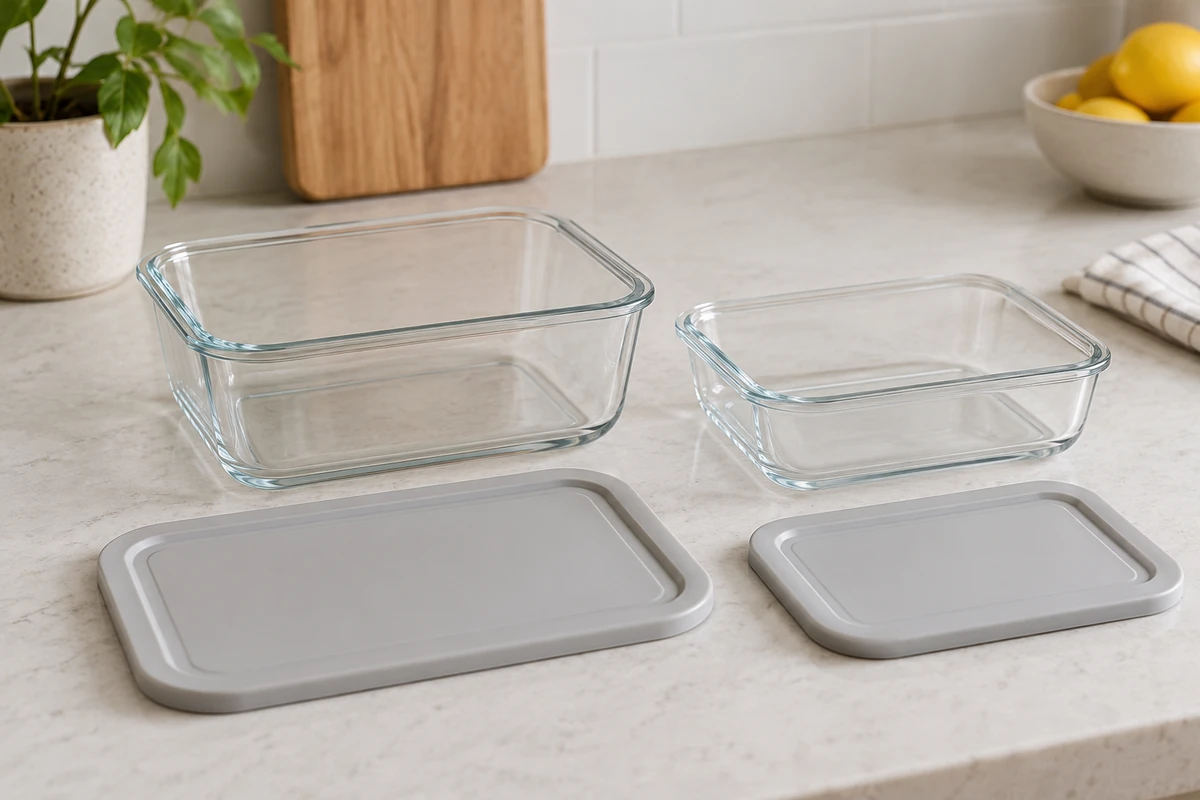
Start with the food-container bases you intend to keep. If those bases already meet the household’s needs and their matching lid is identifiable, compare a loose-lid purchase with complete containers before repeating the last full-set order. Missing covers and a need for more containers are two different requirements.
The useful result is a purchase split: lids for retained bases, complete units for additional storage, and any surplus created by the offered packs. It is not an instruction to try similar lids until one closes. An unidentified base or unresolved pairing stays outside the matched-lid calculation.
Group bases by the lid they actually require
Use the existing product references to divide the retained bases into known lid families. Keep shape, model and the approved lid reference beside each group. Capacity remains useful for describing what a container holds, but it should not be the sole key used to select its cover.
A deeper and a shallower base may share a documented lid, while two containers with the same capacity may have different openings. Count them together only when the actual product information establishes the shared pairing. Otherwise, keep separate rows. This avoids both unnecessary lid variants and a single optimistic order for lids that do not answer every base.
IKEA’s separately listed IKEA 365+ plastic lid 405.779.43 is specified for rectangular food containers in that named series. This is a concrete example of a manufacturer-defined lid family. It does not establish compatibility with other brands, unidentified containers or any lid merely described as rectangular. IKEA 365+ lid details
Work from known references and ordinary authorized observations. A base that is damaged, unidentified or awaiting a suitability decision should not justify a replacement lid yet. Do not force closure or remove components to create a matching answer.
Separate recovery of existing containers from expansion
For each confirmed family, record how many retained bases lack a usable matched lid. Then ask a different question: how many additional complete containers does the household actually need? The first number restores coverage of the existing base population; the second adds capacity or additional independently usable units.
Be specific about that new requirement. If the household wants another large container, two extra shallow bases produced by an unrelated set offer do not automatically meet it. The additional complete-unit row should retain its own model and capacity requirement even when it happens to use the same lid family.
Also distinguish missing lids from deliberate spare lids. A spare may be a sensible separate choice, but it should have a stated purpose and count. Do not turn every rounded pack remainder into demand after the fact simply to make the order appear exact.
The target is not necessarily to minimize the number of purchased objects at any cost. Complete units might be the only available commercial option, or the buyer may have a confirmed use for extra bases. The worksheet makes those consequences visible so the buyer can choose them knowingly.
Translate the offered pack into lids and bases
Ask what one purchase unit actually contains. A listing may sell one lid, a pack of identical lids, several lid sizes, a base without a lid, or a complete container. The word container and a photograph of an assembled item are insufficient contents descriptions.
For loose lids, obtain the exact reference and number per pack. For complete units, obtain both component references and the complete units per purchase pack. If an assortment includes several sizes, expand it by actual family before considering whether it covers the requirement.
Do not assume a supplier can break a fixed set. Request a loose-lid offer and retain an explicit unavailable or unanswered result when that is the response. The existence of a named retailer’s separate lid format shows a buying possibility; it is not evidence that another seller supplies loose lids or offers the same quantity.
Use a retained-base purchase worksheet
Complete one row per established pairing. Put unmatched bases beneath the table, outside the totals, with the question needed to identify them.
| Decision field | Entry for the household | What to obtain from the offer |
|---|---|---|
| Retained base family and shape | Exact base references covered by the pairing | Explicit proposed lid reference for those bases |
| Bases missing lids | Count of retained bases that need covers | Matched lids supplied in each purchase pack |
| Additional complete units | Separate new container requirement by reference | Base and lid contents of each complete-unit pack |
| Purchase combination | Loose-lid packs plus complete-unit packs | Actual selling increments and availability response |
| Surplus created | Extra lids and extra bases listed separately | No assumed credit for unwanted components |
| Unresolved pairing | Identified excluded group and missing evidence | Model-specific clarification before inclusion |
For a mixed route, subtract only the lids deliberately assigned to the new complete containers from that route’s lid total. The remainder can answer retained bases only when it is the same approved lid. A lid cannot simultaneously close a new base and a retained one.
Fictional decision with six missing lids and two new containers
Suppose a household has six retained rectangular bases, all already identified and approved for lid L. They are missing six lids. Separately, it needs two new complete containers of a specified base reference that also uses L. All quantities, eligibility assumptions and offers in this example are fictional.
Offer A can supply six individual L lids plus two complete units. It provides eight lids and two new bases. Two lids accompany the two new bases; the other six cover the retained bases. No surplus base is created, and all eight requested container positions are covered in the plan.
Offer B can supply only eight complete units. It provides eight lids and eight new bases. If six lids are assigned to the retained bases and two remain with two new bases, six newly purchased bases remain without a current purpose in this plan. Buying the complete units has not made the retained six bases disappear.
The buyer’s provisional preference is A because it answers the stated requirement without adding those six bases. That is a quantity decision, not a demonstrated financial saving. Actual prices, availability and purchase conditions are still needed before placing an order.
Now change one fictional offer: loose lids are available only in packs of four. Two loose-lid packs plus two complete units provide ten lids and two bases. After covering the eight planned positions, two lids remain as surplus. Compare that explicit surplus with B’s six extra bases. If the buyer accepts two reserve lids, record the choice; do not pretend the original shortage was eight.
If A’s lid reference is unanswered, the decision cannot advance merely because its counts look better. Keep A conditional and request the pairing evidence. Correct arithmetic does not settle compatibility.
Keep the reorder from changing the household use
A replacement lid can have different use instructions from the retained base or previous cover. Preserve the actual component instructions and ask the responsible reviewer to resolve any changed combination. This purchasing worksheet supplies no heat, freezer, cleaning or food-storage permission.
An attractive loose lid is therefore not automatically an equivalent replacement for a known one. If the proposed lid changes the intended household routine, revisit that product choice rather than hiding the difference in the unit calculation. The final order should name the selected pairing clearly enough that a later reorder can use it again.
See Homeware kitchenware for category context. A Homeware sourcing enquiry can state the retained base references, missing-lid count and separate complete-container requirement using supported links, a compact description or permitted images. Ask for the actual loose-lid and complete-unit formats. The next useful answer is a comparable component offer, with any unmatched base group still visible.
Worked inspection: two bases display the same capacity
Assume a fictional lot of 24 retained containers. Sixteen bases carry reference R-A and eight carry R-B. Both are advertised at 720 mL. Measure the lip length and width, latch position and gasket contact on each retained reference. Photograph the marks and fit on an agreed sample.
The seller confirms a reference for R-A and offers four packs of four loose lids at CNY 14.50 per pack. That is 58 for goods plus 12 for the quoted China delivery, or CNY 70 for 16 if the sample passes. Keep R-B pending until the latch and gasket are confirmed. Buying eight full replacement sets is a separate stock decision with eight added bases.
| Retained base | Quantity and fitting evidence | Purchase decision |
|---|---|---|
| R-A | 16 bases; 146 × 102 mm lip, four latch positions verified on the sample | Quote 16 matching loose lids after approval. |
| R-B | 8 bases; same advertised capacity, but a different gasket seat | Hold until the supplier identifies a matching lid and passes a sample fit. |
| Intended use | Product identification and destination evidence for the exact units | Check separately from the fit decision. |
Frequently asked questions
Can I reorder food-container lids without buying new bases?
Yes, when a separately offered lid is explicitly matched to the retained bases and those bases remain suitable for the intended task. First identify the actual family and model. Then request the loose-lid reference and pack contents. A separate lid sold for a named retail range does not establish another supplier’s offer or compatibility with an unknown container.
Does container capacity tell me which replacement lid to buy?
Capacity is a useful description but does not establish the opening or lid family. Keep the exact retained base and approved lid reference together. Some documented families may share a lid across depths; other similar-capacity containers may not. Leave uncertain bases out of the matched purchase total until their pairing is resolved.
How do I compare six replacement lids with complete container sets?
Keep any new complete-container requirement separate. In the fictional six-lid, two-new-container example, six loose lids plus two complete units meet both needs without surplus bases. Eight complete units can supply the same lids but create six extra bases. Compare real pack quantities, actual prices and conditions before choosing; the component count alone proves no saving.
What if loose lids come only in a larger pack?
Round the purchase to the seller’s actual available pack and record the additional lids separately from the original shortage. Decide explicitly whether to retain those extras or continue searching for another format. Do not assume a seller will split a pack, and do not use good pack arithmetic to overlook an unresolved lid-to-base match.
Sources
Discuss a sourcing request related to this article.Wholesale Food Container Lids: Confirm Fit Before Reordering