
Price Every Storage Bin Base and Matching Lid
Compare grouped storage-bin bases with complete-pair packs by reconciling lid cartons, size mixes, spare components and the full shipping quote.
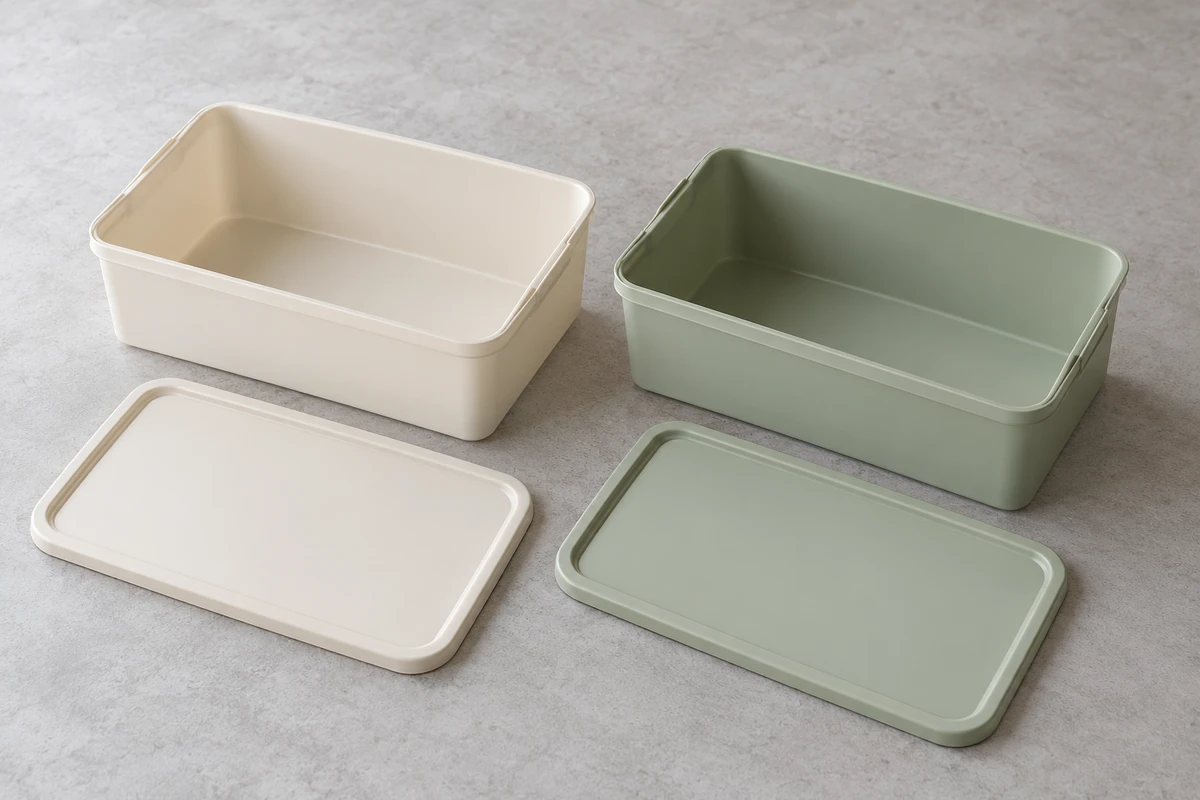
A compact group of empty storage-box bases can make a shipment look inexpensive while its matching lids are absent from the quote. Price the complete base-and-lid assortment before treating the arrangement as an alternative to individually packed boxes. The number of empty bases is only one side of that calculation.
The key problem is asymmetry: bases and lids may have different approved grouping quantities, carton shapes and order multiples. A tidy base pack therefore does not tell you how many lid cartons must travel or how many complete boxes the order will support.
Establish the box-and-lid combinations
Give each approved combination a base reference and a lid reference, including relevant size, colour and revision. List the required number of complete pairs by combination. Preserve separately any lids intended as spares; they add shipped contents without adding complete boxes.
Sterilite’s model 2244 is a named example of a storage box supplied with a snap-on lid. Its product description does not establish that an unknown supplier’s bases can nest for transport. Treat nesting permission, lid pairing and packed dimensions as separate answers for the actual product. Sterilite 20 Qt. Storage Box
Keep the approved household fit out of the freight optimization. Changing to a different lid or base merely because its carton is smaller would reopen the product choice. Similar capacity labels and similar-looking rims do not make variants interchangeable.
Ask for the entire proposed arrangement
Request two genuinely offered candidates. The first may retain each complete base-and-lid pair in its approved individual pack. The second may use an approved grouped base arrangement with lids packed separately. Neither is assumed cheaper, and grouping is considered only when the responsible owner permits it.
For a grouped proposal, ask how many bases are in each identified carton type and whether the final group has a different quantity. Request the corresponding lid schedule independently. Do not assign a nesting factor from the product photograph or force bases together to establish a saving.
A lid carton may contain lids for several base cartons. Conversely, a base group may need several smaller lid groups. Preserve those relationships through carton IDs and component references. “One lid bundle” needs an actual count, not an assumption that it matches the nearest base carton.
Reconcile pairs before dividing the quote
For a single approved pairing, the planned complete quantity is limited by the smaller of its base count and matching lid count. For an assortment, apply that check to each pairing separately and then add the complete quantities. Extra lids for one size cannot fill a shortage for another.
Keep three totals: components shipped, complete pairs planned, and required pairs still unsupported. This makes the commercial consequence visible without treating spares as waste or silently counting incomplete boxes as finished stock.
The packing-list structure helps here. ITA’s guidance describes package-level contents, weights and measurements used for freight costing. Use those fields to reconcile the two component schedules; the guidance is not a universal legal template or evidence that a provider accepts the proposed pack.
Build a base-and-lid freight worksheet
Use one row per approved pairing, with linked carton schedules for the physical measurements. This keeps an assortment check distinct from a generic total-volume table.
| Pairing field | Entry to obtain |
|---|---|
| Required complete boxes | Base ID, matching lid ID, variant and pair quantity |
| Base arrangement | Owner-permitted state, carton types and bases per carton |
| Lid arrangement | Lid carton types, quantities and which base groups they serve |
| Full shipped contents | Base total, lid total and separately intended spares |
| Pair support | Complete planned pairs by variant and any shortage |
| Full quote coverage | Every base and lid carton, quote reference and same delivery point |
| Extra receiving work | Identifying, sorting and matching components, with actual owner and price if applicable |
Keep all outer dimensions and gross weights in the physical schedule, including partial cartons. The UPS measurement guide distinguishes actual weight and dimensional weight. Ask the quoting provider which billing rules apply to the measured complete shipment; the catalogue dimensions of a closed box do not measure its packed group.
Let Pair-pack-total denote the complete quote for individually packed pairs. Let Grouped-total include the base cartons, lid cartons and any separately required packing or matching work. Compare these totals at the same required pair quantity. Leave an unquoted lid carton as an open line, rather than entering zero or allocating the base-only price over finished boxes.
A fictional assortment with the wrong lid balance
Imagine an order needing twelve small boxes and eight large boxes. These quantities, references and packing proposals are fictional. Both approved pairings require one matching lid per base.
The grouped proposal contains twelve small bases and eight large bases. Its first lid schedule lists ten small lids and ten large lids. There are twenty bases and twenty lids, but the planned support is only ten small pairs plus eight large pairs: eighteen complete boxes. Two small bases lack matching lids, while two large lids are surplus to the requirement.
The individually packed alternative contains the required twelve small pairs and eight large pairs. It is therefore not comparable with the incomplete grouped supply merely because both descriptions mention twenty boxes. The buyer returns the grouped schedule for correction and asks whether the lid assortment can be revised.
If the supplier can provide twelve small lids and eight large lids, obtain the actual revised lid packs and complete quote. If fixed lid multiples require additional components, record what must be purchased and shipped. Retain any surplus as an explicit consequence, with no assumed resale credit.
Only after both alternatives support all twenty required pairs should the buyer compare the quoted totals. If the grouped option also requires destination sorting, confirm who accepts that task. A receiver unable to manage loose mixed lids may reasonably prefer the complete-pair option; the freight comparison cannot assign that work without agreement.
Keep a shipping choice separate from a receiving result
Before dispatch, complete pairs are planned quantities. After receipt, reconcile what arrived and which components meet the agreed requirements before calculating an actual usable-box cost. A complete packing list does not predict damage, lid fit or the condition of an unexamined shipment.
For broader context, see Homeware baskets and storage. In a Homeware sourcing enquiry, describe the required pair mix and both carton schedules using a concise text brief or supported references. Ask for the missing lid coverage and any matching work explicitly, so the returned comparison answers the whole storage-box order.
Frequently asked questions
Why can equal base and lid totals still leave incomplete storage boxes?
The components must match by approved pairing. Ten small lids and ten large lids do not complete twelve small bases and eight large bases. Reconcile each size or revision before adding planned complete pairs; show surplus lids and unmatched bases separately.
Can I estimate grouped-base volume from the closed box dimensions?
No. The shipping arrangement has its own outside dimensions, protection and carton count. Obtain a permitted grouping proposal and measured completed packs. A closed-box catalogue measurement or a photograph supplies neither a nesting ratio nor transport permission.
What if the lid supplier sells only fixed packs?
Ask for the offered lid multiple and include every component you must purchase and ship. Compare a permitted revised assortment, the resulting surplus, and individually packed pairs if offered. Do not assume spare lids have a resale value that offsets the extra cost.
Does a lower freight cost per planned pair prove the grouped option is better?
It is one input. Confirm the complete quote, the permitted physical arrangement and any receiving-side matching work. The planned denominator also differs from the accepted-pair count established after delivery; do not treat a budget as evidence of arrival condition.
Sources
Discuss a sourcing request related to this article.Price Every Storage Bin Base and Matching Lid