
Tablecloth RFQ: Turn Table Size and Desired Drop into a Quote
Translate table shape, extension state and buyer-selected drop into finished dimensions, then assess stock-size alternatives transparently.
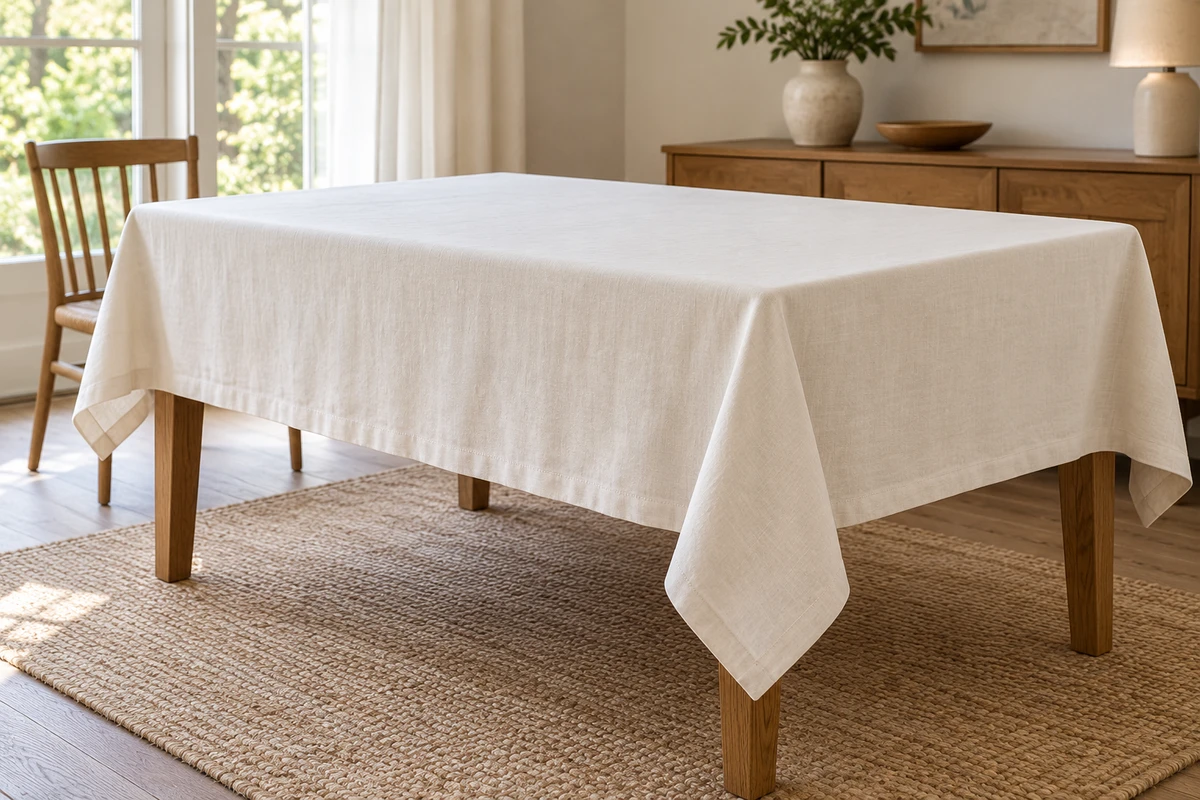
Specify a tablecloth from the actual table shape and the drop the buyer wants at each edge. A request for “a cloth for a four-person table” leaves the supplier guessing about the tabletop, any extension leaf and the intended overhang.
The RFQ should give a finished cloth size on an agreed measurement basis, then invite stock-size alternatives with their resulting drops shown. That lets the buyer decide whether a readily available size works or whether a separately quoted custom size is worth pursuing.
Measure the table in the configuration being covered
Record the tabletop shape and dimensions, with consistent units. For a rectangular top, identify length and width on a simple sketch. For a round top, record its diameter. Keep an extending table’s closed and extended configurations separate, including which leaves are in place.
State which configuration the cloth must serve. If one cloth is expected to cover both, ask the buyer to decide the acceptable drop for each arrangement. A size that gives the desired overhang with the leaf installed will have a different overhang when the table is closed.
For an oval, irregular or specially shaped table, agree a template or sufficiently detailed outline rather than forcing the shape into a rectangular rule. A cloth with the same maximum length and width can still fall differently around its curved or shaped edges. Keep the actual outline in the request if that fall is important.
Let the buyer choose the drop
Drop means the intended cloth extension beyond the tabletop edge in this sizing exercise. Ask the buyer to select it for the setting and users involved. Record different side and end requirements when needed instead of assuming every edge should match.
The choice may depend on chairs, seated use, the room arrangement and the desired appearance. Those are reasons to review the actual setting, not to adopt a universal stylish or safe length. Have the responsible owner settle any accessibility or operational requirement that affects the choice.
Crate & Barrel’s sizing guide adds twice the selected drop to a rectangular table’s length and width, or to a round table’s diameter. That provides a simple sizing method for those matched shapes. Its styling suggestions are retailer advice, not mandatory dimensions for a wholesale order. Crate & Barrel tablecloth sizing guide
Turn the chosen drop into finished dimensions
For a centered rectangular cloth on a rectangular top with equal drop at opposite edges:
- Finished cloth length = tabletop length + twice the chosen end drop
- Finished cloth width = tabletop width + twice the chosen side drop
For a centered round cloth on a round top, finished cloth diameter = table diameter + twice the chosen drop. Keep the cloth shape explicit. A square cloth placed on a round table has a different edge pattern and should not inherit the round-cloth calculation as an even-drop result.
These calculations describe the requested finished geometry. They do not calculate fabric cutting size, seam allowance or shrinkage. Give the supplier the desired finished measurements and ask how its quoted construction and agreed care basis relate to them. Do not add an arbitrary percentage to the order dimensions.
If opposite edges intentionally need different drops, name each edge on the sketch and add the two selected drops for that direction. Record the intended placement so the supplier and buyer are discussing the same result. An unexplained offset should not be used to conceal a stock size that misses the requirement.
Compare stock sizes by the drop they produce
For a centered rectangular stock cloth, subtract the tabletop length from the cloth length and divide by two to find the nominal end drop. Do the same with the widths for the side drop. Use the actual finished dimensions offered, not merely a size name.
If either cloth dimension is smaller than the corresponding tabletop dimension, that configuration does not provide full coverage in that direction. Do not report the negative result as a usable drop. Reconsider the size, orientation or explicit design requirement with the buyer.
Ask the seller to quote its nearest stock size as an identified alternative, with the difference visible. The buyer can accept a different drop, keep the original requirement and request a custom quote, or choose another available stock size. None of those decisions should be made silently by rounding the requested size to a catalogue option.
Use a table and cloth schedule
For multiple tables, give each tabletop configuration a row. Group quantities only after the buyer accepts the same cloth specification for those rows.
| Schedule field | What to record | What the supplier should return |
|---|---|---|
| Table identity | Location or table reference and quantity | Matched response reference |
| Shape and configuration | Rectangular, round or agreed outline; leaf state | Confirmation of the geometry quoted |
| Top dimensions | Length/width or diameter in stated units | Any measurement question |
| Desired drop | Side and end values, or named edges | Assumed placement and proposed deviations |
| Finished cloth | Calculated shape and dimensions | Exact stock size or separately priced custom size |
| Edge and measurement basis | Hem/edge description and agreed finished condition | Supplied construction and dimensional basis |
| Alternative decision | Acceptable drop range if the buyer has chosen one | Resulting drop and outstanding approval |
Keep edge treatment in the specification even when its price is small. The buyer needs the finished edge-to-edge size, while the supplier needs enough construction detail to quote it. The worksheet should not substitute for a separate textile material or care-performance review.
A fictional table with two operating sizes
Suppose a fictional rectangular table measures 120 × 80 cm when closed. The buyer chooses a 20 cm drop on all four edges. The requested finished cloth is therefore 160 × 120 cm: 120 + 40 by 80 + 40. The selected drop is an invented buyer preference, not a recommendation.
A supplier offers a 140 × 120 cm stock alternative. Centered on the same table, it gives a 10 cm drop at each end and 20 cm at each side. That may be acceptable to the buyer, but it differs from the original request.
| Fictional table configuration | Finished cloth | Nominal end drop | Nominal side drop |
|---|---|---|---|
| Closed: 120 × 80 cm | Requested 160 × 120 cm | 20 cm | 20 cm |
| Closed: 120 × 80 cm | Stock alternative 140 × 120 cm | 10 cm | 20 cm |
| Extended: 160 × 80 cm | Original 160 × 120 cm cloth | 0 cm | 20 cm |
| Extended: 160 × 80 cm | Separate 200 × 120 cm request | 20 cm | 20 cm |
If the table extends to 160 × 80 cm, the original cloth ends at the tabletop ends under this idealized centered calculation. A 20 cm drop for the extended configuration calls for 200 × 120 cm. The buyer can request two sizes or reassess whether a single larger cloth is acceptable on the closed table. No manufacturing allowance or observed drape is represented by the arithmetic.
Send the finished requirement and preserve alternatives
Ask for the actual finished size, shape, edge treatment and measurement condition on the quotation. Where appearance depends on how the cloth falls, review the proposed cloth on the relevant table arrangement before approving a quantity order. Keep that observation separate from dimensional arithmetic and unverified wash or performance claims.
The Home textiles page covers the wider category. Start the Homeware sourcing request with the table shape, operating dimensions, chosen drops and quantity. A simple image preview can label the sides and extension state; arrange a separate exchange for a full-size template or longer specification.
Frequently asked questions
How do I calculate a rectangular tablecloth size for an RFQ?
For a centered rectangular cloth, add twice the chosen end drop to table length and twice the chosen side drop to table width. Use the actual table configuration and consistent units. The result is a finished size request; it does not include an invented cutting or shrinkage allowance.
Should I measure an extending table with the leaf installed?
Measure each configuration the cloth must serve and label which leaves are present. If the buyer wants one cloth for both arrangements, calculate the resulting drop for each and obtain the buyer’s decision. Do not assume the closed-table requirement also describes the extended table.
Can a nearby stock tablecloth size replace the custom size?
It can be considered as an alternative. Calculate or record the drop the actual stock dimensions would produce, then have the buyer accept or reject that difference. Keep the original requested size visible so a convenient stock substitution is not mistaken for an exact match.
What changes for a round or oval table?
For a centered round cloth on a round top, add twice the chosen drop to the table diameter. An oval or irregular outline needs its own agreed shape information or template when the edge fall matters. Maximum length and width alone do not describe every shaped-table fit.
Sources
Discuss a sourcing request related to this article.Tablecloth RFQ: Turn Table Size and Desired Drop into a Quote