
Top Up a Mug Motif Without Mistaking a Mixed Pack for Matches
Separate the missing pattern count from total mug demand, confirm each assortment’s motif split and decide whether the mixed remainder has a real use.
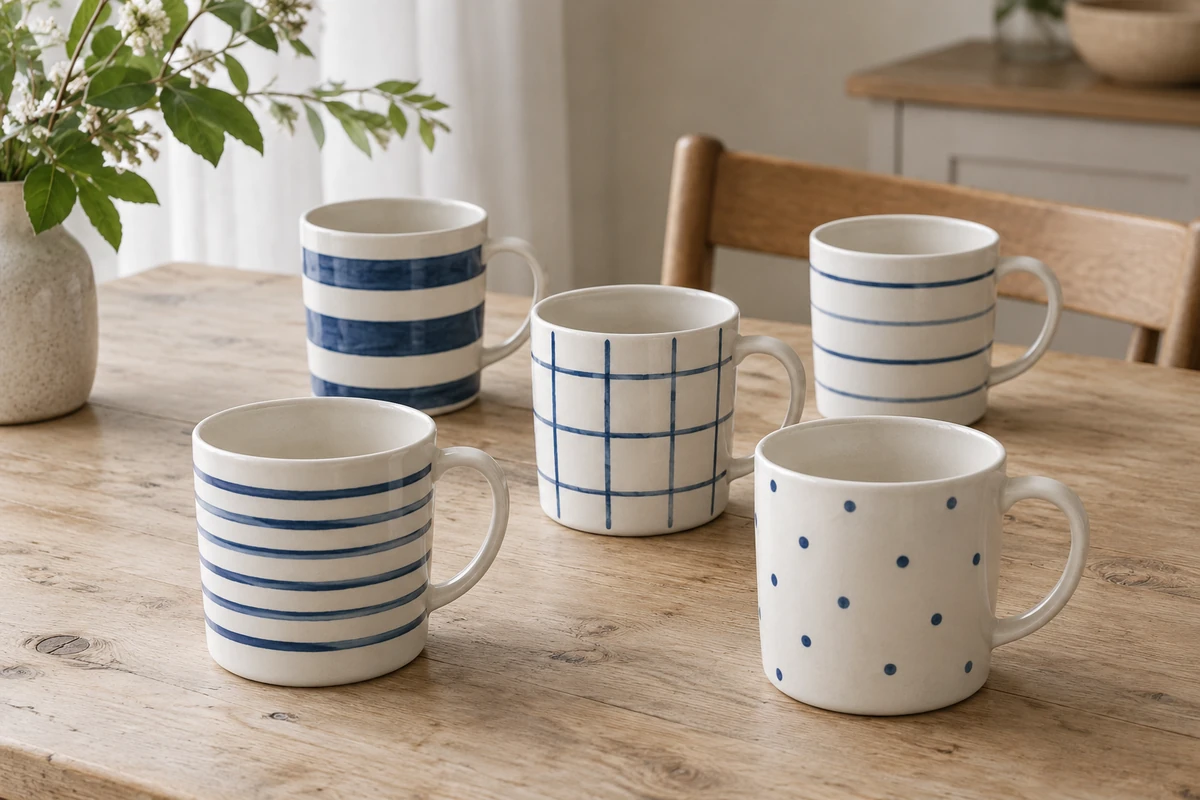
Four mugs in a box do not necessarily replace four missing mugs of one pattern. When the retained collection uses a particular motif, write the replacement requirement by that motif before repeating a mixed-pattern pack. The total mug count and the count that matches the intended appearance are different purchasing quantities.
A patterned-mug top-up starts with an already approved mug form. It asks whether a fixed assortment, a separately offered single-motif option or a consciously revised mixed collection best answers the shortage. It does not create a whole dinnerware setting, promise a batch colour match or infer exact assortment contents from a styled photograph.
Decide what must match in the retained collection
Identify the approved mug form and the actual motif that needs replenishment. Use an attributable product or pattern reference where available. If the buyer’s description is informal, a permitted image can help explain which design is intended, but the supplier still needs to connect that reference to what it offers.
State whether the buyer requires that exact motif or merely prefers it. This distinction changes the valid alternatives. If four identical-pattern replacements are essential, four mugs in other patterns do not cover the shortage. If a coordinated mixed group is acceptable, the owner can choose that broader requirement explicitly.
Keep form and appearance separate. A mug with the desired decoration but a different approved form is a new product proposal, not automatically the same replacement. Conversely, the same form in another motif may be useful while failing an exact-pattern requirement. The purchasing record should make both possibilities visible.
Ask for the per-motif contents of one purchase unit
IKEA’s India ENTUSIASM 804.172.45 listing describes varied patterns and gives a package quantity of four mugs. The official text does not assign a count to each individual motif. It therefore illustrates a mixed-pattern commercial format, not a documented one-of-each rule. ENTUSIASM patterned-mug product information
For the actual offer, request the number of each named motif in one selected pack. Ask whether the composition is fixed, selectable or unresolved. A photograph showing several designs is not the same answer as a written contents commitment for the ordered variant.
Do not derive motif counts from generated image descriptions, customer reviews or the order of pictures in a gallery. Where the seller cannot confirm the composition, retain an unknown row. Multiplying an unknown motif count by the number of packs produces an unknown replacement count, not a guaranteed matching set.
If the supplier offers a single-motif option, obtain its actual order unit and current terms. A range containing several designs does not establish that any one can be bought separately. Keep a requested option distinct from an available offer.
Give every other motif an explicit destination or surplus status
Once the assortment is known, split its contents into the required motif and the remainder. The remainder might meet another genuine household need, or the owner may simply accept it as extra stock. Record that decision rather than treating any usable mug as identical to a missing patterned one.
Avoid assigning speculative resale value to the extra designs. If a retailer has actual demand for them, name that demand and keep it separate from the original top-up. If not, the extra mugs remain a consequence of choosing the fixed pack.
The owner may also decide to broaden the visual group instead of maintaining a uniform motif. That is a legitimate alternative when consciously chosen. It should change the stated appearance requirement, rather than making an incomplete exact-match offer look complete after the fact.
Compare actual supply for the same appearance outcome
Request a complete current offer for the pack quantity that supplies the required motif count. Compare it with any confirmed single-motif offer and with a mixed-group alternative only if the owner accepts that changed outcome. Keep those alternatives clearly labelled.
If the pack contains no confirmed quantity of the desired pattern, its apparent unit price cannot be used as a cost per matching replacement. Even after the split is confirmed, dividing the purchase total by every mug answers a different question from dividing it by the required matching count.
Do not claim that a single-motif route is always less expensive. A fixed pack may have a lower total or the only available supply. The useful comparison explains what each actual offer buys, which part answers the present need and what remainder the buyer consciously accepts.
Use a motif-top-up worksheet
| Worksheet field | Entry to complete | Decision supported |
|---|---|---|
| Approved mug form | Exact retained product reference | Keeps the product form fixed |
| Required motif | Named pattern and actual appearance reference | Defines the replacement group |
| Required count by motif | Individual mugs needed for each pattern | Avoids a misleading total-only requirement |
| Confirmed per-motif pack contents | Seller’s written fixed or selectable composition | Establishes how many packs cover the need |
| Mixed remainder | Other designs and their quantities | Shows additional goods created by the choice |
| Accepted use for remainder | Actual separate need or explicit surplus decision | Prevents invented value from hiding extras |
| Unanswered appearance match | Current variant or batch question | Keeps uncertain similarity visible |
This is an original assortment decision aid. It does not establish food-contact compliance, heating permission, dishwasher suitability or resistance to breakage for any mug.
Fictional example: four matching replacements from a mixed pack
Imagine a buyer needs four mugs of fictional motif A, using an already approved form. A seller offers a four-mug patterned pack, but initially gives no motif split. The requirement, references and all subsequent replies in this example are invented and do not describe ENTUSIASM’s actual composition.
The buyer cannot assume one pack supplies four A mugs. It asks for the composition or a separately documented single-motif option. Suppose the fictional seller then confirms that each fixed pack contains two A, one B and one C.
Under that expressly invented composition, two packs supply four A, two B and two C: eight mugs in total. The four A replacements are covered, while four other-pattern mugs remain. One pack would leave two A still missing, even though its total of four mugs equals the original numerical shortage.
Suppose the owner has a separate confirmed use for two B mugs but no current use for C. Record that distinction: the purchase meets four A replacements and two B needs, leaving two C extra. Do not call all eight “required replacements” or erase C by averaging the motif counts.
If a single-motif offer later confirms four A mugs, compare its actual total and conditions with the two-pack route. The fixed route includes useful B mugs under the added requirement and surplus C mugs; the single-motif route does not meet the separate B need unless another offer does. Compare the complete scope chosen by the owner, rather than mixing totals from different demand plans.
Alternatively, the owner may abandon exact motif matching and accept four assorted mugs. Record that as a changed appearance decision before choosing one pack. The outcome can be sensible, but it is no longer four A replacements.
Preserve pattern identity in the final request
Name the form, selected motif or accepted mixture, individual counts, confirmed pack composition and any remainder accepted. If a later reply changes the composition, recalculate rather than assuming the earlier pack count still covers the required pattern.
See Homeware kitchenware for broader context. A Homeware sourcing enquiry can include a supported product link, concise description or permitted pattern-reference image. Confirm the provider’s actual sourcing scope; a range photograph or enquiry submission does not establish single-motif availability or future replacement continuity.
Frequently asked questions
Does a four-mug patterned pack contain four matching mugs?
Not unless the selected offer’s actual contents say so. Confirm the count of each motif and whether composition is fixed or selectable. The named ENTUSIASM text supports a patterned four-pack but does not establish exact per-motif counts; do not infer those counts from its images.
How do I calculate mixed packs for one missing mug motif?
Use the seller-confirmed count of the required motif in each pack, then show all other motifs separately. In the expressly fictional two-A/one-B/one-C example, two packs supply four A plus two B and two C. That teaching composition is not a claim about a real branded pack.
Can other patterns be counted as replacement demand?
Only if the owner consciously accepts a changed appearance requirement or identifies a separate need for those patterns. Otherwise they remain extra goods. A mug being generally usable does not make it a matching replacement, and speculative resale should not erase the remainder.
Should I request a single-motif option before repeating an assortment?
Yes, when exact-pattern replenishment matters, ask whether a documented single-motif offer exists and what its current purchase unit contains. Do not assume availability from a range photograph. Compare actual complete offers for the owner’s chosen appearance outcome, including any useful or unwanted remainder.
Sources
Discuss a sourcing request related to this article.Top Up a Mug Motif Without Mistaking a Mixed Pack for Matches