
Check the Received Pan and Lid Pair While Cold
Keep pan and lid identities together, observe only permitted cold seating, and resolve visible damage without confusing fit with cooking suitability.
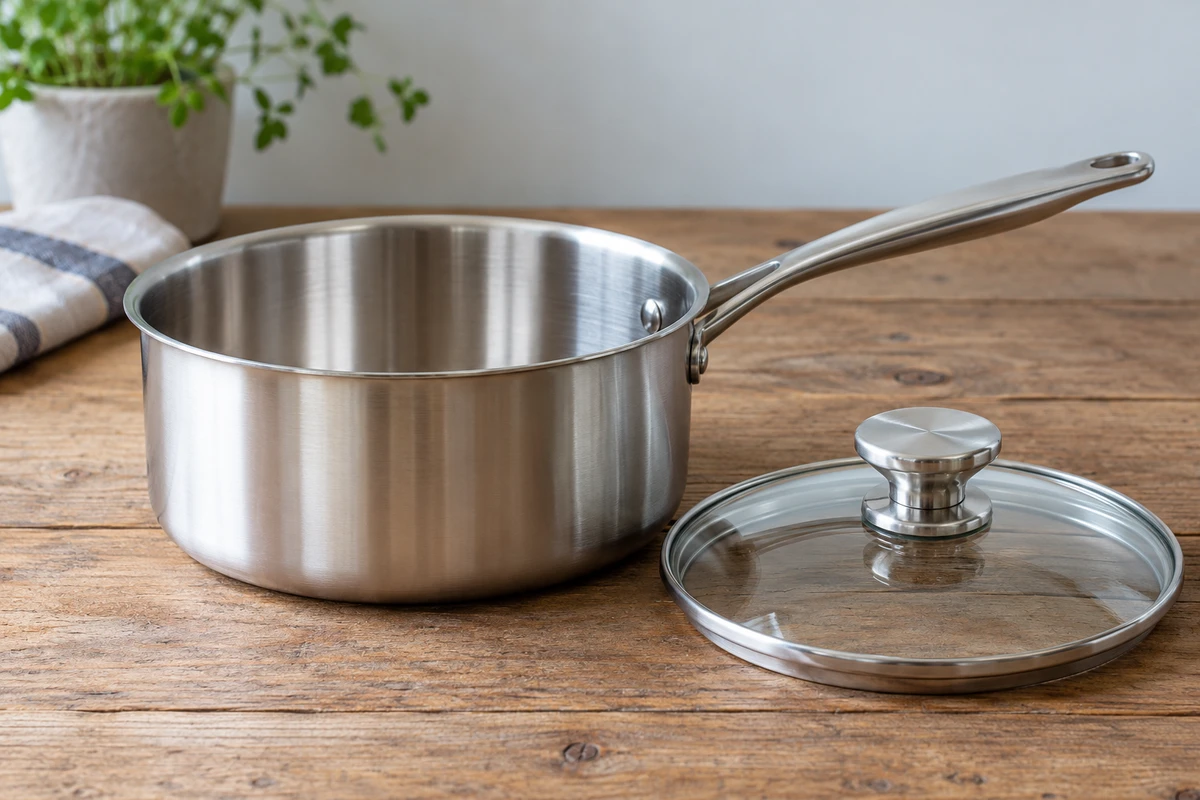
Keep the received pan and its intended lid together until you know which two components the order actually pairs. A lid that appears to cover the opening can still be an unidentified substitute, while an approved lid that arrives visibly damaged should not proceed to a fit observation. Resolve identity, visible condition and ordinary cold seating as separate questions.
This receiving review concerns an empty, unheated pan and lid. It does not involve cooking, pressure, liquid filling, screw adjustment or repair. Only continue ordinary handling where the item’s instructions and agreed receiving scope permit it, and stop if damage or interference makes that handling uncertain.
Find the intended pair before trying the available lids
Start with the approved order line, component list or sample reference. Does the pan come with a lid, is the lid a separate accessory, or was a particular alternative approved? Identify the pan model, size option and revision alongside the lid model and revision. A shared series name is useful context but cannot fill an absent pairing reference.
Le Creuset’s Toughened Non-stick section describes optional glass lids sold separately for that cookware. Its Essential Non-stick Ceramic section also addresses the glass lid as a component and warns against using a damaged glass lid. These are named-range examples of component scope and care, not compatibility evidence for an unknown supplier’s cookware. Le Creuset care and use
Preserve which package each component came from. If the pan and lid arrive in separate cartons, link their accessible labels to the order before removing that context. If several similar sizes are unpacked together, keep the groups distinct rather than arranging all loose lids by apparent diameter. A tidy work surface should not erase the only evidence of a packing mix-up.
Where the lid has no individual marking, record the package reference and the supplier’s explanation of how it identifies that component. An unmarked lid is not automatically the wrong one; it is a reason to establish the link before treating a plausible fit as confirmation.
Read a seating problem without trying to cure it
Look at accessible surfaces before bringing the pair together. Visible glass damage, a distorted-looking rim or an obviously displaced knob or handle is a reason to pause the affected observation. Do not touch suspect edges to decide how serious a chip is. A safe photograph and a plain description can raise the question without further manipulation.
For an apparently intact pair that can be handled normally, observe how the identified lid rests on the identified pan in the intended cold position. Note what is actually visible: one side remains raised, the lid rests off-centre, the rim does not locate as expected, or the position appears consistent with the approved reference. Use that reference and the product instructions rather than inventing a universal gap allowance.
Do not press the lid down, twist it to overcome interference or keep trying different positions until the photograph looks right. Stop at unexpected resistance. If a handle or knob looks displaced, preserve that condition for the supplier instead of tightening hardware. A correction performed before review would create a second condition and leave the original receiving question unanswered.
Some products may have an intentional opening, vent or rim feature. Describe it and ask whether it matches the approved design. A visible opening alone does not establish poor sealing, and a lid resting evenly does not establish a seal. Neither observation supports an airtight, leakproof or pressure-related claim.
Use a worksheet that keeps the pan and lid distinct
Complete this original editorial worksheet for the specific pair observed. It is a decision aid, not a laboratory method or a sampling plan. Use separate sheets for different pairings instead of letting one apparently good combination represent an entire cookware family.
| Pairing question | Record for this received pair | Decision it informs |
|---|---|---|
| Which components arrived? | Pan ID, lid ID, size options and original package references | Whether the received identities can be connected to the order |
| What pairing was approved? | Order line, component list or approved sample reference | Whether this lid was intended for this pan |
| What does the rim show? | Accessible condition and any visible seating obstruction | Whether ordinary cold observation can continue |
| How does the lid rest? | Unforced cold position and the comparison reference | Whether the observed seating remains unresolved |
| What is visible at the knob, handle and glass? | Location-specific observation or reason handling stopped | Which component needs a condition response |
| Which use claims remain separate? | Applicable instructions and unresolved heat or food-use evidence | What cannot be concluded from pairing alone |
Keep the identities visible in photographs through the accompanying record, rather than applying a label directly to a questionable surface. A useful set of images can show the original package identity, the whole pair and the visible mismatch from a safe viewpoint. If an image cannot be obtained safely, say which view is missing; do not create the scene again just to complete the sheet.
A fictional neighbouring-carton mix-up
Imagine two invented pan variants, P-A and P-B, whose listings use the same advertised size. The approved component sheet pairs P-A with lid L-A and P-B with L-B. All identifiers, observations and supplier responses here are fictional, with no real manufacturer or shipment represented.
During unpacking, a lid from P-B’s neighbouring carton is placed beside P-A. Its package reference identifies it as L-B. Ordinary cold placement, before any damage is suspected, shows one side sitting above P-A’s rim. The receiver stops and records P-A/L-B as the combination observed. This does not yet establish that P-A is defective; the observed pair differs from the approved one.
The receiver does not continue swapping loose lids to find a neat-looking combination. The supplier is asked to reconcile both carton references with the approved component sheet. Suppose the response confirms that L-B belongs with P-B and identifies a separately packed L-A. That answer resolves the claimed pairing, but L-A still needs its own condition review before any permitted seating observation.
Now suppose a visible chip is noticed on L-A while it remains safely supported in its pack. Its seating check stops there. The receiving outcome has two parts: the original raised-lid observation involved the wrong pair, and the intended L-A is held for its visible condition. Correcting the first explanation does not make the second issue disappear.
If the supplier proposes another lid as a replacement, ask for its exact identity and the documented pairing it supports. Treat an alternative as a proposal for the buyer to review. Do not replace L-A’s identity on the record or call the new lid approved because it looks like the old one.
Close the pairing question at the right boundary
A useful supplier response identifies which component was wrong, damaged or still unexplained and what happens to that component under the agreed terms. Record who decides the remedy and which received units it covers. Avoid a general “cookware passed” conclusion when only one cold pair was observed.
Even a documented, normally seated pair leaves other purchasing requirements separate. Cold seating does not establish oven temperature, induction compatibility, food-contact suitability, coating identity or cooking performance. Any claim being made for the pan-and-lid assembly needs applicable evidence for that assembly and its components.
For buying coordination, start with Homeware kitchenware and the Homeware sourcing request. Identify the pan, lid and unresolved pairing in a supported marketplace link or concise description. The form accepts up to five PNG, JPEG, WebP or GIF images, at most 10 MiB each and 20 MiB total. Agree a separate exchange for original documents, and agree any physical inspection scope before treating it as part of the service.
Frequently asked questions
Does the same advertised diameter mean that a lid belongs to the pan?
No. Preserve the exact pan and lid references and ask for the approved pairing. A catalogue size may help identify an option, but it does not document the rim interface or an authorized substitute. A lid that appears to cover the opening still needs its connection to the ordered component list.
Should I try other lids if the first one sits unevenly?
First check the identities and original carton references. Repeated swapping can conceal a packing error and create undocumented combinations. Stop if there is interference, damage or uncertain handling. Ask the supplier to reconcile the approved pair before any further ordinary observation permitted by the product instructions.
Can a chipped lid still be used for a cold fit check?
Keep a visibly damaged glass lid out of the handling sequence and seek a scoped disposition. Le Creuset specifically warns against using a damaged glass lid in its relevant instructions; an unknown product needs its own guidance as well. Do not touch the suspect edge or attempt to repair it to complete a fit record.
What can I conclude when the approved lid seats normally?
You can describe the cold seating of that identified pair under the conditions actually observed. It does not prove sealing, pressure performance, a temperature limit or food-contact suitability, and it does not cover unexamined units. Keep those claims and any remaining receiving requirements open to their appropriate review.
Sources
Discuss a sourcing request related to this article.Check the Received Pan and Lid Pair While Cold