
Check Storage-Box Lid Closure with the Intended Contents
Compare empty closure with normal closure around the specified light household contents, keeping any obstruction or changed arrangement visible.
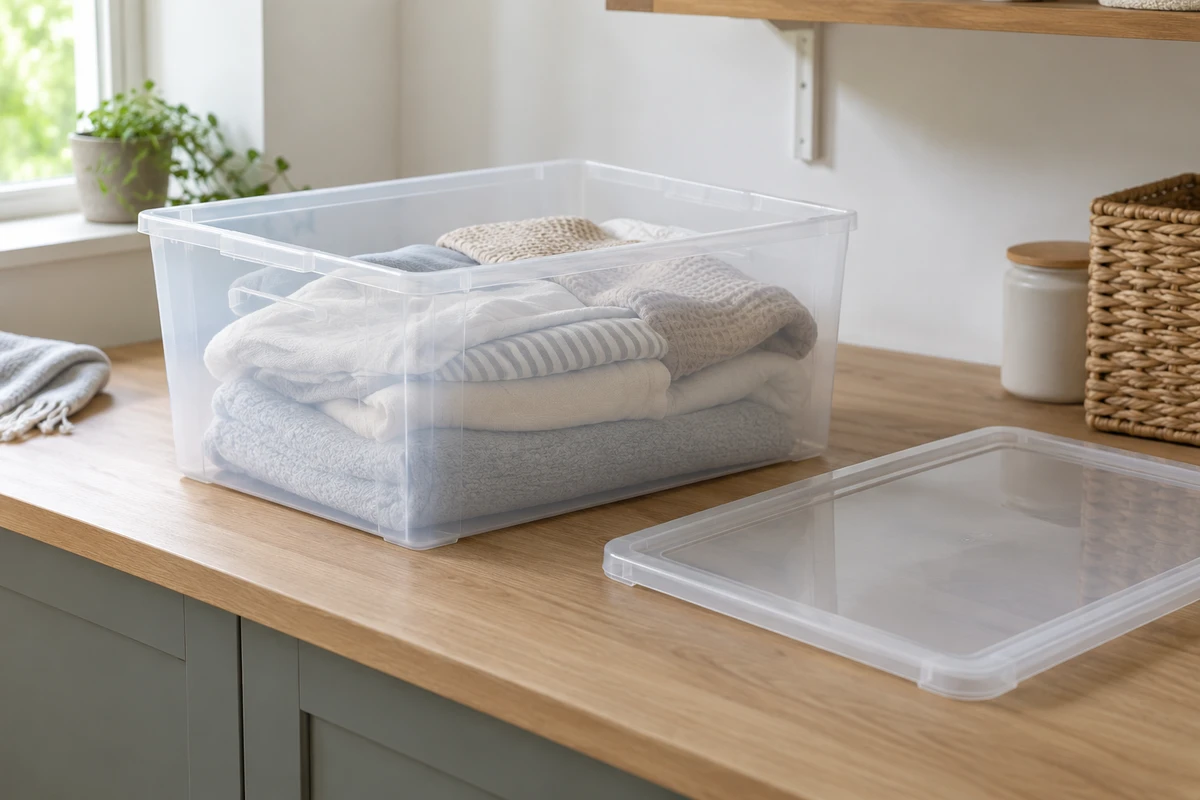
An empty storage box can close correctly and still fail the job it was bought for. At receipt, pair the delivered base with its intended lid, then observe ordinary closure around the buyer’s identified light contents in their agreed arrangement. If an item obstructs the lid, record that interference before anyone presses harder or changes the arrangement to make it fit.
The decision is whether this box-and-lid combination accommodates the stated household use. It is not a load-capacity assessment, a stacking exercise or evidence that the box is airtight or waterproof.
Keep the lid that belongs with the base
Identify the delivered box and lid by their accessible product or packing references. Check against the approved component pairing before considering contents. A similar-coloured lid from a neighbouring carton should not become the reference merely because it looks close in size.
Read the applicable closing instructions. Some lids snap onto a rim; another product may have a different closing arrangement. Sterilite’s 20 Qt. Storage Box, model 2244 is a named example with a snap-on lid and separately published exterior and interior-at-bottom dimensions. Those details illustrate why both pairing and measurement basis matter; they establish nothing about an unknown supplier’s box.
If the base, rim, lid or supplied closure is visibly damaged, put the contents observation on hold. Do not bend the lid into shape, trim an edge or work the closure repeatedly as a receiving repair. An unclear pairing or damaged component needs its own answer before the buyer can interpret fit around the intended objects.
Establish the empty result without making it the final result
On a supported, safe-to-handle box, use the normal closing action described for that product. Observe whether the lid sits in its intended position and the relevant closing features engage. Record what happened at the different sides where visible, especially if one corner remains raised.
Stop if the expected ordinary action meets unexplained resistance. “Lid placed; far corner remains visibly raised” is an observation the supplier can investigate. “Needs more pressure” assumes both a cause and a remedy that may be wrong. This article sets no force, flex or repeated-cycle procedure.
The empty result becomes a comparison point. If closure is already unresolved while empty, adding contents will make the question less clear. If empty closure is normal, keep that limited result and move to the intended arrangement only when the product instructions and agreed handling scope permit it.
Recreate the actual contents instead of an easy substitute
Name the intended light objects and how they are to be stored. A box for folded cloth napkins might have a specific fold and bundle count. A box for reusable gift bags might need the bags flat, with their handles inside. Those arrangements are more informative than saying “household items.”
Use clean, dry, ordinary contents that are appropriate for the product and safe to handle. Do not use sharp, fragile, hazardous, valuable or heavy objects to conduct this observation. If an agreed representative replaces the actual contents, record exactly what it represents and what it leaves unanswered. A small empty mock-up cannot stand in for all properties of the real object.
Preserve the agreed orientation and quantity. Reducing a bundle, rotating a rigid item or moving part of it outside the box changes the household job. Such an alternative may be useful, but it needs a separate result and the buyer’s decision. Otherwise the receiving record can accept a configuration the customer never intended to use.
Consider loose details before approaching the lid. A textile edge or bag handle caught at the rim is different from an item that projects above the space under the closed lid. Record the arrangement as found, then follow only the normal, permitted placement instructions; do not compress a bundle to conceal inadequate space.
Locate the obstruction while leaving the product unchanged
Offer the lid in its normal orientation and follow the ordinary closing action only while it remains unobstructed. If it contacts the contents before reaching its closing position, stop. Observe the location from an accessible view without squeezing fingers between components or pressing the lid down to see how much it bends.
Describe where the conflict occurs: a folded bundle at the centre, a projecting item at one end or contents caught near a rim. A view of the open contents arrangement followed by the stopped lid position usually answers more than a photograph of the lid alone. Do not stage a fully closed photograph by holding the lid under pressure.
Keep the relationship to the empty result explicit. Normal empty closure followed by obstruction with the intended contents narrows the receiving question to that arrangement. It does not prove that the base is defective or that the contents are “too large” in every possible position. The buyer still needs to compare the observed arrangement with the approved use.
Likewise, a lid that closes around the contents establishes only the stated observation. It does not confirm a seal, safe loaded carrying, stacking strength or resistance to water. None of those outcomes should be added to a product listing from this receiving note.
Use a closure worksheet with an arrangement reference
This original worksheet links the empty and contents-present views of one box. It is an editorial aid, not a testing method, a universal interior-clearance requirement or permission to apply the result to an unexamined shipment.
| Entry | Record for the reviewed combination |
|---|---|
| Box and lid pairing | Exact delivered references and applicable closing instructions |
| Empty closure | Normal seating observed, or specific side or corner left unresolved |
| Contents arrangement | Identified light items, quantity, orientation and any approved representative |
| Space under the lid | Visible relationship between contents and intended closed lid position |
| Obstruction | Location and point where normal closure stopped; no forced result |
| Changed arrangement | Any proposed rotation, smaller bundle or replacement box, kept separate |
| Decision needed | Original use met, configuration clarification required or alternative for buyer review |
A worksheet for a different lid revision needs its own entry. Do not splice an empty result from one lid together with a contents result from another, even if both belong to the same product family.
Fictional example with a raised gift-box corner
Imagine a fictional retailer receiving base B6 and lid L6 to store four light, empty presentation boxes in a fixed upright arrangement. These identifiers, quantities and observations are invented. They describe no real product or supplier.
B6 and L6 close normally while empty. With the four presentation boxes arranged as approved, the upper corner of one box meets the underside of L6 before the lid reaches its intended position. The receiver stops without compressing the presentation box or pushing the lid into place. The open-arrangement photograph identifies the fourth box and the contact location.
The fictional supplier first replies with the storage box’s outside height. That number does not resolve the interference under the received lid. The buyer returns the observation and asks whether the approved contents arrangement was considered with this exact base and lid pairing. Exterior height and an interior-at-bottom measurement describe different boundaries from the local space the projecting corner needs.
The supplier then suggests storing three presentation boxes or turning all four sideways. Either might merit consideration, but the order required four upright. The buyer keeps the original receiving result unresolved and evaluates the alternatives on their own merits. A lower quantity would change the storage task; a rotated arrangement would require its own ordinary fit observation and approval.
If a replacement lid or larger box is proposed, identify the new combination before reviewing it. Do not label the original B6/L6 observation a success merely because a different arrangement later works. Any replacement’s exterior fit in the intended storage location also remains a separate question.
Close the household-fit question with a specific answer
A useful supplier response names the affected combination and the exact proposed change. “Same capacity” or “larger than the contents” leaves the actual obstruction unexplained. The buyer should be able to choose between the original requirement, a clearly described alternative and the agreed commercial remedy without reconstructing what was tried.
See baskets and storage for category context. Through the homeware sourcing page, describe the box, lid and intended contents, and agree any receiving-observation service separately. The initial form accepts supported marketplace HTTPS links, descriptions of 8–1200 characters, or up to five PNG, JPEG, WebP or GIF images, limited to 10 MiB each and 20 MiB combined. Keep longer worksheets or other file types for a separately agreed exchange.
Frequently asked questions
Does an empty lid fit prove the box is suitable for the planned contents?
It provides a useful baseline for that box-and-lid pair, but it leaves the actual contents arrangement unanswered. Identify the objects, quantity and orientation, then observe only the normal permitted closing action. A projecting item or detail caught at the rim can stop closure even when the empty result was satisfactory.
Should I compress soft contents until the lid closes?
Do not compress them to obtain a receiving pass. Preserve the agreed ordinary arrangement and record where it prevents closure. A different fold, smaller bundle or other permitted arrangement can be considered as a separate proposal if the buyer approves it. The changed arrangement must not silently replace the use that was ordered.
Which dimensions resolve an obstruction under the lid?
Ask for the relevant space in the exact closed box-and-lid configuration and at the obstruction location. Outside dimensions and interior-at-bottom dimensions describe other boundaries and cannot automatically answer that question. Keep the actual contents arrangement and observed contact point with the request instead of relying on nominal capacity alone.
Does the lid closing around the contents prove the box is sealed or stackable?
No. It describes normal closure for the stated arrangement only. Airtightness, waterproofness, loaded carrying and stacking involve different claims and evidence. Do not add those properties to an acceptance record or product listing from this observation, and do not improvise loading, water or stacking exercises to establish them.
Sources
Discuss a sourcing request related to this article.Check Storage-Box Lid Closure with the Intended Contents