
Resolve Uneven Tablecloth Drop Before Altering the Cloth
Separate placement from a remaining tablecloth shape or size discrepancy, using the specified table and an unchanged unwashed comparison basis.
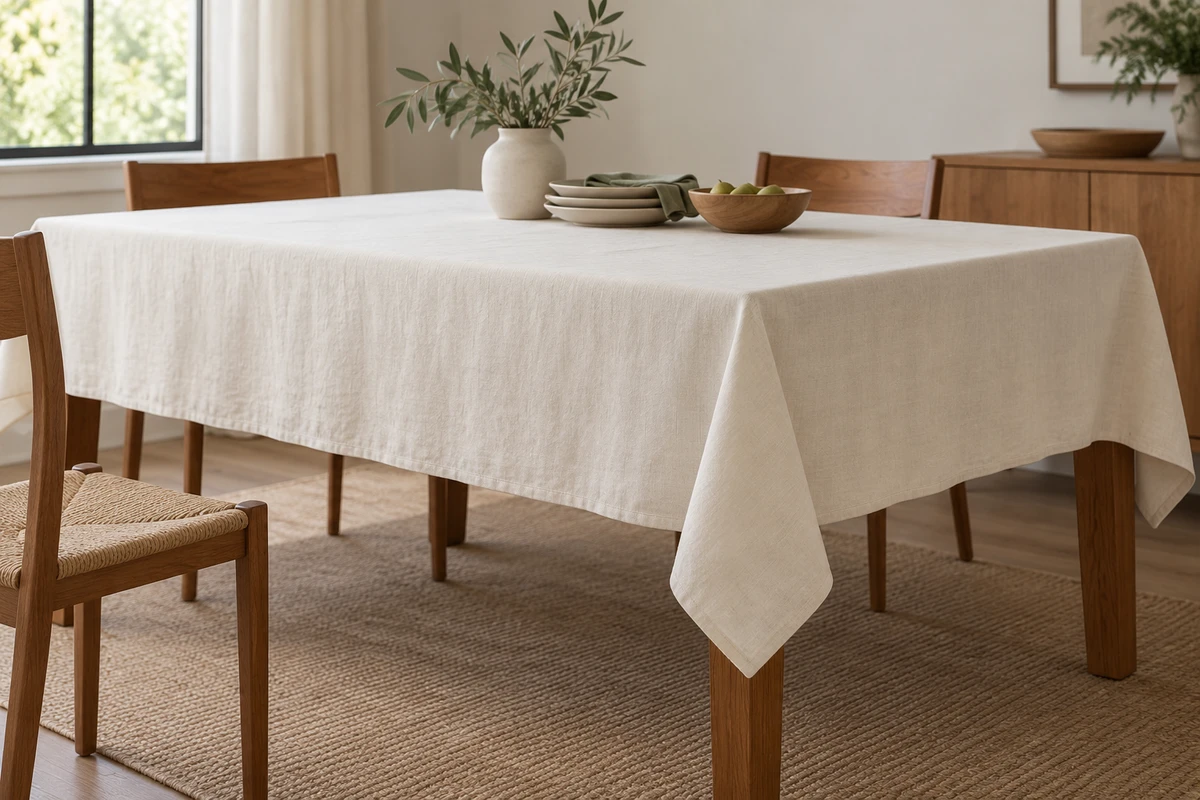
When a received tablecloth hangs unevenly, establish its orientation and position on the specified table before deciding that the cloth is the wrong shape. Keep the original unwashed condition intact. If careful positioning resolves one difference but another remains, describe the remaining discrepancy separately instead of treating a better-looking arrangement as complete acceptance.
The decision here is about a cloth already received against an agreed reference. Choosing an ideal drop or calculating a new ordering size belongs earlier in the purchase. At receipt, the useful question is whether the delivered cloth can be compared fairly with what was approved, without washing, ironing, trimming or pulling it into a more convenient shape.
Start with the table that the order actually describes
Confirm the table identity and its present configuration. Check whether an extension leaf is fitted, whether the table has been changed since the order, and which direction the cloth’s length was meant to run. A cloth can look too short on an extended table while still matching the closed-table configuration it was bought for. Resolve that difference before attributing the appearance to manufacturing.
Give the two ends and two sides simple names on a sketch, such as end A, end B, side C and side D. Put the cloth’s existing label or another recognizable feature on the same sketch, without marking or altering the fabric. This keeps “the left side” from changing meaning when another person takes a photograph from the other end.
Identify the shape combination as well. A rectangular cloth on a rounded or irregular tabletop should be compared with the actual agreed arrangement. Equal drop everywhere may never have been the requirement. Do not judge a curved corner by the same observation used at the midpoint of a straight side unless that was the agreed basis.
Confirm what unwashed means in this comparison
Find the approved finished-size reference and its measurement condition. Was the receiving comparison expressly for the as-supplied, unwashed cloth? If the only recorded requirement concerns dimensions after an agreed care process, the unwashed observation cannot settle that later result. Ask the buyer and supplier to clarify which receiving decision the present reference supports.
Record whether this specific cloth has already been washed, ironed or otherwise altered. A washed reference sample and a newly unpacked cloth should not silently become like-for-like measurements. Keep both conditions visible and ask for a comparable reference or a defined review, rather than inventing a shrinkage correction.
Packaging folds may make the edge difficult to read. Follow the actual instructions and agreed handling basis for an ordinary observation, but do not iron out uncertainty to obtain a cleaner photograph. If the cloth will not lie sufficiently clear for the agreed dimensional comparison without treatment, report that limit. The present answer may be “not yet comparable,” rather than “wrong size” or “acceptable.”
Make centring visible before interpreting the hem
Crate & Barrel describes drop as the cloth extending beyond the tabletop edge and relates sizing to the two opposite overhangs. That geometry explains why the table and placement matter to this receiving question. Its styling recommendations do not supply an acceptance tolerance for your purchase. Crate & Barrel tablecloth sizing guide
Use the agreed table and cloth reference points to establish orientation and centring. Do not pull on the corners or stretch an edge to align it. Avoid making a printed stripe the sole centre reference unless the approved specification makes that stripe the positioning datum; print alignment and cloth-edge geometry can be different questions.
Record the initial placement before ordinary repositioning. Then describe what changed and which opposite drops changed with it. Compare named locations, not a corner in one view with the middle of an edge in another. A wide view establishes the table arrangement; closer views show the particular hem location that remains in question.
If centring makes opposite end drops appear alike, it has answered the end-placement question at those observation points. It has not demonstrated that the long hems are parallel, the corners match the approved outline or every finished dimension meets its requirement. Keep those remaining questions visible without diagnosing a cutting, sewing or fabric cause from appearance alone.
Use a before-and-after placement worksheet
This original worksheet is designed for a single cloth on a specified table. It does not define textile conditioning, a formal test or a sampling plan. Fill in measurements only where the parties have agreed the method and points; otherwise retain a clearly labelled visual observation.
| Field | Initial position | Centred comparison or unresolved point |
|---|---|---|
| Table and cloth references | Table ID, leaf state, cloth ID and approved outline | Confirm whether the same configuration remains in use |
| Unwashed condition | As received, with any known previous treatment stated | Reference condition matches or needs clarification |
| Orientation | End A/B and side C/D on a sketch; recognizable cloth feature | Describe the positioning change without stretching |
| Opposite drops | Same named observation points at opposite edges | Which imbalance disappears and which remains |
| Shape and dimensions | Visible hem course and any permitted agreed measurements | Specific edge, corner or dimension needing a response |
| Remaining decision | What the first view appeared to show | Placement resolved, comparison limited or supplier response needed |
Write observations narrowly: “At side C near end A, the hem hangs visibly higher than at the agreed comparison point on side D” is more useful than “the tablecloth is crooked.” It identifies a question the supplier can answer. It also avoids an unsupported conclusion about why the difference exists.
Where a dimensional observation is permitted, retain the actual units, measurement points and unwashed basis beside it. A size printed on the package does not replace the received value, and a measured difference does not become an automatic rejection without the applicable agreed criteria.
A fictional cloth that improves but still needs an answer
Imagine an invented rectangular cloth T-07 for table R-2 with its extension leaf removed. The order includes an unwashed finished-shape reference. The unpacked cloth is first laid off-centre, with a visibly shorter drop at end A than at end B. These identities and events are fictional and do not describe a real supplier or inspection.
The receiver sketches the table, notes the cloth label near end A and keeps the initial photograph. Ordinary repositioning, without pulling the fabric, brings the opposite end drops into the agreed centred arrangement. The initial end imbalance is now explained by placement.
Along side C, however, the hem still appears higher near end A than near end B. The comparable locations on side D do not show the same fall. Rather than moving the cloth diagonally until one photograph looks balanced, the receiver records the persistent difference at those named points. No claim is made that the cloth was cut incorrectly or will change after washing.
The supplier first replies that the cloth only needed centring. The buyer can now answer precisely: centring resolved the end-to-end imbalance, while the side-hem discrepancy remains in the same unwashed condition. The reply includes the approved outline, the two placement views and the relevant agreed measurements if available.
Suppose the supplier requests ironing before it will comment. The buyer pauses that dependent step and asks how the original condition will be assessed and preserved. This article does not authorize the treatment. A later agreed assessment or remedy should be recorded separately rather than replacing the earlier observation with a post-treatment photograph.
Ask for a decision on the remaining difference
A focused supplier question names the cloth, table arrangement, reference condition and precise issue still visible after positioning. Ask whether the supplied shape and dimensions match the approved requirement, what evidence addresses the discrepancy, and who will decide the outcome under the agreed terms.
A useful conclusion can be limited: placement corrected for this cloth, dimensional comparison still open, or this specific discrepancy resolved against the agreed reference. It need not become a verdict on the whole shipment or a claim about laundering, fibre content or long-term appearance.
For related buying context, see Home textiles. Use the Homeware sourcing request to describe the table configuration and the remaining cloth question. Image previews can show the named edges; the form accepts up to five PNG, JPEG, WebP or GIF images, limited to 10 MiB each and 20 MiB total. Original templates or longer documents need a separately agreed exchange. Any physical inspection service and its scope must also be agreed for the actual order.
Frequently asked questions
Does uneven drop prove that the delivered cloth is the wrong size?
No. First identify the table configuration, cloth orientation and agreed placement. An extension leaf or an offset cloth can change the observed overhang. After those points are reconciled, any remaining shape or dimensional difference should be compared with the actual approved criteria. Do not infer a production cause from the first photograph.
Should I iron or wash the tablecloth before comparing it?
Preserve the agreed receiving condition. If the comparison is expressly unwashed, washing or ironing would create a different state. Where folds prevent a useful observation, record that limitation and request an agreed next step. A post-care size requirement needs its own defined assessment; it cannot be resolved by guessing how the new cloth will change.
What if centring fixes the ends but one side still looks uneven?
Keep both results. The end-positioning issue may be resolved while a particular side, corner or dimension remains open. Name the same observation points on a sketch, preserve the unwashed condition and compare with the approved outline. Do not pull a corner, shift diagonally or trim the hem to make the unresolved difference disappear.
Can a printed stripe be used to centre the cloth?
Only when it is the agreed positioning reference. Otherwise identify the cloth edges and table reference points first, while recording print alignment separately. A stripe can look centred while the fabric edges remain uneven, or the edges can be positioned correctly while the print differs. Those observations need distinct questions for the supplier.
Sources
Discuss a sourcing request related to this article.Resolve Uneven Tablecloth Drop Before Altering the Cloth