
Approve the Packed State of Velvet Cushion Covers
Compare proposed folds and compression states for empty velvet cushion covers using an agreed appearance basis before accepting a packing change.
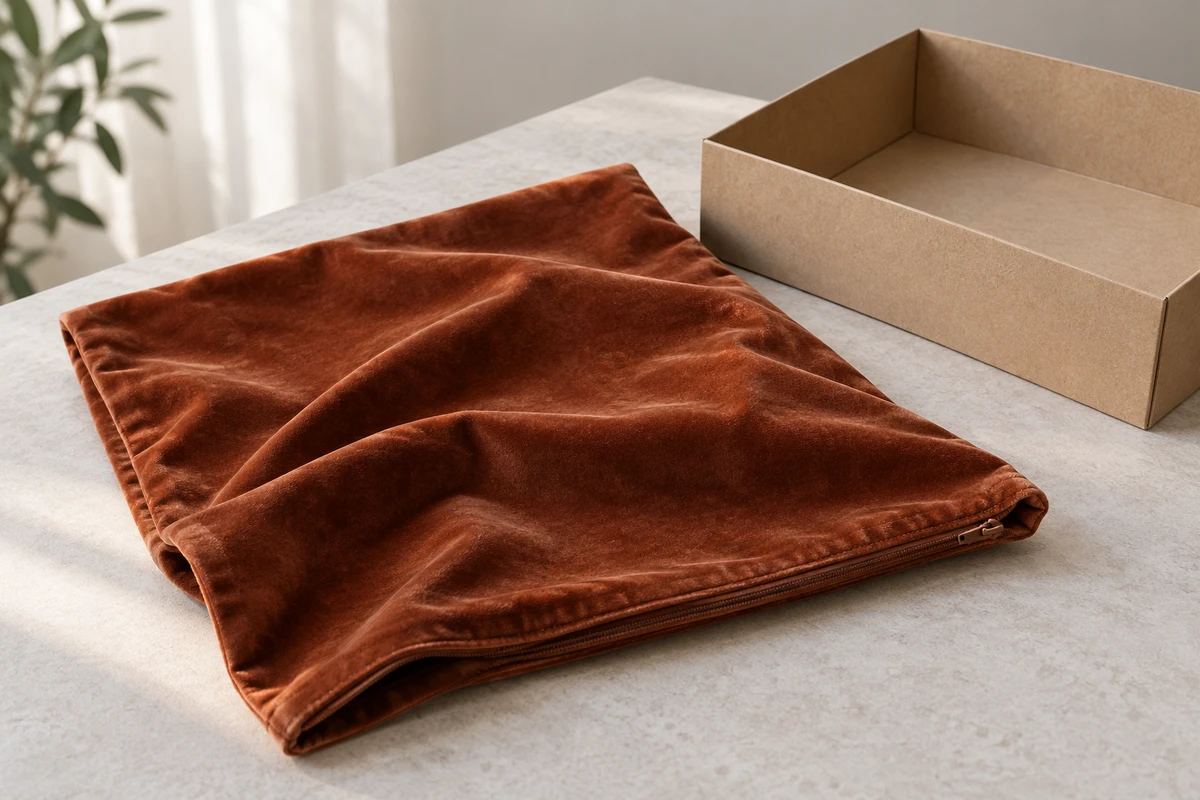
Before accepting a more compact pack for velvet cushion covers, ask what physical state is actually being proposed and how its appearance will be judged after permitted opening. A photograph of a loosely folded empty cover cannot settle a proposal described only as “compressed packing, same finish.” The missing link is the particular cover in the particular pack state.
Keep this decision focused on empty covers. The cover-versus-filled-cushion purchase choice should already be settled. Adding an insert for the approval photograph can obscure the relationship between the proposed cover-only pack and the appearance the buyer is being asked to accept.
Define the state before comparing the picture
Identify the approved cover, colour or appearance variant, front and back construction, and opening position. Name the velvet face clearly where the back uses a different material. “Face inward” becomes ambiguous if the packer and reviewer have different ideas about which surface is the front.
Ask for the proposed fold and any compression to be described against that specific article. Record the pack reference, orientation, required layers and information supplied by the responsible packaging owner. An undefined instruction such as “press flatter” should remain unanswered; the buyer should not invent a pressure, compression ratio or folding method.
The named SANELA cover offers a bounded example of why appearance deserves its own basis. IKEA identifies a zipper on this velvet cover and discusses marks and creases in its care guidance. That does not define acceptable marks for another SKU or establish that a changed pack will recover its prior appearance. IKEA SANELA product and care information
Compare three evidence situations
A documented loose-fold proposal gives the reviewer an identifiable starting arrangement. If it includes a corresponding permitted-opening observation, the buyer can consider the appearance represented by that sample. It still says nothing about a different fold or longer storage condition that was never reviewed.
A documented compressed proposal adds a changed condition. Ask the owner to define it sufficiently for review and to identify the evidence needed for the actual cover and distribution job. Do not let a claim about saving space replace the appearance question. Freight calculations belong in a separate commercial comparison after the pack is adequately described.
An unspecified compact-pack promise cannot be compared meaningfully with either documented state. The appropriate response is a request for the missing proposal, not a rejection of all compact packing or an assumption that every velvet cover behaves alike.
| Proposal | What is represented | What remains open | Buyer’s next decision |
|---|---|---|---|
| Identified loose fold | Named cover, faces and actual folded condition | Appearance under any unrepresented later conditions | Whether its evidence answers the agreed initial requirement |
| Identified compressed arrangement | Specific changed pack state | Applicable opening and appearance evidence | Whether the changed state meets the agreed review basis |
| “More compact, same appearance” | A commercial intention only | Physical arrangement and result | Request a defined proposal before comparing |
None of these descriptions is a universal packing recommendation. Product instructions and responsible packaging review control the physical work.
Write an appearance basis people can use
Name the reference appearance and the review stage. For example, a buyer may want a decision about the empty cover as opened under its approved instructions. That differs from a photograph of a filled display cushion, a treated sample or a supplier’s catalogue image.
Use a consistent agreed viewing basis so that the comparison answers the intended question. Record the actual sample and observation conditions without claiming that a photograph diagnoses the cause of a mark. If lighting, orientation or the sample itself changes between views, say so rather than attributing the difference to packing alone.
Do not add steaming, ironing, brushing or other care treatment to make the proposal meet the reference. A treatment would change the question and needs its own applicable guidance and authorization. Nor should the buyer assume that waiting an arbitrary number of hours closes an unresolved crease. Any required conditioning or interval belongs to the agreed specialist review, with the actual conditions recorded.
Use a pack-state approval worksheet
Complete one worksheet for each materially different proposal. Copy product references from the accepted specification; do not substitute generic fabric swatches for the finished sewn cover.
| Worksheet field | Entry to complete | Decision it supports |
|---|---|---|
| Cover-only reference | Exact empty cover and appearance variant | Which product is being compared |
| Velvet face orientation | Front/back reference and proposed relation to folds | Whether both reviewers mean the same surface |
| Fold and compression proposal | Owner-defined arrangement and revision | Which physical change needs approval |
| Actual mockup condition | Sample reference, represented state and any difference from proposal | Whether the evidence matches the proposed pack |
| Appearance basis after permitted opening | Reference, review stage, conditions and observation record | Which appearance conclusion is justified |
| Approval limits and change owner | Accepted scope, unresolved condition and responsible person | What can proceed and what must return for review |
A row saying “same as previous” should point to an exact previous proposal. If that earlier record describes a filled cushion or another back construction, it cannot silently fill the cover-only row.
A fictional compact-pack request
Imagine fictional cover V1, an empty velvet cover with an approved plain back. Proposal A documents a loose fold and identifies the opened sample used for an appearance discussion. Proposal B says it will be packed more tightly but provides only A’s photograph. All objects and replies in this example are invented.
The buyer retains A as the documented candidate and leaves B pending. This is an evidence decision: A has a defined state, while B has not yet supplied its own. It does not establish that A protects the product in transport or that B will cause marks.
B’s next reply identifies a different fold and compression arrangement, but the returned opened sample contains an insert and uses another cover variant. That evidence still leaves V1’s cover-only appearance unanswered. The buyer requests the actual V1 proposal and the applicable review basis, without directing the supplier to compress the goods according to an improvised method.
Suppose the responsible owner subsequently provides a V1-specific comparison. The buyer can now make a limited decision against its agreed appearance reference, recording any remaining concern. If the review does not settle that concern, keep B pending rather than replacing uncertainty with a promise that marks will disappear. The fictional example ends with a clear evidence requirement, not a manufactured pass result.
Carry the chosen state into the packing record
Record the selected proposal by issue, including the face orientation and agreed appearance scope. If the supplier later proposes a different fold, compression arrangement or contacting layer, return the affected fields for review. An unchanged outer label cannot preserve approval for an altered internal state.
The Homeware textiles category gives broader sourcing context. Submit the cover reference and precise pack-change question through the Homeware sourcing page, using supported marketplace HTTPS links, an 8–1200 character description or permitted images. Up to five PNG, JPEG, WebP or GIF images are supported, limited to 10 MiB each and 20 MiB combined; document files are not. Confirm the provider’s actual review scope. A well-defined request makes the next appearance decision answerable without inventing a recovery guarantee.
Frequently asked questions
Can a folded velvet sample approve a compressed pack?
Only evidence applicable to the actual proposed state can support that decision. A loosely folded cover may provide a useful appearance reference, but it does not demonstrate the result of a different compressed arrangement. Request the specific cover, face orientation, fold and compression proposal, with the relevant owner-controlled review conditions.
Should the buyer wait for packing marks to disappear?
Do not invent a waiting period or assume recovery. Agree what condition and stage the appearance decision covers, and record any interval that actually applies to the review. Manufacturer care guidance for a named cover is not automatic permission to treat an order sample or a promise that its marks will disappear.
Which details belong in a velvet pack-state reference?
Identify the empty cover, material and appearance variant, the two faces, opening location, fold proposal, compression description, required packaging and the actual mockup. Connect the pack reference to the observed opened condition and agreed appearance basis. Keep a drawing’s intended state distinct from a physical result.
When does a packing change require a fresh appearance decision?
A changed fold, face orientation, compression arrangement, cover construction or contacting layer may change the basis of the previous review. Name the changed field and ask the responsible owner which evidence remains applicable. An unchanged outside pack size or photograph of a different colourway is not enough to carry approval forward.
Sources
Discuss a sourcing request related to this article.Approve the Packed State of Velvet Cushion Covers