
Reorder Shoulder Shapers for Selected Retained Hangers
Separate compatible curved hangers from other wardrobe forms, then compare accessory-only quantities with any genuine need for new complete hangers.
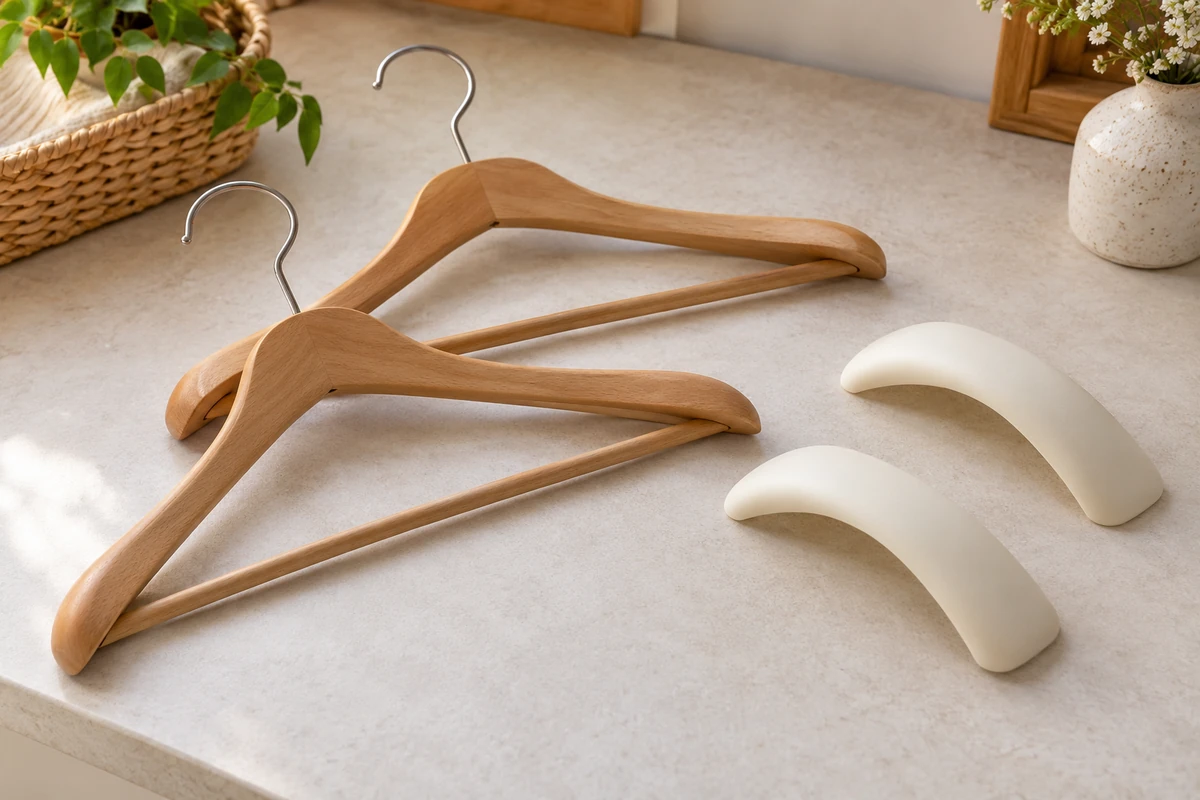
Buy shoulder-shaper accessories for the hangers you have actually selected, rather than for the total number of hangers in the wardrobe. A mixed collection may contain suitable curved hangers, other forms that are outside the accessory’s documented scope, and suitable hangers that do not need a shaper at all. Those are three different purchasing groups.
A shoulder-shaper top-up begins with retained items and an already established accessory match. It asks how many loose accessories to request and whether any complete hangers are separately needed. It does not promise garment protection or assume that adding an accessory makes an unsuitable hanger suitable.
Count the curved-hanger group before counting accessories
Identify the retained hanger reference and shape from existing records. Keep straight, curved, clip and other forms distinguishable even when their colour or maker is the same. Where the reference is uncertain, ask for a product-specific answer rather than treating a familiar silhouette as confirmed compatibility.
Next select the positions that actually need the accessory. The owner may want it on a limited group of existing hangers, while leaving the rest unchanged. That selection is a requirement, not a defect finding about the hangers without shapers. Record the count and intended group without inventing a clothing-care rule.
Separate any new complete-hanger need. An additional wardrobe position without a hanger needs a complete item; a loose shoulder accessory does not supply the hook and hanger beneath it. Conversely, a retained suitable hanger needing only its accessory does not automatically create demand for another whole hanger.
Read the accessory’s named match narrowly
IKEA’s BUMERANG shoulder shaper 702.932.74 is a separate product whose official page identifies the BUMERANG curved clothes hanger as its dimensional match. That is a useful example of a form-specific accessory, not evidence that every hanger carrying a related name can take it. BUMERANG shoulder-shaper product information
For another seller’s goods, request the exact retained hanger and proposed shaper references together. Ask which shape or version the offer covers and what documentation supports the proposed pairing. A reply saying only “for wooden hangers” leaves the specific accessory question open.
Do not infer compatibility from a catalogue photograph of a mixed wardrobe. Nor should a product-family title overrule an explicit shape limitation. If an alternate accessory is proposed, keep it separate until the responsible product-specific review has answered the new match. There is no need to replace the retained hanger’s identity merely to make a quantity sheet balance.
Distinguish one accessory from one selling unit
Ask how many actual shapers are included in the seller’s purchase unit. A listing may describe a single accessory, a pack or a combination containing a hanger too. Write down the contents rather than copying an unexplained “quantity” into the reorder.
Compare accessory-only supply with any complete-hanger bundle offered for the same approved need. The bundle may be a real option, but its additional hangers should remain visible. Do not give those extra items an assumed resale value or call them replacements if the owner intends to retain the existing hangers.
If the seller offers only a larger accessory pack, show the resulting accessory remainder separately from complete hangers. These are different leftovers. A spare shaper may have an identified future use within the same approved hanger group, while a new hanger requires its own actual demand; neither use should be assumed.
Use a wardrobe-specific top-up worksheet
Complete a row for each retained hanger form and another for genuinely new complete items. This original purchasing aid keeps the accessory population small enough to explain.
| Worksheet entry | What to record | Purchase consequence |
|---|---|---|
| Retained hanger shape and reference | Exact curved or other form, with current identification | Defines the population being considered |
| Established shaper match | Exact accessory and product-specific basis | Unanswered pairings remain candidates |
| Hangers selected for a shaper | Count within the matched group | Creates the accessory requirement |
| Other forms excluded | Counts outside the documented match | Do not increase the shaper order |
| Loose accessory purchase unit | Confirmed shapers per actual offer | Converts required pieces into purchase units |
| Complete hangers separately needed | Actual new positions or separately approved replacements | Creates a different order line |
| Resulting extras | Additional shapers and additional hangers, separately | Requires an explicit use or surplus decision |
The selection count cannot exceed the matched retained group without an explanation. If it does, check whether new hangers have been mixed into the accessory row. Also check whether “four” means four accessories or four multipacks before making a commercial comparison.
Fictional wardrobe: sixteen hangers, four accessories
Imagine a wardrobe with ten identified curved hangers and six other hanger forms. For this example only, the selected shaper is already approved for all ten curved hangers. The owner wants it on four of those ten and has no need for additional complete hangers. Every count, approval and seller response in this scenario is fictional.
The requirement is four matched shapers. It is not sixteen shapers, because the six other forms are outside the assumed match and six of the curved hangers were not selected. It is not four new complete hangers, because the selected four already exist.
Suppose fictional Offer A confirms one loose shaper per purchase unit. Four units would answer the stated accessory count. Offer B confirms one new curved hanger with one matched shaper per unit. Four B units would supply the four accessories but also create four additional hangers. No price or availability advantage is assumed for either offer.
The buyer should request both actual totals and decide whether B’s added hangers have a genuine purpose. If the answer is no, leave them as extras in the comparison. A lower-looking bundle price might still be commercially attractive, but the decision must acknowledge the extra goods rather than rewriting the original need.
Now suppose the owner adds two new wardrobe positions. The request changes to four shapers for the retained group plus two complete hangers meeting the new-position brief. It does not become six loose shapers. Any decision to equip the new hangers with shapers must be stated separately, including their actual pairing.
Ask a question the seller can answer precisely
A concise request can identify the retained curved hanger, the selected accessory, the number of retained positions receiving it and any complete-hanger requirement. Ask for contents per purchase unit and a current offer for those exact quantities. Request an explicit alternative if the seller can supply only a bundle.
Keep appearance changes and compatibility changes distinct. A different colour may need the owner’s presentation decision even when the documented match is unchanged. A different shape or model is a new pairing question. Do not let a reassuring colour description conceal that second change.
See Homeware baskets and storage for category context. Use the Homeware sourcing enquiry for a supported marketplace link, a concise description or supported images of the identified items. Confirm the actual coordination scope; the enquiry is not a garment-performance assessment or permission to force an accessory onto an uncertain hanger.
Frequently asked questions
How many shoulder shapers should I reorder for a mixed wardrobe?
Count only the retained hangers with an established accessory match that the owner actually selects for the top-up. Keep other hanger forms and suitable but unselected hangers outside that count. New wardrobe positions needing complete hangers belong on a separate line.
Does a matching hanger brand prove that a shoulder shaper fits?
No. Keep the exact shape and product reference in the pairing record. The named BUMERANG example identifies a curved-hanger match; it does not establish fit to every hanger in that family or another manufacturer’s range. An uncertain pairing needs its own product-specific answer.
Should I buy complete hangers when I only need the shoulder accessories?
Compare actual accessory-only and complete-hanger offers when both are available. A complete bundle can supply the accessory but adds hangers the current requirement may not need. Record those extras and their intended use without assuming resale value or automatic savings.
What should an accessory-only hanger inquiry include?
Identify the retained hanger, matched shaper, number of selected positions and confirmed pieces per selling unit. State any separate need for complete hangers and ask the seller to explain bundle-only alternatives. Keep compatibility, appearance choices and purchase quantities as distinct answers.
Sources
Discuss a sourcing request related to this article.Reorder Shoulder Shapers for Selected Retained Hangers