
Salt and Pepper Mill Handover: Match the Refill and Cleaning Route
Identify what belongs in each mill and preserve its actual cleaning limits before a shared refill note turns specific guidance into an any-spice claim.
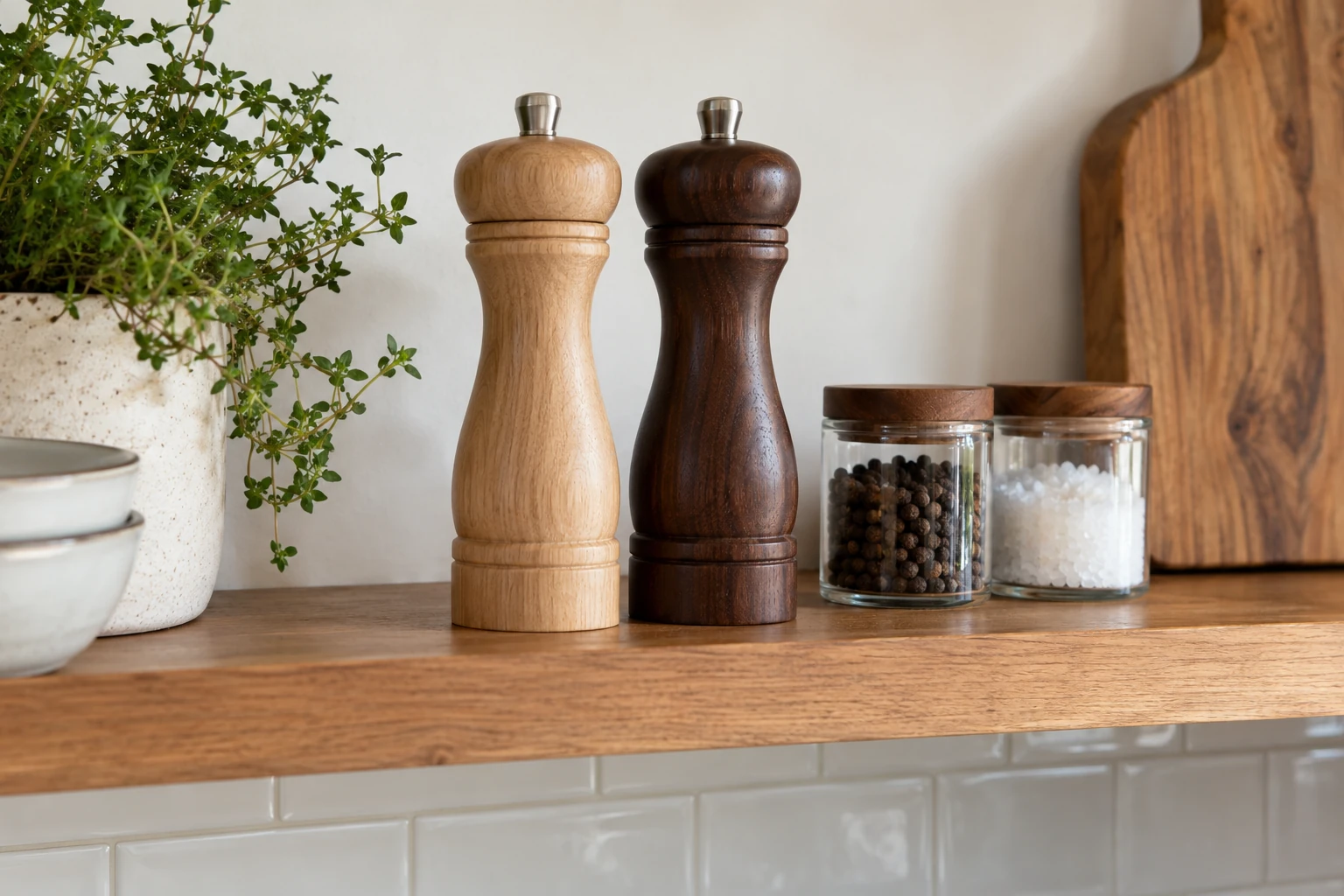
Give each mill a defined purpose before handing over its refill routine. The recipient needs to know which exact mill is intended for which supported ingredient, what refill product is proposed, and which cleaning directions apply. Similar bodies in a matching pair do not make those answers interchangeable.
The handover should explain each mill’s filling and cleaning requirements for the person receiving an empty mill or one returned for care. It is not a grinding demonstration, a mechanism service guide or permission to test an unfamiliar ingredient.
Match the ingredient to the mill’s documented purpose
Identify the maker, full model and supplied variant for each mill. If the purchase contains a matching pair, preserve any product distinction shown in the order and applicable instructions. Colour can help someone recognize an item after its identity is established, but colour alone does not establish the mechanism or approved fill.
Next, describe the ingredient the recipient actually intends to use. Keep its product name and stated form with the original refill information. A request for peppercorns is more specific than a request for seasoning; a proposed blend introduces its own ingredients and characteristics that may not be addressed by a general mill description.
Le Creuset’s Mills guidance names dry peppercorns or salt crystals as fills and specifies exterior wiping while excluding immersion in water. These are bounded directions for the manufacturer’s mills covered by that guidance. They do not establish all-spice compatibility or cleaning permission for a different grinder. Le Creuset care and use, Mills
For the actual product, ask the provider to connect the supplied mill and proposed ingredient to its applicable instructions. Preserve the source’s exact scope rather than turning a list of named fills into “any dry spice.” Conversely, do not invent exclusions for every other ingredient; classify an unanswered alternative as requiring a product-specific answer.
Separate the proposed refill from what is already inside
The intended future ingredient and the current contents are different entries. An empty-product order, a supplier-filled mill and a mill previously used by the household need different identity questions. Record what the available records actually establish without opening or emptying a mechanism to complete this worksheet.
If the current contents are unknown, state that clearly and obtain an appropriate response before treating the mill as ready for the planned refill. A bag pictured next to the mill does not identify what was put inside, and the colour of visible contents cannot supply their product history.
An instruction for initial filling also does not necessarily answer a proposed change of ingredient. Ask whether the actual maker guidance covers that transition and what additional information the responsible person needs. Do not use the handover to invent a purge, grinding trial or internal cleaning procedure.
Keep exterior care and immersion separate
Read which part of the mill the cleaning statement concerns. An exterior-care direction does not answer whether water may enter the mechanism or whether the whole object can be immersed. Retain the relevant prohibition or uncertainty rather than shortening the instruction to “wash after use.”
A request to prepare a mill for a different fill can make this distinction important. The buyer may want the previous ingredient removed, but that desired outcome does not authorize soaking, dismantling or operating the grinder with a cleaning material. Give the exact product and the proposed change to the responsible provider for an applicable answer.
For a household recipient, make the care route visible where the mills are returned after use. The handover can identify the mill and point to its actual instructions without adding an unsupported cleaning recipe. Where those instructions do not settle a necessary care requirement, the planned use remains incomplete.
Use a refill-purpose card for each mill
This original worksheet is deliberately mill-specific. Complete one card per identified purpose, and keep a proposed alternative fill on a separate line so it cannot silently replace the accepted one.
| Card entry | What to retain | Decision it supports |
|---|---|---|
| Mill identity and purpose | Maker, model, variant and intended ingredient role | Which physical item the refill note concerns |
| Supported ingredient description | Applicable maker wording and source | Whether the proposed fill is within the documented scope |
| Recipient’s refill product | Exact product reference and stated form | Whether the refill actually matches that scope |
| Current contents | Documented empty or filled state, with any unknown history | Whether a change-of-fill question remains |
| Cleaning boundary | Exterior, immersion and other relevant care statements | Whether the recipient’s planned cleaning route is covered |
| Alternative requested | Specific different ingredient or transition | What must remain pending rather than become a general permission |
The useful output is a readable connection between one mill and one supported plan. It does not require inventing a spare-parts inventory, a maintenance interval or a table of grind settings. Those additions would distract from the refill decision and could imply instructions that have not been supplied.
A fictional any-spice note
Imagine a fictional household order containing mills M-P and M-S. The matched product guidance identifies their intended dry ingredient roles and excludes immersion. The buyer’s draft handover says “use any spice and soak after use.” All names and circumstances here are invented; no actual mill is filled, cleaned or operated.
The buyer replaces the unsupported summary with references to each mill’s matched ingredient and care guidance. It also records the recipient’s proposed refill products. The intended pepper refill is adequately identified in this fictional record, while a flavoured seasoning blend proposed for the other mill is not addressed by the available instruction.
That creates two different outcomes. The supported ingredient information can accompany the relevant mill, subject to all remaining actual product requirements. The proposed blend stays pending. It is not accepted because its grains appear similar, and it is not tried through the mechanism to see whether grinding is possible.
The household can retain the documented fill plan, request an applicable answer about the identified blend, or look for a different product with guidance covering that desired task. If it chooses the first option, the handover explicitly removes the blend from the current plan. A later change of mind reopens that question rather than inheriting the original answer.
The soaking instruction is removed as well. Resolving the refill identity does not make the earlier cleaning instruction valid. Both parts of the note must match their own source before the recipient is given a usable summary.
Keep the refill choice clear at replenishment
When the refill product changes, compare its identity and stated form with the recorded supported scope. A new package design may be an identification question; a different ingredient or blend is a use question. Ask which changed before deciding whether the previous handover still answers it.
Retain the complete current mill instructions with the short purpose card. If a mechanism behaves unexpectedly or the contents become uncertain, the card supplies identification for the responsible provider; it does not authorize forcing the knob, dismantling the mill or improvising a remedy.
See Homeware kitchenware for category context. Through a Homeware sourcing enquiry, identify the exact mill, the proposed ingredient and the unresolved care question using supported links, text or images. Confirm what supplier clarification is available rather than assuming a compatibility test or servicing commitment.
Frequently asked questions
Can every salt or pepper mill grind any dry spice?
Do not expand named ingredient guidance into an all-spices claim. Identify the exact mill and proposed ingredient, including its stated form, then compare them with the applicable instructions. Leave an unaddressed ingredient or blend pending for a product-specific response. Similar grain size or a successful-looking grind would not establish that permission.
What should accompany a mill when it is handed over?
Give the recipient the mill identity, intended supported ingredient, proposed refill reference and complete current care instructions. Keep any uncertain current contents or requested ingredient change visible. A short purpose card is useful only if it points back to guidance that actually covers the supplied model and does not replace that guidance with a generic refill slogan.
Does permission to clean the outside mean the whole mill can be soaked?
No. Determine which part of the product the instruction covers. An exterior-care statement does not establish immersion permission or an internal-cleaning method. Preserve the actual limitation and ask for model-specific guidance if the desired care task is unanswered. Do not supply a soak, disassembly or grinding procedure as a workaround.
What if the ingredient already inside the mill is unknown?
Record the contents as unknown and ask the supplier or responsible product owner to resolve the history and appropriate next step. Do not infer it from colour, visible grain shape or a nearby refill bag. The intended future fill can be identified separately, but that alone does not make the existing mill ready for a change of ingredient.
Sources
Discuss a sourcing request related to this article.Salt and Pepper Mill Handover: Match the Refill and Cleaning Route