
Cushion Covers vs. Filled Cushions: Compare Landed Cost
Use the same approved cushion, finished count and receiving point for both quotes. Verify the local insert price and fit and the compressed cushion’s recovery before comparing totals.
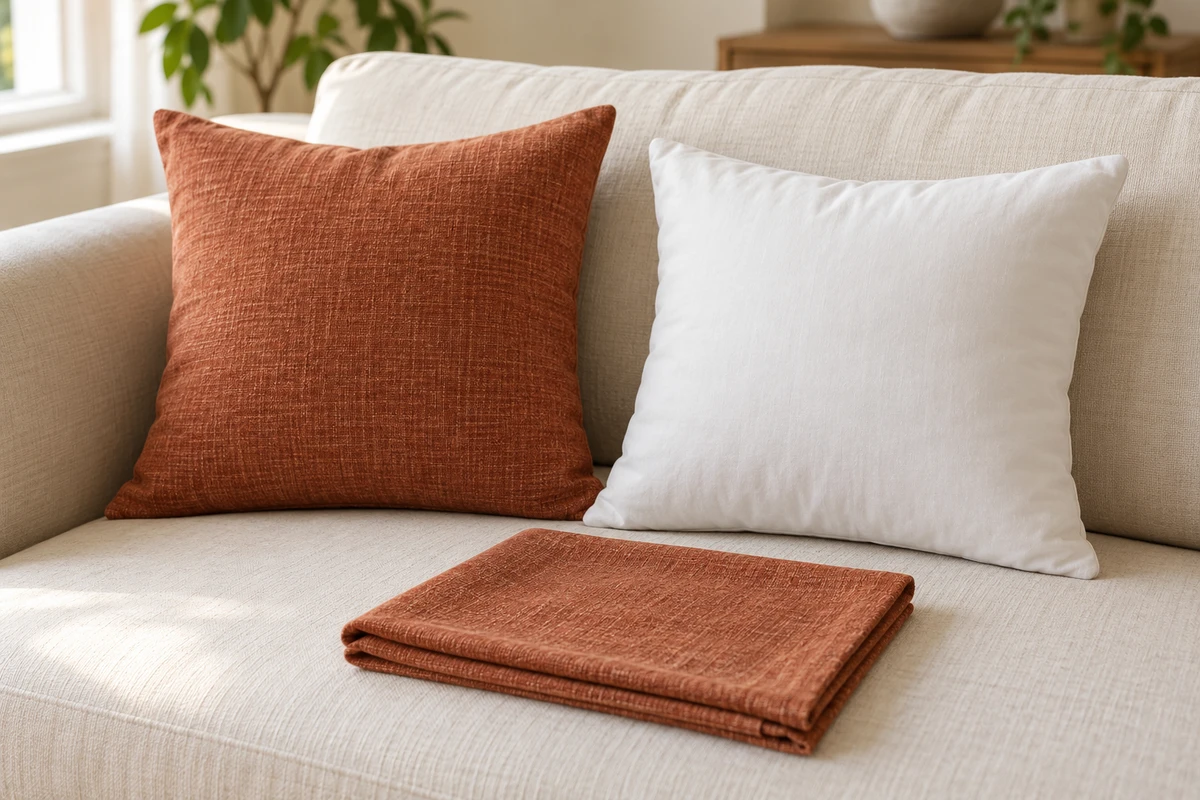
Importing empty cushion covers can move part of the purchase closer to the destination, but it leaves an unfinished cushion to be supplied. Compare that route with importing the approved filled cushions only after the matching local inserts, their delivery and the required completion work are real offers.
The decision here begins with acceptable product combinations already identified. It asks where the inserts should be purchased and what it costs to hand over the same finished cushion quantity. Choosing cover dimensions or deciding whether old inserts remain suitable belongs earlier in the buying process.
Define the finished quantity at one handover point
Record the required cushion count by cover variant and its approved insert pairing. State where the finished combinations are needed and what “finished” includes: inserts fitted, closures in the agreed state, and any required presentation or grouping. The actual provider must confirm any work beyond supplying components.
A cover listing needs careful interpretation. IKEA identifies SANELA 005.911.30 as a cushion cover, shows an inner cushion separately under “Complete with” and states the inner-cushion size it fits. This named example supports distinguishing two purchased components; its dimensions are not a rule for matching another supplier’s product. SANELA product details
Preserve the approved local insert reference alongside the imported-combination reference. If the local choice differs in construction or appearance, document that accepted alternative before comparing its price. A familiar nominal size does not establish an equivalent finished cushion.
Request two actual packed import offers
For the filled-cushion route, request the goods scope, actual completed-pack dimensions and gross weights, transport coverage and delivery point. Confirm that “complete” means the agreed cover and insert supplied together in the specified state.
For the cover-only route, obtain a separate offer and physical packing schedule. Do not subtract the insert’s bare weight from the filled-cushion quote to calculate freight. The outer packs, carton count and chargeable basis can change.
DHL’s UK guidance compares actual with volumetric weight and assesses packages separately. That principle explains why the real packs matter, but its published example is not a quotation for these cushions. Ask the selected provider for the applicable method and the two actual offers. DHL weight and dimensions
Use the offered packing states without assuming compression. Any proposed change needs its own product and packing review. An apparent reduction in volume does not establish restored appearance after opening.
Turn the local insert option into a purchasable line
Obtain a dated local offer identifying the insert, available quantity, purchase multiple, delivery scope and any conditions relevant to holding that quantity. A catalogue page can identify a candidate but cannot reserve the stock for this order.
Ask whether the required quantity can be bought directly or only in a larger pack. If a purchase multiple creates spare inserts, include their actual purchase and delivery costs. Keep the spares visible; they do not increase the required finished cushion count unless the buyer also orders suitable covers.
Check the relationship between insert availability and cover arrival. If the two are to meet at a local workshop, confirm that location accepts both deliveries and identify any required storage or handling. If the buyer will do the permitted completion work, obtain their agreement and record the time or cost basis used. An internal task is still a task even when no supplier invoices for it.
Use a finished-cushion comparison worksheet
Keep quotation currencies, validity dates and delivery endpoints next to the amounts. Do not total unlike currencies without an explicit conversion basis, and leave missing offers open.
| Cost or condition | Complete import | Covers plus local inserts |
|---|---|---|
| Product scope | Approved filled combination and required quantity | Approved covers plus identified matching local inserts |
| Import movement | Actual filled-cushion packs and quote | Actual cover-only packs and quote |
| Destination component purchase | Any expressly required extra | Insert offer, purchase multiple and delivered quantity |
| Completion work | Confirmed supplied state; any remaining work | Named filling and checking owner, scope and actual cost basis |
| Final movement | To the agreed finished-goods handover point | From the local completion point if different |
| Open condition | Missing included component or service | Stock, matching, completion capacity or uncovered delivery |
Define Complete-total as the complete-import acquisition and delivery costs plus its remaining required work. Define Local-total as the cover acquisition and import costs, actual local insert purchase and delivery, permitted completion work and any onward movement. Include other applicable costs on the same verified basis; their treatment may differ between supply routes and must not be assumed equal.
The decision difference is Local-total minus Complete-total. Use actual quotes with each line counted once. A lower cover freight subtotal identifies only one potential saving within that larger comparison.
Twenty fictional cushions and a local pack multiple
Suppose an invented order requires twenty cushions in one approved combination. One offer supplies twenty filled cushions. Another supplies twenty covers, and a local seller offers the approved insert only in packs of six. All counts and seller responses here are fictional; no real availability or price is implied.
Four packs would supply twenty-four inserts. The local route can plan twenty finished cushions and four spare inserts, provided the exact combination and completion work remain approved. Its purchase comparison must include all twenty-four inserts, not twenty times an assumed unit price from the pack.
The first worksheet also lacks a filling owner. Even if the cover freight offer is lower, the local option is not yet a complete proposal. The buyer obtains a scoped completion offer that identifies which twenty inserts will be fitted, how the four spares are handed over and whether finished cushions need another delivery.
If that provider cannot accept the work within the buyer’s actual requirement, retain the complete-import candidate or seek another confirmed completion arrangement. If both options become feasible, compare their complete quoted totals for twenty required cushions. Dividing the local total by twenty-four would incorrectly credit four loose spares as finished cushions.
Keep the next enquiry focused on the missing local step
For Homeware textiles, the relevant question may now be procurement coordination rather than another cover specification. A Homeware sourcing enquiry can summarize the approved combinations, required finished quantity, destination and available local insert offer using supported references or a concise description.
Ask which import-side tasks can be offered and arrange local purchase and completion separately where needed. Do not assume the site supplies inserts locally or provides filling. Choose the route that supplies the agreed finished cushions with its remaining work and costs accounted for.
Worked comparison: 24 completed cushions at one handover
Assume 24 fictional cushions in one approved cover and insert combination. Compare the same final handover and all payable lines you have confirmed. For the cover-only option, request the local insert packs, reasonable delivery scope and assembly as purchasable lines. Ask how a filled sample recovers after unpacking.
In this example the filled option totals CNY 900, or 37.50 per accepted cushion. Covers with local inserts total CNY 864, or 36.00 per accepted cushion. These subtotals use only the lines shown. Confirm the same tax, delivery and packing scope. If the insert fit or all 24 finished units remain unconfirmed, mark that option as pending instead of assuming a completed count.
| Payable line or gate | Imported filled | Covers plus local inserts |
|---|---|---|
| Goods from China | 720 | 432 |
| Quoted logistics to the comparison point | 180 | 120 |
| Local inserts and completion | Included in filled goods | 24 × 10 + 72 = 312 |
| Comparable subtotal per 24 accepted | 900, or 37.50 each | 864, or 36.00 each |
| Acceptance evidence | Finished sample and recovery after unpacking | Exact insert fit, packed covers and completed count |
Frequently asked questions
Does a cheaper cover-only freight quote prove local inserts will save money?
No. Add the actual insert purchase, its delivery, any purchase-multiple surplus, permitted filling work and the final movement to the same handover point. Keep unresolved amounts open. The comparison concerns finished cushions, not the international transport line alone.
Can any local insert with the same size label be substituted?
Use the approved matched combination or obtain approval of a clearly identified alternative. Nominal size alone does not establish the required fit or appearance. This cost comparison begins after that product decision and cannot authorize a substitution to make the local offer cheaper.
How should spare inserts from a pack multiple be counted?
Include every insert that must be purchased and delivered in the local-route total. Show the surplus separately and divide by the required finished cushion quantity when comparing that outcome. Do not assign an invented resale credit or count uncovered inserts as additional finished cushions.
What if our own team will fit the inserts?
Confirm that the team accepts the permitted work, has the required capacity and will receive both components. Record its agreed time or cost basis and any onward delivery. Calling the work internal does not demonstrate that it is available or that the cover-only route is ready to use.
Sources
Discuss a sourcing request related to this article.Cushion Covers vs. Filled Cushions: Compare Landed Cost