
Drinkware Delivery Costs: Budget the Onward Retail Parcel
Separate bulk inbound freight from the actual two-glass or mixed customer parcel, including approved repacking work and a second-leg quote.
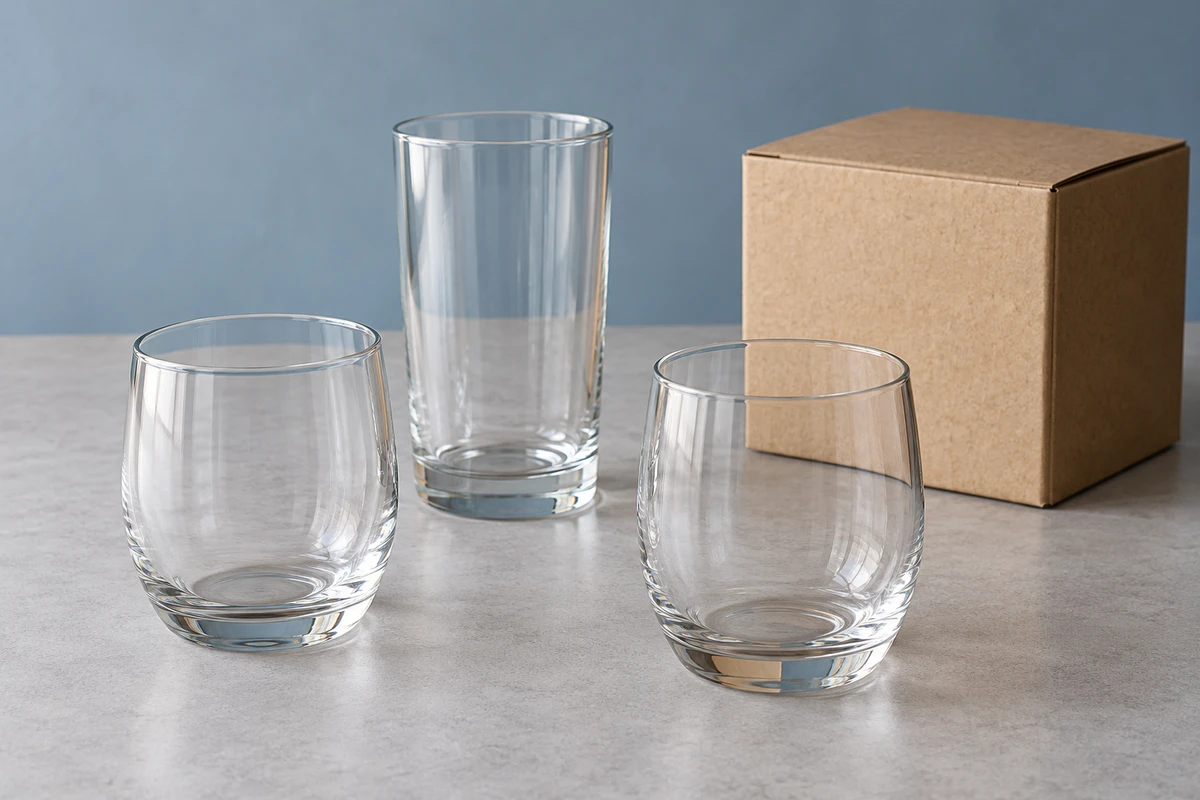
A retailer’s drinkware delivery budget needs two stages when glasses arrive in bulk but leave in smaller customer orders. Dividing the inbound freight by the number of glasses gives an allocation for the first stage. It does not price the parcel that carries two glasses from the retailer to a customer.
Start with the retail order shapes you actually intend to sell. A single glass, two matching glasses and a small mixed order are different fulfilment proposals. Obtain an approved onward pack and a real service quote for each relevant shape before treating delivery as covered.
Separate the stock shipment from the sales unit
Record the inbound bulk assortment and the actual customer-facing offer. If a bulk carton contains one model but customers choose two sizes, identify where the second model enters the order and who performs the pick. If the customer buys an intact retail set, preserve that commercial unit rather than breaking it apart in a cost model.
Do not use apparent physical fit as a cost shortcut. IKEA’s named POKAL glass is described as not designed to be stacked. That exact-model restriction cannot be ignored to make a smaller parcel, nor can it be generalized as a finding about every other glass. POKAL product guidance
Keep the approved product and packing permissions attached to each order shape. This article compares the spending needed for the retail route; it does not prescribe protective materials, cells, thicknesses or a glass-handling trial.
Ask what changes when the bulk carton is opened
The inbound arrangement may be designed around many glasses travelling together. Removing most of them changes the represented configuration. Ask the packaging owner for the actual two-glass or mixed-order proposal rather than treating the partly emptied bulk carton as an approved parcel.
Identify the work between receipt and dispatch: picking the approved references, any authorised retail preparation, packing into the accepted onward configuration and the actual dispatch handover. Ask which tasks are included in the fulfilment offer and which need separate provision. Confirm any material charge from the actual proposal; do not invent a generic packing allowance.
An inbound protective assessment applies only within its stated scope. It is not evidence that a different onward parcel will protect the glasses. Keep the onward review visibly pending until the responsible owner answers it, even if its labour and transport costs are already quoted.
Build cost rows by customer order shape
| Customer order shape | Packing question | Work to quote | Transport question |
|---|---|---|---|
| One approved glass | Actual single-item onward configuration | Pick and authorised packing work for one order | Accepted parcel quote to the intended endpoint |
| Two matching glasses | Actual two-item configuration, respecting model guidance | Work and materials for that specific pair | Full two-glass parcel dimensions, weight and quote |
| Mixed approved glass models | Identified positions and permitted relationships for both forms | Correct-model picking and approved mixed-order preparation | Quote for the actual mixed parcel, not an average glass |
| Intact retail set | Whether its approved retail group remains intact | Any agreed outer preparation and dispatch work | Quote for the complete actual set parcel |
These are alternatives to investigate, not claims that all four packs exist or are approved. Remove order shapes the business does not intend to offer. Where an offer is missing, mark the retail option incomplete rather than filling it with an estimate presented as a price.
Keep allocation and incremental fulfilment apart
For each order shape, record its allocated share of inbound freight separately from its actual onward costs. Then add the quoted pick-and-pack work, authorised materials and second-leg transport needed for the stated endpoint, avoiding duplication where a provider’s price already includes them.
DHL UK’s weight and dimensions guidance illustrates that the packed piece matters to billing. It does not supply the divisor, rate or acceptance conditions for your chosen local service. Use the onward provider’s actual requirements and the dimensions of the onward pack.
The distinction helps answer two different questions. Inbound allocation contributes to the business’s total cost record. The onward rows identify spending and work caused by fulfilling the customer order. Do not count the whole inbound shipment again for every customer parcel, or omit onward work because an allocated inbound figure already exists.
Worked decision: two glasses from a bulk receipt
A fictional retailer receives a bulk carton of approved drinkware and intends to sell two matching glasses per customer order. All quantities and alternatives here are illustrative; no real prices, loss rates or supplier services are supplied.
The initial budget contains only twice the allocated inbound freight per glass. That number says nothing about the two-glass onward pack, the worker who prepares it or the delivery to the customer. The retailer asks a fulfilment provider for the exact two-glass proposal, its work scope and a quote for the actual parcel.
Offer P includes picking and the approved packing work but excludes the second delivery. Offer D supplies an accepted transport quote for the represented parcel. The retailer can combine their stated scopes only after confirming the handover between P and D and checking that the material charge has not been counted twice. If the onward pack’s protective review remains open, the cost record is still conditional.
The retailer also considers offering an intact larger retail set where a separately approved supply and pack genuinely exist. That changes the customer offer and order quantity; it should not be described as a cheaper way to fulfil the original two-glass purchase. Compare it as a separate retail decision with its own demand and complete cost record.
The resulting worksheet may show a viable quoted two-glass route, an unresolved route, or a decision to delay offering that order shape. It should never claim that inbound packaging alone has settled the onward delivery.
Retain the quoted shape as orders change
Refresh the record when the customer mix, glass model, packing revision, dispatch point or destination scope changes. A parcel price for two identical glasses is not automatically valid for two different forms. Keep actual claims terms separate and do not invent breakage percentages to make a preferred option look cheaper.
See Homeware kitchenware for category context. A Homeware sourcing enquiry can describe the inbound assortment and intended onward orders using supported product links, descriptions or images. Ask what coordination can actually be provided; do not assume a local fulfilment or parcel-packing service is included.
Frequently asked questions
Does inbound freight per glass price a two-glass customer order?
No. It allocates one inbound cost but does not price picking, approved onward packing, local work or the second delivery. Use the customer’s actual order shape and endpoint to obtain those missing offers.
Can a retailer reuse the supplier’s bulk carton for onward delivery?
Only if the actual onward configuration is approved for the intended use and separately accepted by the provider. A bulk carton’s existence or an inbound test claim does not establish suitability after its contents change. Do not improvise dividers, nesting or protective materials to reuse a box.
Should I compare individual glasses and small sets separately?
Yes, when those are genuinely offered customer choices. A single glass, two matching glasses and a mixed-model order can require different approved parcel configurations and work. Keep each shape’s complete quote rather than multiplying a single-glass estimate.
Can I include an assumed breakage percentage in the parcel budget?
Do not invent a loss rate or describe a hypothetical percentage as evidence. Use actual agreed commercial terms and any relevant verified records if available. Protective suitability and claims arrangements remain separate from the arithmetic.
Sources
Discuss a sourcing request related to this article.Drinkware Delivery Costs: Budget the Onward Retail Parcel