
Keep Damaged Drinkware Out of Fit and Stacking Checks
Keep visibly damaged glasses out of further checks, preserve unit-specific evidence and apply exact-model stacking restrictions to apparently intact units too.
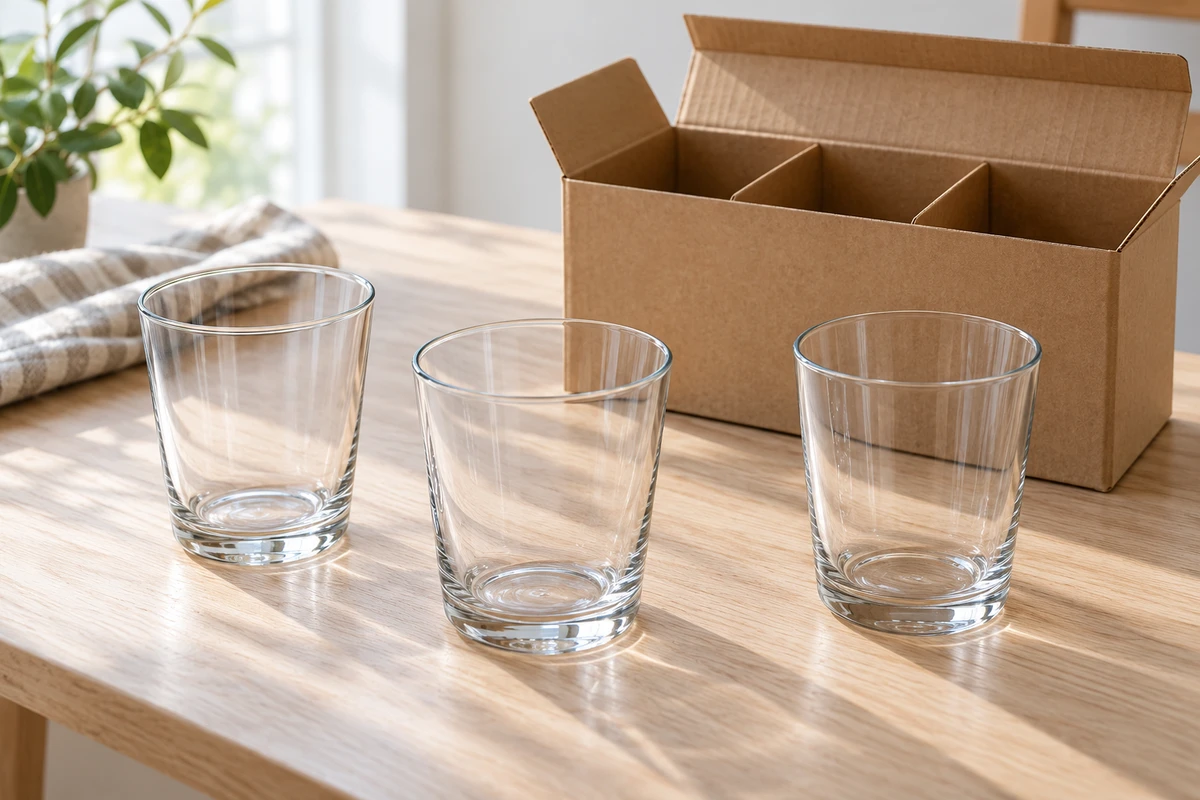
A received drinking glass with visible damage should leave the ordinary fit-and-stacking sequence immediately. Keep its identity and location clear without touching the suspect area, then ask the responsible person for a safe disposition. An apparently intact glass has a separate question: do this exact model’s instructions allow the proposed handling at all?
These two decisions should stay independent. Finding one damaged unit does not establish the condition of every glass in the order. Equally, finding no visible damage on another unit does not authorize stacking, prove suitability for drinks or turn an ordinary receiving observation into safety certification.
Let the model instructions settle the stacking question first
Read the supplied product reference and current model-specific handling guidance before planning to nest or stack glasses. Check the exact item identifier, size and variant. A general glassware catalogue, a photograph of a similar shape or a seller’s description of the series may not describe the delivered model.
IKEA’s POKAL glass 102.704.78 provides a concrete example: its official page says the glasses are not designed to be stacked and warns against using damaged, scratched or chipped glass. Those instructions belong to that named model. They are not a basis for declaring every glass stackable or unstackable. IKEA POKAL product guidance
For a model whose instructions prohibit stacking, omit that activity even when a received unit looks intact. For a model with no clear instruction, record stacking permission as unresolved and ask the manufacturer or responsible product reviewer. “We have always packed them that way” does not answer which handling the actual product permits.
A request to save shelf space or reduce carton volume should not change this sequence. If the intended retail or storage arrangement depends on stacking and the ordered model prohibits it, that is a purchasing mismatch to resolve. Repeatedly trying the arrangement cannot make the model suitable for the requirement.
Describe the visible condition without tracing an edge
Maintain the connection between each observable glass and its package or receiving location before similar units are mixed. Where individual markings are absent, a carton and compartment reference can help the supplier understand which item the observation concerns. Do not reach into uncertain packaging merely to produce a complete identification photograph.
Use only ordinary observation of safely accessible items within the product instructions and agreed receiving scope. If a chip, crack, scratch or questionable line is visible, describe its location and what can be seen. Do not run a finger or fingernail around the rim, rub two rims together, tap the glass or apply pressure to decide whether the mark matters.
An uncertain line can remain uncertain. Write “visible line on the sidewall; unable to determine its nature by ordinary observation” rather than choosing a harmless explanation. The next step is a scoped response from the appropriate person, not an improvised experiment or an assurance that the glass will probably be fine.
If damage makes movement uncertain, stop handling and identify the location for personnel responsible for safe handling. A damage hold is a decision to keep the item out of use and further checks; it is not an instruction to pick it up, repack it or discard it yourself. Follow the applicable handling procedure for the setting.
Preserve enough context for a useful damage response
The supplier needs to know which glass and which arrival condition are being discussed. Safe photographs may include the accessible carton label, the overall packing arrangement and the visible issue from a distance or angle that does not require touching the suspect area. A photograph cannot be worth a new handling risk.
Connect each image to the item or compartment reference in the written message. Keep the original view if an annotated copy is used to point out the location. Do not stage a fresh stack, remove fragments or place a finger beside the damage to make it easier to see. When a useful view is unavailable, state that limit plainly.
Keep observation and cause separate. “Chip visible when this compartment was opened” describes the receiving event. “The carrier broke it” attributes a cause that needs other evidence. Exterior carton condition, packing arrangement and arrival timing can be relevant context, but no single photograph necessarily establishes when or how the damage occurred.
Use a hold sheet with a separate handling decision
This original editorial worksheet helps keep damaged units and model restrictions visible in the same conversation. It supplies no defect percentage, sample size, test procedure or universal release rule.
| Record | What to enter | What remains a separate decision |
|---|---|---|
| Glass and model identity | Item code, size/variant and carton or compartment link | Whether the document actually covers this model |
| Visible condition | Unit-specific location and plain observation | Whether uncertain features require further assessment |
| Safe photo reference | Image ID, view and any missing context | Whether another view can be obtained safely |
| Model handling guidance | Exact document and relevant restriction | Whether a proposed stacking activity is permitted |
| Hold scope | Identified affected unit or area; any uncertainty about other contents | Scope of additional assessment decided by the responsible person |
| Disposition owner | Who answers the damage question and who approves the outcome | Return, replacement or other handling under agreed terms |
Keep “no visible damage observed” distinct from “not examined.” If several units were inaccessible, do not put them into the intact count. If a carton cannot safely be opened further, state that the contents remain unresolved. A count of photographs is also not necessarily a count of distinct glasses; multiple views may show the same item.
A fictional arrival with eight observable glasses
Imagine an invented order whose packing list describes 24 glasses of model G-4. During an agreed ordinary receiving review, eight identified glasses can be viewed safely before further handling stops. One has a visible rim chip, one has an uncertain sidewall line, and six show no visible damage in the views obtained. All quantities, codes and events are fictional.
The chipped unit is held out of use and fit checks. The unit with the unexplained line is also left unresolved for a responsible assessment; the receiver does not scrape it or fill it to see what happens. The record identifies both locations without requiring another lift or a closer touch.
The remaining six glasses are described only as having no visible damage in those observations. The packing list’s 24 does not become an inspected count, and the unexamined balance is not assumed intact. The buyer asks the responsible reviewer to determine the next safe receiving scope rather than inventing an acceptable damage rate from eight views.
Now suppose the exact G-4 instructions say it must not be stacked. A colleague proposes using two of the apparently intact glasses to check whether the intended display stack works. The activity is omitted because the model instruction already answers that handling question. A successful-looking stack would not override it.
The supplier’s response may address replacement of the chipped unit while leaving the sidewall line and the display requirement unanswered. Keep all three outcomes explicit: the agreed remedy for the identified damage, the remaining assessment question, and the model’s incompatibility with the proposed stacking arrangement. Replacing one glass does not resolve the display plan.
Close the issue without broadening the conclusion
Ask the supplier for a response tied to the identified items and actual remedy terms. Confirm who is responsible for any next handling step before movement, repacking or onward transport. This article does not prescribe disposal or promise a refund, replacement, inspection service or claim outcome.
If the intended business use depends on a different handling capability, obtain an identified alternative and its applicable guidance. Do not let a substitute inherit the original model’s record, and do not copy another manufacturer’s care claims into the proposed product description.
Explore Homeware kitchenware for category context, then start a Homeware sourcing request with the exact drinkware reference and unresolved requirement. The form accepts up to five PNG, JPEG, WebP or GIF images, at most 10 MiB each and 20 MiB in total. Use only safely obtained views; arrange original documents and any physical receiving work separately within an agreed scope.
Frequently asked questions
Can I use an undamaged-looking glass to check a proposed stack?
Only ordinary handling permitted for the exact model can be considered within the agreed scope. If the instructions prohibit stacking, omit it regardless of appearance. If permission is unclear, leave the question unresolved and ask for model-specific guidance. One successful-looking arrangement cannot override a restriction or prove future handling performance.
How should I check whether a rim mark is a chip?
Do not trace the rim with a finger or fingernail, rub it or apply force. Record what is visible from a safe viewpoint and keep the item out of use or further fit checks while the uncertainty is addressed. A responsible person should decide the next safe assessment and handling step; uncertainty does not require a homemade test.
Does one chipped glass justify calling the whole carton damaged?
Describe the identified damage and the scope actually observed. Other units may be unexamined or inaccessible and should remain unresolved rather than counted as intact. If the packing area may contain damage that makes further handling uncertain, stop and have the responsible person determine the hold and assessment scope. The article supplies no lot-level acceptance rate.
What should the first supplier message include?
Give the exact model, carton or compartment link, visible issue and safe photo references, with the observation date and any limits. Separate the event you observed from an unproven cause. Ask for an item-specific response and the applicable remedy or handling instructions; do not assume that a photo alone establishes carrier responsibility or an automatic refund.
Sources
Discuss a sourcing request related to this article.Keep Damaged Drinkware Out of Fit and Stacking Checks