
Inspect Both Cutting-Board Faces Before Use
Compare the delivered board’s intended faces, groove, edges and feet before use, without turning a visual check into a grip or hygiene claim.
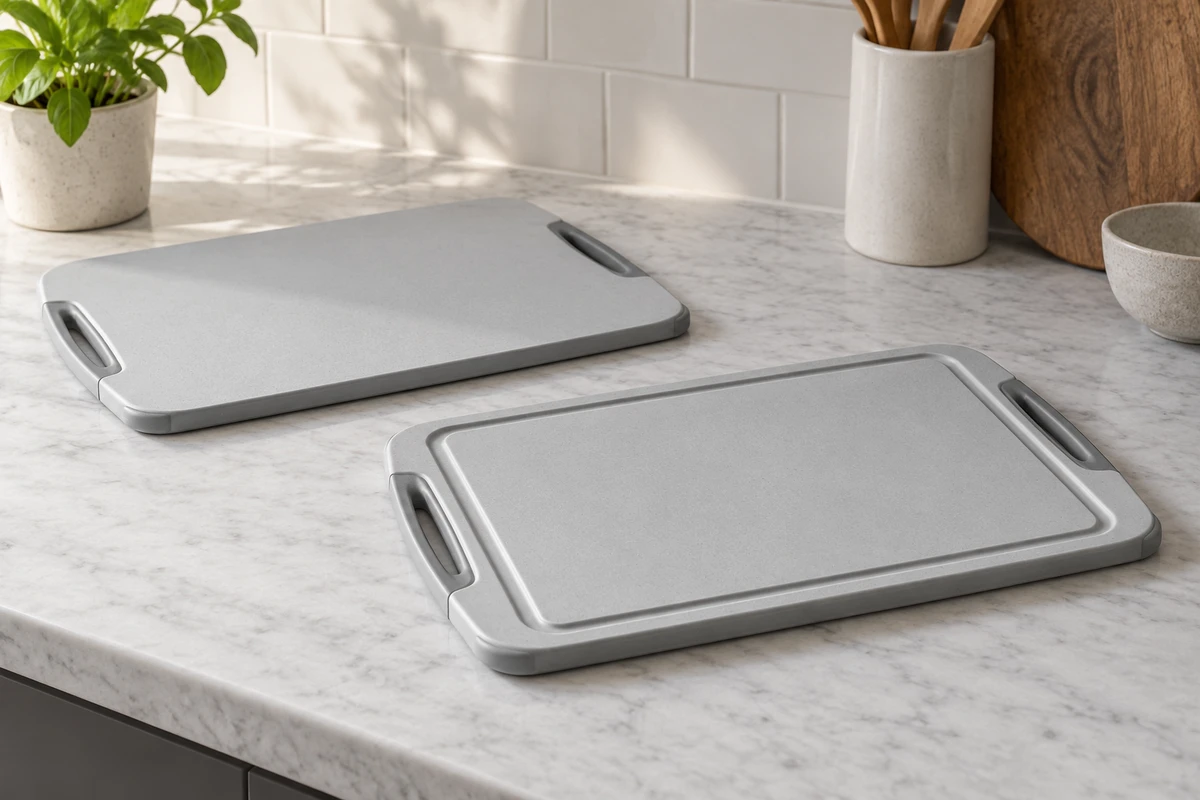
A cutting board can arrive with an intact-looking upper face and still differ from the approved product underneath. Before first use, identify the intended purpose of each face and compare the visible groove, edges and support features with the agreed configuration. The useful decision is whether this board matches that configuration or needs to remain on hold for a specific discrepancy.
Keep the observation before food preparation, cutting or cleaning trials. Ordinary permitted handling can reveal a missing feature; it cannot establish grip, hygiene or knife performance. If visible damage makes handling uncertain, stop rather than turning or pressing the board to investigate.
Give each face a name that survives turning the board over
Use fixed identifiers from the approved product reference, such as “solid face A” and “grooved face B.” “Top” and “bottom” can change when a board is turned, making a later photograph ambiguous. Link both face descriptions to the same received board and variant.
OXO’s Carving and Cutting Board 11272900 provides a named example of why the distinction matters. Its product details describe different solid and grooved faces, tapered handle edges and feet. Those details describe that OXO model, not the configuration or performance of another seller’s board. OXO Carving and Cutting Board details
For the actual receipt, establish whether both faces are intended working surfaces and which features belong on each. A flat-looking underside is not enough to declare it usable for cutting. Conversely, a specified grooved face should not be recorded as a defect simply because the other face is solid. If the order reference shows only one side, ask for the missing configuration information before concluding that the delivery matches.
Read the surface as a set of locations
Look at each accessible intended face under the agreed ordinary viewing conditions. Describe visible marks by location: central face, groove channel, groove outlet if specified, edge beside the handle, or another identifiable region. A broad “surface damaged” entry gives the supplier little basis for answering which feature is affected.
Keep a local mark separate from the feature’s overall shape. For example, a visible interruption in a groove edge is different from the groove following a different route from the approved drawing. One is a condition observation; the other may be a configuration discrepancy. Neither should be resolved by claiming that the groove “still works” without appropriate evidence.
Do not trace a suspect edge with a finger or insert anything into a groove to judge it. Use a safe existing view and leave inaccessible areas unexamined. Do not cut food, scrape the surface, apply cleaner or attempt to remove a mark as part of this arrival review. These actions can change the very condition the buyer needs to assess.
Make feet and support features part of the received product
Compare the specified number, positions and visible form of feet or other support features with the approved reference. Some designs may have different support arrangements; use the actual product specification rather than borrowing a pattern from a familiar board.
Distinguish “present in the reviewed view,” “not visible from this view,” and “specified feature appears absent.” A cropped photograph that omits one corner cannot establish absence. An identified view of the expected location may support a discrepancy report, but it does not reveal why the feature is missing or whether the remaining supports are adequate.
Describe a visible support feature that appears detached or out of its specified position without trying to reseat it. Do not pull, twist, peel or remove feet to investigate attachment. A repair proposal needs separate authorization, product instructions and review; pressing a loose component back into place would conceal the as-received state.
Handle edges deserve their own comparison where they form part of the approved design. Record visible damage or a configuration difference without treating a comfortable-looking contour as proof of handling performance. The whole board, including its underside features, is the supplied article.
Keep at-rest seating observations modest
If the product instructions and safe ordinary handling permit placing the intact board in its intended orientation, note how it sits at rest on the identified surface. Record which face is upward, the surface used and anything plainly visible. Do not press alternating corners, deliberately rock, flex, slide or load the board.
A visible gap or seating concern is a question to resolve, not a diagnosis of warpage. The limited view may not establish the cause or the relevant acceptance criterion. Write “visible gap at the identified location in this orientation” rather than inventing a flatness tolerance or calling the board non-slip.
If that observation cannot be made safely or is outside the agreed scope, enter “not observed.” The buyer can ask the responsible reviewer what additional product-specific evidence is needed. An unanswered seating question should remain unanswered even when the other face looks satisfactory.
Use a face-and-support worksheet
Keep the actual board reference, approved configuration and permitted observation scope at the top. The worksheet below is an original editorial aid for this receiving decision, not a physical test procedure.
| Area of the received board | What to compare | What to record | What remains unproven |
|---|---|---|---|
| Solid face A | Approved purpose and visible layout | Identified face view and local condition | Cutting behaviour, hygiene and durability |
| Grooved face B | Specified groove path and face purpose | Location of any visible interruption or discrepancy | Liquid capacity or containment performance |
| Groove and outer edges | Accessible appearance against the reference | Exact region; stop if damage makes handling uncertain | Cause of the mark or edge safety from a photograph |
| Feet or support features | Required count and locations | Present, not visible or apparently absent at each location | Grip, attachment strength and adequacy of remaining feet |
| Handle or handling edges | Specified geometry and visible condition | Which edge and which observed difference | Handling strength or comfort in use |
| At-rest orientation | Permitted configuration and stated surface | Observation only, or not observed | A flatness diagnosis or slip-resistance result |
Give an unresolved row a specific next question. “Confirm the feature required at the rear corner shown in image B2” is more useful than “please confirm quality.” Keep any supplier answer attached to that board and configuration instead of accepting a generic photograph of another model.
A fictional missing foot hidden by a good top view
Imagine a fictional board B7 whose approved reference specifies a solid face, a grooved face and four support feet. An arrival photograph shows the grooved face clearly, with no recorded visible discrepancy there. An ordinarily accessible underside view of the same board shows three feet and an empty location where the fourth is specified. These identifiers, counts and observations are invented.
The first photograph supports only its face-specific observation. It cannot establish the full board’s completeness. The receiving note should identify the apparently absent foot, link the underside view to B7 and hold that board’s configuration decision. No claim is made that three feet provide enough support or grip.
Suppose the supplier replies that the three-foot arrangement is a newer version. Ask for the exact revised configuration and whether a substitution was authorized for this order. That explanation may clarify the supplier’s proposal; it does not make the original four-foot requirement disappear. The buyer must decide how the alternative is to be handled.
If the supplier instead proposes sending a loose replacement foot, do not assume the receiver should attach it. Resolve the remedy and any authorized work separately. Until the relevant decision and evidence are complete, the missing-feature question remains open. The example does not call for trying the board with a knife to see whether the difference matters.
Close the configuration question without overstating it
A useful outcome names the faces and features reviewed, the discrepancy or match found, and any area that could not be observed. Keep appearance and completeness decisions separate from the material, food-contact, care and performance evidence required for the actual product.
See Kitchenware for wider buying context. In a Homeware sourcing request, identify the board, approved face arrangement and unresolved feature, using a supported product reference, text or image preview. Agree any additional inspection or remedy work explicitly; a clear photograph does not itself commission a test or establish a supplier commitment.
Frequently asked questions
Does an unmarked upper face establish that the cutting board is complete?
No. The approved configuration may include features on the other face and around its edges, including feet or handles. Identify both intended faces and compare accessible support locations. A top-only photograph can support a limited observation while leaving the underside and the complete configuration unresolved.
What should I write if a board seems uneven at rest?
Describe only what was observed, including the board identity, orientation, surface and visible location of the concern. Leave the cause and acceptance decision open. Do not press, rock or flex it to diagnose warpage, and do not introduce a universal flatness allowance that was never agreed for the product.
Can I use the board on the other face while a missing foot is being resolved?
Do not infer that an alternative orientation resolves the discrepancy. Refer to the exact product instructions and the responsible decision about the affected board before use. A different face may be an intended working surface, but that alone does not establish that the incomplete support arrangement is acceptable.
What if a mark disappears after cleaning?
This receiving method does not call for a cleaning trial. Preserve the as-received observation and ask how the specific concern should be assessed under the product instructions and order terms. Cleaning can change the condition under review, while a changed appearance would still not establish hygiene, material identity or long-term performance.
Sources
Discuss a sourcing request related to this article.Inspect Both Cutting-Board Faces Before Use