
Order Lint-Roller Refills by Rolls and Sheets, Not Handle Count
Convert lint-refill packs into rolls and labelled sheets, keep new handles separate, and avoid treating sheet counts as cleaning-session promises.
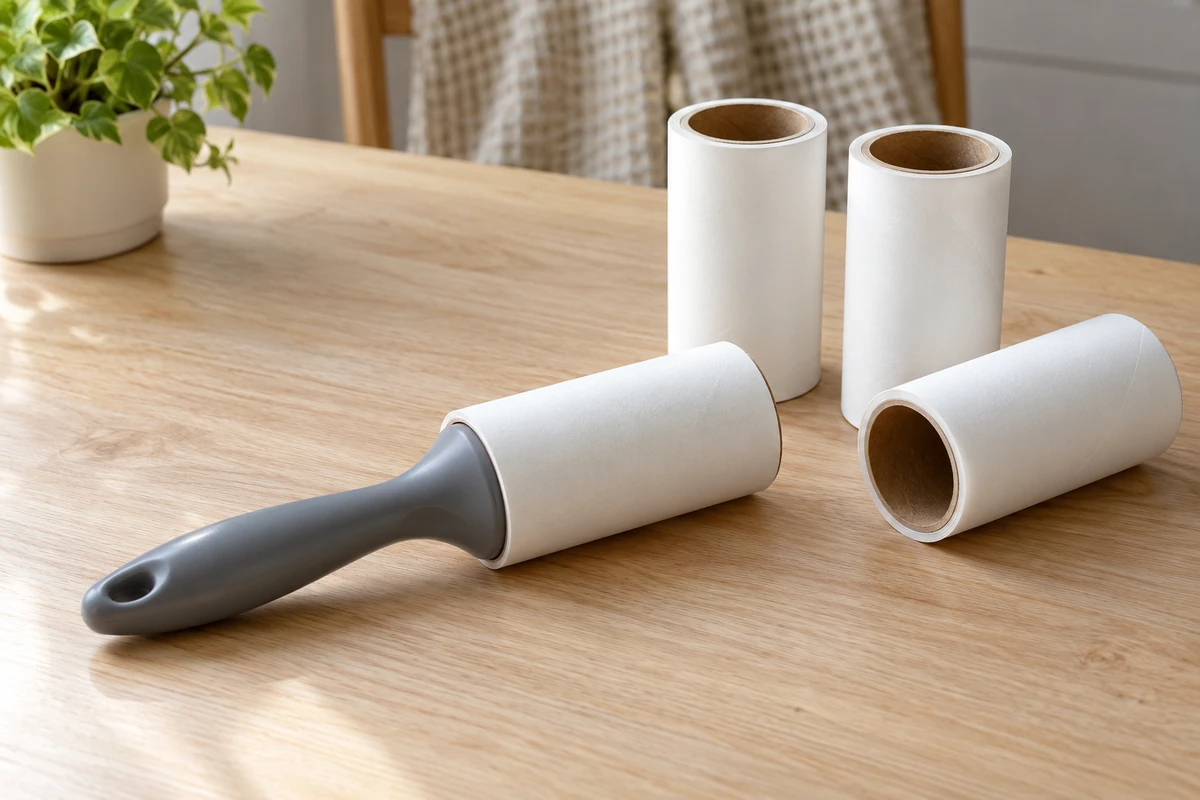
Compare lint roller refill packs in three clearly named units: purchase packs, refill rolls and labelled sheets. Keep handles on a separate line. A household with enough compatible handles may need several rolls without needing another complete roller, while a large sheet total says nothing by itself about how many cleaning sessions the purchase will cover.
The first decision is whether the proposed refill belongs to the retained handle family. Only then is it useful to convert packs into rolls and sheets. A well-counted incompatible refill remains the wrong purchase.
Identify the retained roller before comparing quantities
Use the handle’s known product reference and the maker’s matched refill information. Preserve different handle families separately. Do not assume that two rolls of similar width, or two items called standard lint roller, share the same intended pairing.
IKEA’s BÄSTIS refill 301.411.26 is described for BÄSTIS lint rollers. The official listing specifies four rolls, with 60 sheets on each roll. This supplies a concrete named pack format; it is not a universal definition of a refill pack. BÄSTIS refill contents
For another seller, obtain its own handle association and quantities. A title borrowed from a marketplace search result is not enough if the actual selected variant has different contents. Ask whether the quoted item is a refill-only pack or includes a complete handle-and-roll product.
Keep unidentified handles outside the matched refill count. Seek their model-specific answer rather than planning a physical adaptation. This article provides no modification or fitting procedure.
Preserve pack, roll and sheet as separate units
A purchase pack is the seller’s orderable unit. A roll is the replaceable consumable unit. A sheet is the labelled subdivision on that particular roll. Write all three even when one listing makes the conversion look obvious.
For a verified pack, total rolls equal packs purchased multiplied by rolls per pack. Labelled sheet total equals those rolls multiplied by sheets per roll. Use those calculations only for a uniform, confirmed format. A mixed pack with different roll counts or sheet counts needs its individual contents expanded first.
Do not combine roll length and sheet count as if they were interchangeable without a supported conversion. Likewise, a package labelled 240 sheets may contain several rolls or one different product format. The total alone does not tell you what can be placed with each retained handle.
Keep the unit in informal messages as well as in the worksheet. “Please order eight” could mean eight packs, eight rolls or eight complete rollers. A short request such as “eight compatible refill rolls, supplied as two packs of four, no new handles” closes that ambiguity.
Separate handles from consumable demand
Count additional complete roller positions independently. A new storage location may need a handle and its initial roll; an existing position may need only replenishment rolls. The buyer should decide the actual arrangement rather than automatically buying one handle for every roll.
When a complete roller comes with an initial roll, describe that inclusion separately from the refill-only purchase. The initial roll can count toward a total planned roll requirement only if the requirement was defined to include it. Otherwise, record it as the starting consumable for the new position and leave the existing refill need unchanged.
This small distinction prevents two opposite errors. One buyer may add an unnecessary refill for a roll already included. Another may deduct the new position’s initial roll from the old positions’ refill requirement, leaving the old requirement short.
Use a roll-and-sheet purchase worksheet
The worksheet is an original commercial counting aid. It does not forecast cleaning performance or decide product suitability for a fabric.
| Field | What to record | Decision it supports |
|---|---|---|
| Retained handle family | Exact model and current matched refill reference | Is this the intended consumable? |
| Actual requirement | Refill rolls needed for the identified positions | Keep new handles out of refill demand |
| Rolls per pack | Seller-confirmed contents for the chosen variant | Convert the order unit to usable roll units |
| Sheets per roll | Labelled count, or explicitly unknown | Compare stated consumable quantities |
| Packs to purchase | Actual offered increment and resulting roll total | Show any extra rolls bought |
| Complete rollers | Separately needed handle-and-roll units | Avoid duplicating or omitting initial rolls |
| Next review evidence | Actual use and remaining identified rolls | Update demand without a fixed life assumption |
If the seller confirms rolls but not sheets, a roll-based comparison may still be possible for the same approved item. Keep the sheet comparison unavailable. An unknown field should not be filled from a similar page or an older pack solely to finish the table.
Fictional purchase of eight refill rolls
Suppose a household already has every handle it needs, all identified as compatible with the named BÄSTIS refill. It has a separately established requirement for eight replacement rolls. These household conditions and the purchasing decision are fictional; the four-roll, 60-sheet format is the named product information cited above.
Two packs provide eight rolls. Eight multiplied by 60 gives 480 labelled sheets. The order should therefore read two refill packs, eight rolls in total, no new handles. It should not read eight rollers or 480 cleaning sessions.
A second fictional seller offers a compatible format of three rolls per pack, with 70 labelled sheets per roll. Three packs would provide nine rolls and 630 labelled sheets. That offer adds one roll beyond the eight-roll requirement. A larger sheet count does not automatically make it preferable: compatibility, actual available terms and the buyer’s need still govern the choice.
The buyer keeps the first format as the exact-count candidate and the second as a surplus-bearing candidate. A financial comparison waits for actual complete offers. This example assumes no price, shipping charge, stock reservation or equivalence of cleaning performance between the two formats.
Now imagine one new handle is required for a separate position. The buyer requests that complete roller on its own line and asks whether its initial roll is included. The original eight-roll requirement remains intact unless the buyer explicitly revises its scope. Adding a new handle should not silently turn eight refill rolls into seven.
If the proposed second seller cannot establish handle compatibility, remove it from the ready-to-compare candidates. Its attractive arithmetic is not a reason to order a trial quantity for adaptation.
Do not turn sheet count into a service-life promise
A sheet total measures labelled consumable quantity, not the number of garments, rooms, sofas or sessions that can be completed. The household may use different amounts for different permitted tasks. No sheets-per-job assumption is established here.
Record actual roll use over a meaningful household period if it will help the next purchase. Note any change in the number of positions or routine that makes the period unrepresentative. That record can support a later requirement without declaring a universal monthly order or borrowing a subscription default.
Keep remaining unopened rolls and partly used rolls distinguishable. A partly used roll should not be counted as a full 60-sheet roll merely because that was its original label. If the remaining amount is unknown, retain it as partly used rather than inventing a precise sheet balance.
The named BÄSTIS page also specifies dry storage. Use the applicable instructions for the actual item when deciding whether a larger refill purchase fits the household’s storage arrangements. The comparison gives no shelf-life period or performance assurance for stored rolls.
For broader textile-related buying context, see Homeware textiles. A Homeware sourcing enquiry can identify the handle family and request the exact refill pack, roll count and labelled sheets per roll. Eligible marketplace links, concise descriptions and supported images can carry those details. This accessory example does not establish a separate cleaning service or a sourcing capability for every roller system.
Frequently asked questions
How many lint-roller refill packs give me eight rolls?
Divide the eight-roll requirement by the confirmed rolls per pack and use the seller’s actual purchase increment. In the named four-roll format, two packs give eight rolls. Keep compatibility established first and record the unit explicitly. A different seller’s pack may contain another number, so a familiar product category does not supply the conversion.
Does 480 lint-roller sheets mean 480 cleaning sessions?
No. It is a labelled consumable quantity, not an established task count. Use per task depends on the actual permitted routine, and no universal sheets-per-job rate is supplied here. Keep sheet totals separate from household demand, and use actual usage records if they will help decide the next refill quantity.
Should new roller handles be included in the refill quantity?
List additional complete rollers separately and ask whether each includes an initial roll. Define whether the overall roll requirement includes those initial rolls before deducting anything. A household with enough handles may need only refills, while a new position needs its own complete-tool answer. Do not let one purchase line silently cover two different requirements.
How can I compare packs with different roll and sheet counts?
Confirm the retained-handle match, rolls per pack and labelled sheets per roll for each actual offer. Show how many packs cover the required rolls and what extra rolls are purchased. Compare real complete prices and terms separately. A larger sheet total neither establishes equivalent performance nor proves that the surplus-bearing format is better for the household.
Sources
Discuss a sourcing request related to this article.Order Lint-Roller Refills by Rolls and Sheets, Not Handle Count