
Planter RFQ: Match the Inner Pot, Drainage and Saucer
Specify nursery-pot fit, the hole or no-hole variant and the matching saucer before comparing complete planter quotes.
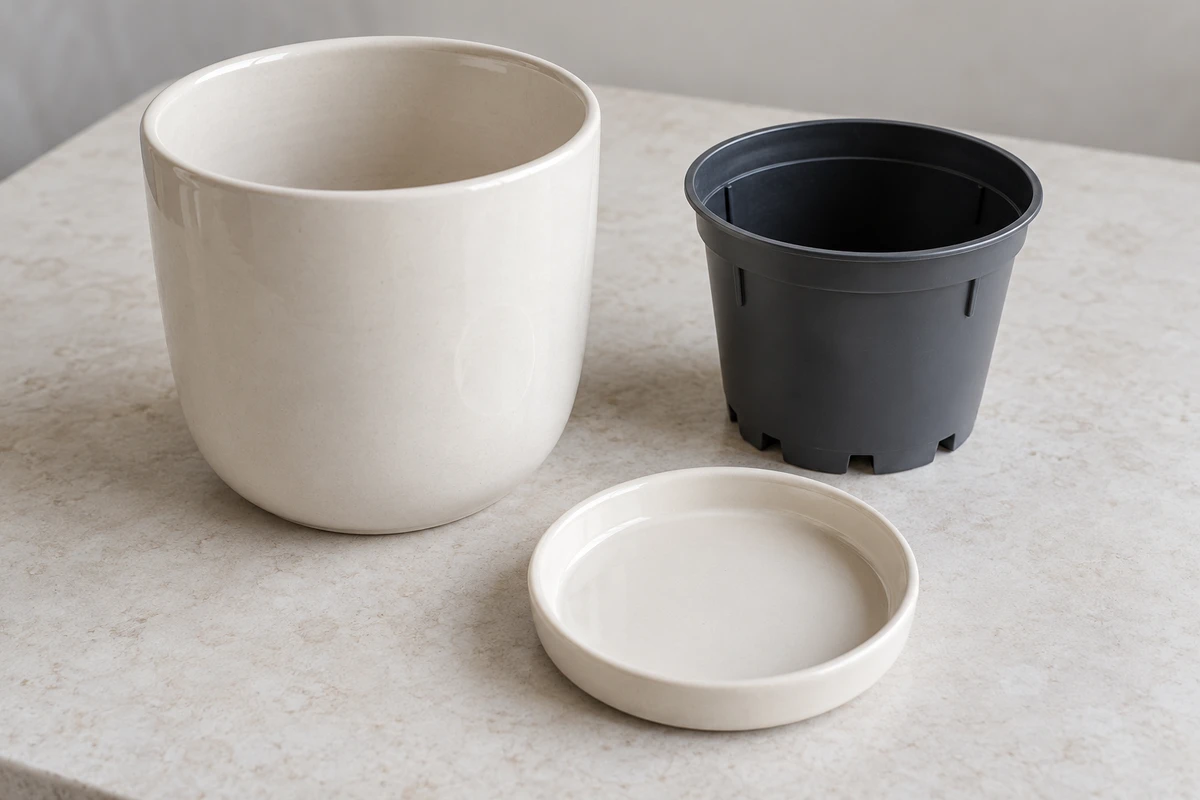
Before comparing wholesale planters with saucers, decide what the customer is buying: a vessel for direct planting or a decorative container around a removable nursery pot. The two arrangements ask different things of the opening, interior and drainage. Write that choice into the RFQ so the same nominal pot size does not conceal two different offers.
For a retailer retaining existing nursery pots, start with those actual pots. The ceramic vessel’s outside diameter tells you about its display footprint; it does not by itself tell you whether the intended inner pot can enter, sit at the right height and be removed.
Define the intended pot arrangement
State whether soil will be placed directly in the quoted vessel or whether the plant will remain in a separate inner pot. If the inner pot is to be supplied too, identify it as another included item. If the buyer will supply it, give its model or a measured reference rather than assuming that every nursery pot with the same size label is identical.
Describe the intended indoor display and the planned handling arrangement. For example, the buyer may want the inner pot to be removable for its established watering routine. The supplier should answer whether the proposed combination accommodates that requirement and provide its own use instructions. This RFQ is not a watering schedule or a recommendation for a particular plant.
Avoid merging direct-planting and cover-pot options in one price row. A hole-equipped vessel with a matching saucer may be a useful alternative, but it should be compared as a different configuration if the original request is for a no-hole decorative cover pot.
Measure the inner pot and the space it needs
Record the inner pot’s maximum outside diameter, including any projecting rim. Also measure its base diameter, height and relevant change in width between base and rim. Name the measurement points on a simple sketch or photograph. For a non-round pot, use the required widths and depths rather than reducing its shape to one diameter.
Ask for the decorative vessel’s clear opening, usable internal depth and internal profile at the heights relevant to the proposed inner pot. A broad opening can sit above a narrower interior. A listed inside diameter without a reference point leaves the lower fit unanswered.
Ask the supplier to identify where the inner pot would sit and how high its rim would stand relative to the decorative vessel. Decide whether that appearance is acceptable for the range. Include the ability to remove the inner pot in the sample review; a drawing showing that it can enter does not settle the everyday handling requirement.
Do not derive a universal clearance by subtracting one catalogue’s inside and outside measurements. Ask for the proposed combination, the supplier’s measurement basis and any relevant production variation. The buyer can then agree a fit requirement for that particular combination.
Use product specifications as a model for the questions
IKEA’s KLARBÄR article 405.084.26 provides a useful specification example. The retrieved Qatar product page separates inside diameter, outside diameter and maximum flowerpot diameter. It describes drainage holes, states that the saucer is supplied with the pot and identifies two packages. The returned page is an older product snapshot, used only to illustrate those distinct fields, not current availability.
Ask the seller of your proposed planter to answer the same scope questions for its own item. The named example supplies no evidence of another pot’s fit, water containment, surface protection or outdoor performance.
Copy a worksheet for each pot and saucer option
Use a separate worksheet for every size and construction being considered. Add a supplier variant reference so that a reply about one diameter or hole arrangement cannot be mistaken for an answer about another.
| Requirement | Buyer’s entry to complete | Supplier reply or unresolved point |
|---|---|---|
| Planting arrangement | Direct planting or removable inner pot; buyer-supplied or included inner pot | Proposed arrangement and all supplied items: ___ |
| Existing inner-pot profile | Maximum rim diameter, base diameter, height and intermediate profile where relevant | Exact reference accepted for the proposed fit: ___ |
| Decorative vessel interior | Required entry, seating position, usable depth and removal access | Clear opening, internal profile and measurement points: ___ |
| Drainage configuration | Hole or no-hole requirement; identify any alternative separately | Hole arrangement or no-hole variant confirmed: ___ |
| Saucer scope | Included, separately priced or not requested; required matching variant | Saucer dimensions, usable seating area and paired pot reference: ___ |
| Display footprint | Available width, depth and height for the complete displayed set | Outside pot dimensions and overall pot/saucer footprint: ___ |
| Supplied unit and packages | Quantity by configuration; what one saleable set contains | Pot and saucer quantities, package arrangement and exclusions: ___ |
| Remaining decision | Stock option or proposed modification | Fit sample reference, deviation, separate change quote and next answer due: ___ |
Leave missing dimensions visibly unanswered. “Fits 12 cm plants” cannot complete a row asking about a specific inner pot’s rim and height. If a supplier proposes a different inner pot, identify that substitution and ask whether replacing the buyer’s existing pots is actually acceptable.
Make holes and the matching saucer explicit
Request the hole or no-hole variant in writing and ask for a view of the base that corresponds to the quote. If drainage holes are requested, have the supplier identify their arrangement and any supplied removable component. Do not infer this from a photograph of the top or from the generic word planter.
For a saucer, ask which exact pot it matches and whether its usable seating area accommodates that pot’s base. Request its outside dimensions as well: the complete display may occupy more space than the pot alone. Keep an optional saucer distinct from one included in the unit price.
Ask how the pot and saucer are supplied, whether together or in separate packages, and how each is identified by size and finish. The RFQ needs the contents of one complete saleable configuration. Detailed transport protection and damage assessment can be reviewed separately through the site’s ceramic packaging guide.
A no-hole description is not a leakproof result. A saucer does not establish that furniture is protected, and a drainage hole does not establish outdoor or frost suitability. Request relevant product instructions and evidence where those properties are required rather than adding them to the size approval.
Fictional decision between two nominally identical sizes
A fictional retailer wants decorative no-hole cover pots around existing nursery pots. The reference nursery pot measures 120 mm across its widest rim, 94 mm at the base and 112 mm high. These invented measurements are for the example only.
Both offers are advertised as “12 cm pots.” Offer A supplies a drainage pot and saucer. Its returned drawing gives a 118 mm clear entry opening. On those stated figures, the buyer’s 120 mm rim is 2 mm wider than the opening, so A does not meet the requested entry requirement. It also changes the requested hole arrangement. The buyer sets A aside rather than treating its included saucer as a reason to overlook either difference.
Offer B is a no-hole cover pot without a saucer. The supplier reports a 130 mm opening and 118 mm usable internal depth, but its first reply gives no lower internal profile. The buyer keeps B under consideration and requests that missing profile plus a fit sample using the identified nursery pot. The larger entry and stated depth alone do not establish the full fit.
The decision is to investigate B’s stock configuration before commissioning a changed pot. The buyer has not approved it and has not established water containment. If B cannot accommodate the reference nursery pot, the next comparison is a different stock cover pot or an explicitly quoted modification. Drilling or otherwise altering a delivered ceramic pot is not part of this example.
Request the stock answer before a modification
Ask the supplier to identify any existing size that meets the inner-pot profile and requested hole arrangement. Where a modification is proposed, separate the change, sample work, minimum quantity and schedule from the stock quote. Leave those commercial answers blank until the supplier returns them.
Review the matched sample for entry, seating height, removal and the intended visual relationship between the two rims. Include the proposed saucer when it is part of the chosen configuration. Record the exact components reviewed; a different inner pot or altered ceramic profile needs its own fit answer.
For the wider category, see home décor and ceramics. Send the reference-pot measurements, quantity, destination and chosen arrangement through the homeware sourcing page. It accepts supported marketplace HTTPS links, an 8–1200 character description, or up to five PNG, JPEG, WebP or GIF images, limited to 10 MiB each and 20 MiB in total. Use an image preview for the profile sketch and arrange any other file exchange separately.
Frequently asked questions
Do wholesale planters include saucers?
Ask for a written contents list for the exact quoted variant. Some offers may include a matched saucer, while others price it separately or describe only the pot. Record the paired pot and saucer references, quantity of each and whether they arrive together or in separate packages. A saucer shown in a lifestyle photograph is not enough to establish the supply.
Is planter diameter the outside size or the inner-pot fit?
A diameter label needs a definition. Request outside diameter for the display footprint, clear opening and relevant internal measurements for fit, and the supplier’s stated compatible inner-pot size where available. Keep the inner pot’s maximum rim diameter, base, taper and height with the request. One interior diameter without its measurement position cannot describe the whole space available.
Should I order drainage holes for a decorative cover pot?
Choose the intended arrangement first and ask the supplier to quote that exact hole or no-hole configuration. If you will retain removable nursery pots, describe how that combination will be handled and request the proposed product’s instructions. Treat a drainage vessel with a saucer as a separate option if it changes the brief. Neither hole choice establishes plant health, leakproof performance or suitability outdoors.
What dimensions matter when fitting a nursery pot inside a ceramic planter?
Measure the nursery pot’s widest rim, base, height and relevant taper, then compare them with the ceramic vessel’s opening, usable depth and internal profile at the corresponding heights. Ask where the inner pot will sit, how much of its rim will show and whether it can be removed as intended. Confirm the actual pairing on a labelled sample instead of assuming a fixed clearance works for every pot.
Sources
Discuss a sourcing request related to this article.Planter RFQ: Match the Inner Pot, Drainage and Saucer