
Planter Winter Handover: Keep the Empty-Pot Condition Visible
Compare the recipient’s filled winter display with the exact planter’s cold-weather conditions, preserving qualifications instead of handing over a broad frost claim.
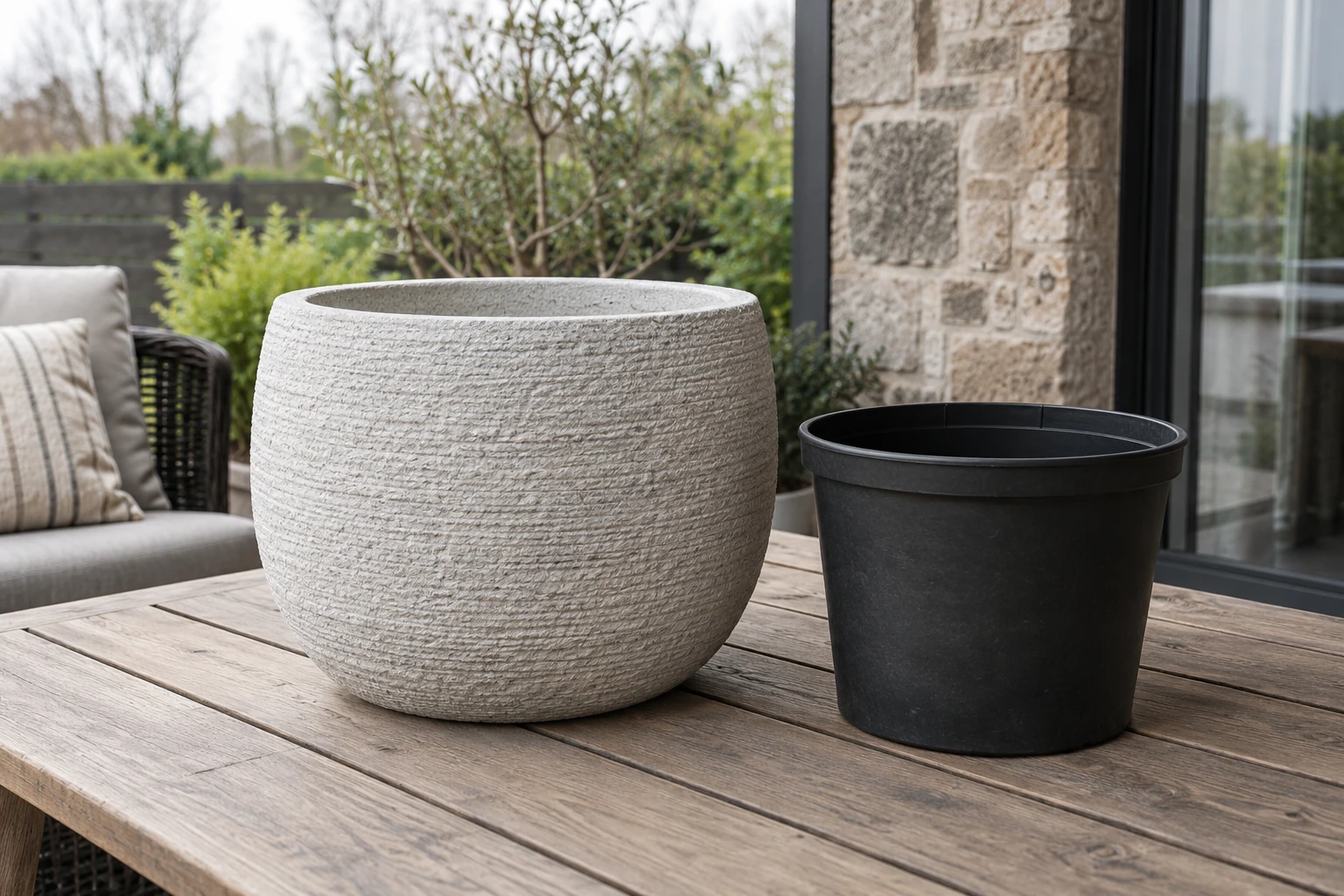
Keep the condition attached to a planter’s outdoor claim when passing it to the recipient. If the maker’s cold-weather statement applies only when the pot is empty of soil, a handover card cannot shorten it to an unrestricted winter-use promise for a filled planter. The buyer must resolve that difference before treating the seasonal plan as complete.
For seasonal outdoor use, start with the already selected pot and the recipient’s intended arrangement. It does not revisit the nursery-pot fit, demonstrate drainage or test frost resistance. The practical decision is whether the actual planned state is covered by the applicable instructions, needs a changed plan or remains unanswered.
Read the condition alongside the product name
Identify the exact planter, size and construction from the supplied records. Obtain the complete current statement that is relevant to the intended outdoor period. Preserve the qualifying words beside the claim rather than keeping them in a separate reference that the recipient is unlikely to see.
IKEA’s US MUSKOTBLOMMA 304.548.91 is a useful named example. Its product page describes below-zero outdoor keeping on the condition that the pot has been emptied of soil. This supports the conditional statement for that item only. It provides no cold-weather threshold or frost guarantee for another planter. IKEA US MUSKOTBLOMMA product details
For an unknown supplier item, request the actual instructions rather than copying that manufacturer’s wording. “Terracotta,” “outdoor” and a similar shape do not establish that the same condition applies. If the seller provides only a broad claim, ask it to identify the covered product state and the source of that claim.
Keep the source market and product reference visible when collecting information. A different size, coating or later substitute may have a different statement. Do not combine the strongest feature from one page with the easiest condition from another to produce a more convenient description.
Describe the winter plan as it really exists
Ask whether the recipient intends to leave the pot filled with soil, keep a separate planted inner pot inside it, or retain an empty decorative vessel outdoors. These are descriptions of the proposed arrangement, not instructions for moving or altering a planted container.
Connect that state to the actual seasonal location and intended period. A summer outdoor display does not answer a winter question. Equally, the phrase “covered terrace” does not establish that a cold-weather condition is irrelevant. Where the instructions do not answer the stated situation, retain the uncertainty and request a product-specific response.
A plan involving a removable planted inner pot deserves its own answer. Do not assume the outer pot counts as empty for the manufacturer’s purposes merely because the soil sits inside another container. Describe the complete arrangement and ask whether the applicable statement covers it. That is more useful than interpreting “empty” in the buyer’s favour.
If the recipient expects a filled outdoor display to remain unchanged through winter, say that explicitly. A condition that requires a different state may make this product a poor match for that expectation, even when the planter’s appearance and size are satisfactory.
Do not substitute drainage for the stated empty condition
A drainage feature and an empty-state condition answer different questions. A hole in the base does not demonstrate that soil has been removed or that the intended filled arrangement is covered by a cold-weather statement. A matched saucer likewise supplies no independent winter-use permission.
This distinction matters when a supplier responds with a base photograph instead of answering the seasonal question. The image may identify a visible feature while leaving the requested use unresolved. Ask for a response that names the exact pot, the proposed filled or empty state and the relevant instruction.
Avoid improvised fixes that the instructions do not support. Do not drill a pot, add a liner, devise a covering arrangement or propose a cold trial as a way to make the condition disappear. The buyer’s choice is between an evidenced product-use arrangement and a changed requirement, not between unverified workarounds.
Nor should the buyer turn missing coverage into a claim that failure is certain. “Filled winter use not established” states the actual evidence gap. It is different from asserting that a particular pot will crack on a particular night, which this review cannot predict.
Use a seasonal-state worksheet
Complete one original worksheet for each exact planter and intended seasonal state. The rows expose a mismatch; they do not supply a weather forecast, plant-care plan or handling method.
| Seasonal question | What to record | Decision if the entry is incomplete or conflicting |
|---|---|---|
| Exact planter | Product, size, finish/construction and applicable instruction | Obtain the matched record before transferring a claim |
| Requested seasonal location | Actual proposed position and period | Clarify the intended exposure rather than relying on “outdoor” |
| Manufacturer condition | Full relevant statement, including any required empty state | Keep the qualification attached to the claim |
| Planned contents | Soil-filled, planted inner container, or empty vessel as proposed | Compare that actual state with the stated condition |
| Intended-use mismatch | Exact difference between the plan and the covered state | Seek a product-specific answer or change the plan |
| Chosen seasonal outcome | Covered arrangement, revised location/use proposal, alternative product, or unresolved | State what has and has not been decided |
| Recipient wording | The chosen scope and any remaining limitation | Remove shortened or contradictory winter promises |
When a state is unknown, use “not established” rather than selecting the nearest convenient answer. The worksheet should reveal the decision the recipient still needs, including any change that would affect the appearance or ongoing use of the planted display.
A fictional frost-resistant card with its condition missing
A fictional buyer selects planter P6 for a terrace display. Its applicable product statement allows the stated cold-weather keeping only when emptied of soil. The recipient intends to leave P6 filled and planted throughout winter, but the prepared handover card says simply “frost-resistant outdoor planter.” All references and events in this example are invented.
The buyer first restores the missing condition and marks filled winter use as unresolved. This corrects the promise without claiming that the intended arrangement has failed a test. A supplier photograph showing the drainage hole does not close the gap because it says nothing about whether the filled state is covered.
The buyer now has three genuine choices. It can seek an attributable answer for this exact filled arrangement; it can consider a different seasonal use or location under the actual instructions; or it can seek another product whose documented scope matches the unchanged filled-display requirement. Each choice preserves the distinction between the desired result and the evidence available.
Suppose the recipient says the planted display cannot be changed seasonally. The buyer therefore keeps P6 out of the completed winter-use selection and requests a suitable alternative with product-specific documentation. P6 might still have another agreed use, but that requires a deliberate decision. The old frost-resistant card should not stay attached to the original winter plan.
If the buyer instead chooses a permitted different state, any physical work needed to achieve it must be separately planned by the appropriate people. This example provides no emptying, lifting, soil-removal or plant-care procedure. A revised document cannot itself change what is inside the pot.
Carry the condition through the next season
The recipient’s final note should identify the pot, describe the selected seasonal arrangement and retain the full relevant condition. If the arrangement later changes, the earlier answer should not automatically transfer. Replacing an empty display with a planted inner container is a new state worth checking against the actual instructions.
Keep any alternative-product request focused on the unresolved requirement. Ask for coverage of the intended filled seasonal use rather than another broad frost-related slogan. The buyer can then compare genuine options without pretending that drainage, material or successful saucer pairing settles the winter question.
See Homeware decor and ceramics for category context. Through the Homeware sourcing enquiry, describe the exact planter, intended seasonal state and missing answer. Supported links, descriptions or images can open the discussion; the form is not a technical-document upload channel, and no cold-weather testing or performance guarantee is implied.
Frequently asked questions
Does an outdoor planter label cover a soil-filled winter display?
Not by itself. Obtain the exact product’s applicable seasonal statement and compare it with the recipient’s proposed filled or empty state. If the statement is conditional and the intended state differs, leave that use unresolved or change the plan. Do not turn a general outdoor label into an unrestricted winter guarantee.
Does a drainage hole satisfy a condition that the pot must be empty of soil?
No. The visible presence of a hole does not establish the required empty state or coverage of filled winter use. A supplier’s drainage photograph can answer a feature question while leaving the seasonal question open. Request a product-specific answer that names the actual pot and the planned state instead of substituting drainage for the stated condition.
What if a planted inner pot remains inside the outer planter?
Describe that complete arrangement to the responsible product source. Do not assume that keeping soil in a separate container satisfies an empty-state requirement for the outer vessel. The applicable instructions or a product-specific clarification must answer that question. No emptying, lifting or plant-care procedure is supplied by the handover worksheet.
What should I do when the recipient wants the planter left filled all winter?
Make that unchanged-state requirement explicit. Seek coverage for the exact arrangement, consider another properly documented product or deliberately change the seasonal plan. If only empty-state coverage is available and the recipient will not change the arrangement, do not mark the filled winter-use selection complete. Missing coverage is not proof of a predicted failure.
Sources
Discuss a sourcing request related to this article.Planter Winter Handover: Keep the Empty-Pot Condition Visible