
Reorder Saucers for Retained Pots Without Rebuying the Pots
Keep an established pot–saucer pairing as the starting point, then compare current saucer-only supply with the extra pots created by complete-set purchases.
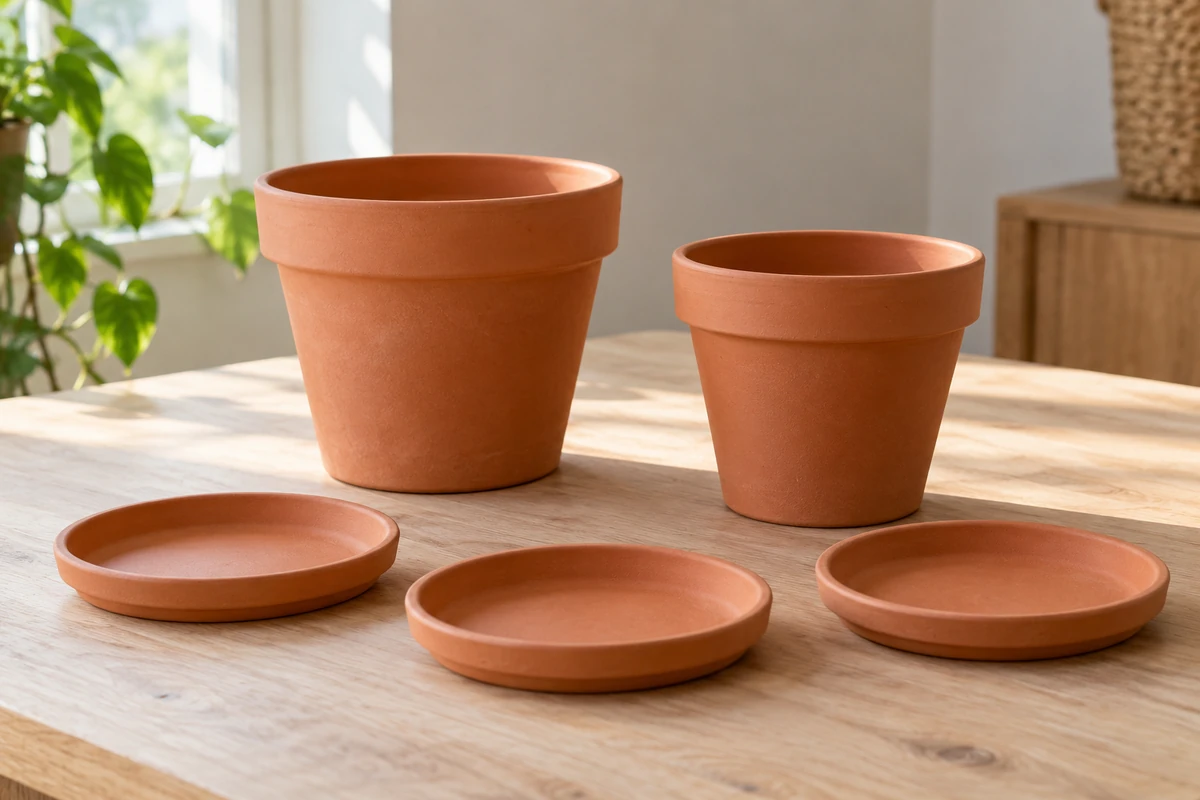
If eight retained pots have a shortage of three saucers, the replenishment question is how to obtain those three companions, not how to buy eight new planter sets. Begin with the already approved pot–saucer groups, identify the actual saucer shortfall and ask whether those saucers are currently offered separately.
A saucer-only reorder for retained pots compares replacement supply routes and the extra pots each route creates. It does not repeat the initial planter-fit specification or a dry-seating inspection. An alternate saucer without an established pairing remains a proposal, however convenient its nominal size or product name may look.
Count the missing companion within each retained group
List the pots the buyer intends to keep and the corresponding approved saucer reference. Count only the saucers missing from that defined group. If some pots never required a saucer under the chosen arrangement, do not create new demand for them merely because a catalogue sells complete sets.
Separate a missing companion from a request for additional complete display positions. A new pot-and-saucer position needs both components. A retained pot with a missing saucer needs only the companion under the existing plan. Combining those requests makes it difficult to see which pots are genuinely required and which are acquired only because of a bundle.
If the retained collection includes different pot groups, keep their saucer requirements distinct. An established pairing for one group does not cover another just because their rims appear similar. Where the pairing record is unavailable, mark that group unresolved before selecting a replacement supply.
Ask for current separate supply, not an assumed spare policy
A saucer can be a separately listed product. Elho’s universal saucer round 19 cm in anthracite is one named example, with SKU 1380311942500 and distinct dimensional fields. Its listing demonstrates a standalone commercial format; it does not prove that the buyer’s exact original saucer is sold alone or that a supplier maintains spare stock. Elho standalone saucer specification
Request the exact approved saucer reference first. Ask whether it is offered separately now, what one selling unit contains, and whether the quoted finish and size are the intended variant. A photograph beside a pot can illustrate appearance without establishing that the seller accepts a saucer-only order.
Distinguish three answers: the original saucer is currently offered separately; only a complete pot-and-saucer set is offered; or an alternate saucer is proposed. Each answer creates a different purchasing route. An unanswered stock or contents question should not be converted into an unavailable-item claim.
Keep an alternate’s fit question short and separate
The Elho specification separates a 19 cm outside top from a 17 cm inside top and a 15.5 cm inside bottom. Thus a nominal 19 cm saucer is not a 19 cm flat seating area. These dimensions describe that exact product and do not establish a match to any retained pot. The word universal is a product name, not a substitute for the actual pairing answer.
For an alternate, carry its exact reference and relevant usable seating information to the responsible product-specific review. Keep the outcome linked to the retained pot group. Do not turn this replenishment worksheet into another full dimensional RFQ or prescribe a physical seating procedure.
No water-containment, furniture-protection, drainage or plant-health conclusion follows from a matching size reference. Likewise, purchasing a replacement saucer does not establish a new indoor, outdoor or seasonal-use permission. Follow the actual product instructions and keep those separate questions outside the supply arithmetic.
Compare three replacement routes honestly
The first route is current separate supply of the established saucer. Its actual selling increment may provide the exact shortage or leave extra saucers. Confirm the increment rather than assuming single-piece sales from a standalone page.
The second route is a complete set containing the established saucer, where such an offer actually exists. Expand it into pots and saucers. If only the saucers answer the present shortage, the additional pots remain extra purchased goods. Do not call them replacements for retained pots the buyer intends to keep.
The third route is an alternate saucer whose pairing has been separately established before selection. It may have a different appearance or selling increment. The owner should accept those differences explicitly. Until its pairing is resolved, keep its quotation as a candidate rather than ranking it as a fully equivalent supply.
For all routes, request actual current totals with the relevant commercial scope and leave missing amounts open. Do not assume saucer-only supply is always cheaper, lighter to ship or faster to obtain. Those conclusions require the actual offers and, where relevant, separate shipment information.
Use a companion-replenishment worksheet
| Worksheet field | Entry for each retained group | Purchase consequence |
|---|---|---|
| Retained approved pot group | Exact pots and established companion reference | Defines what is staying |
| Saucer shortfall | Actual missing saucers | Establishes the narrow replenishment need |
| Pairing status | Original approved pairing or separately reviewed alternate | Keeps unresolved proposals out of selected supply |
| Relevant seating reference | Existing approval or identified alternate’s inner information | Preserves the prerequisite without reopening the whole fit brief |
| Saucer-only purchase unit | Current offer and saucers per unit | Shows exact or surplus-bearing companion supply |
| Complete-set alternative | Pots and saucers per confirmed set | Exposes additional pots created |
| Extras and appearance choice | Extra saucers, extra pots and accepted differences | Makes the owner’s trade-off explicit |
This original worksheet concerns the buying decision. It neither demonstrates fit nor authorizes moving, altering or testing a planted pot.
Fictional example: eight retained pots, three missing saucers
Imagine eight pots of an approved group, with three of their established saucers missing. No additional complete display positions are needed. All counts, product references and seller responses below are fictional.
Offer A confirms the original saucer as a single-piece purchase unit. Three units cover the shortage without adding pots. Offer B confirms complete sets containing one pot and one matching saucer. Three B sets also cover the saucer shortage but add three pots that the current plan does not need.
Offer C proposes a different nominally 19 cm saucer with no completed pairing answer. C stays provisional. Its title cannot settle whether it belongs with the retained pots, and a low displayed price would not change that status. The buyer requests the missing product-specific answer separately.
Suppose A instead clarifies that its actual selling unit contains four saucers. One unit would cover the shortage and leave one saucer extra. That is a different consequence from B’s three extra pots. The comparison should retain both kinds of remainder rather than reducing them to a generic extra-pieces total.
The owner may choose A’s extra saucer, B’s complete sets or a subsequently reviewed C offer on the basis of actual terms and accepted consequences. If B’s extra pots have no current purpose, keep that fact visible; do not assign them speculative resale value. If a separate new display need later arises, record that new requirement before giving the pots credit for it.
The worked outcome is a precise supply comparison, not an automatic price winner. The existing eight pots remain the reference population, the current shortage stays three saucers, and any changed purchase scope has an explicit reason.
Keep the companion-only request clear
See Homeware decor and ceramics for broader context. In a Homeware sourcing enquiry, identify the retained pot group, approved saucer, missing quantity and request for separate supply. Use a supported marketplace link, concise description or permitted images, and ask the provider to state the actual offer rather than implying a guaranteed spare-parts service.
Frequently asked questions
Can I reorder saucers without buying the pots again?
Ask for a current separate offer for the exact approved saucer and confirm its selling unit. Standalone saucer products exist, but that does not establish availability for your original pairing. Keep a complete-set-only response or alternate proposal as a different route with its own consequences.
Does a universal 19 cm saucer fit any retained 19 cm pot?
No such match follows from the name or nominal size. The named Elho item distinguishes outside top, inside top and inside bottom dimensions. Preserve the established pairing or obtain a product-specific answer for an alternate; do not use this quantity worksheet as a fit test or protection guarantee.
How do I compare three saucers with three pot-and-saucer sets?
Expand both actual offers into components. If only three companions are missing and the pots are retained, three complete sets add three extra pots. If a separate saucer pack instead supplies four, it leaves one extra saucer. Keep those different remainders and actual commercial totals visible.
What if the original saucer is no longer offered separately?
Confirm whether the answer is a current set-only offer, an unresolved supply question or a documented alternate. An alternate needs its own pairing and appearance decision before selection. Do not infer a universal spare-parts policy, modify a saucer or replace all retained pots simply to close an unanswered line.
Sources
Discuss a sourcing request related to this article.Reorder Saucers for Retained Pots Without Rebuying the Pots