
Flat-Pack Shelf Costs: Budget the Work Between Delivery and Handover
Compare flat-pack and ready-assembled shelving at the same handover stage, including confirmed room placement, assembly and packaging-waste work.
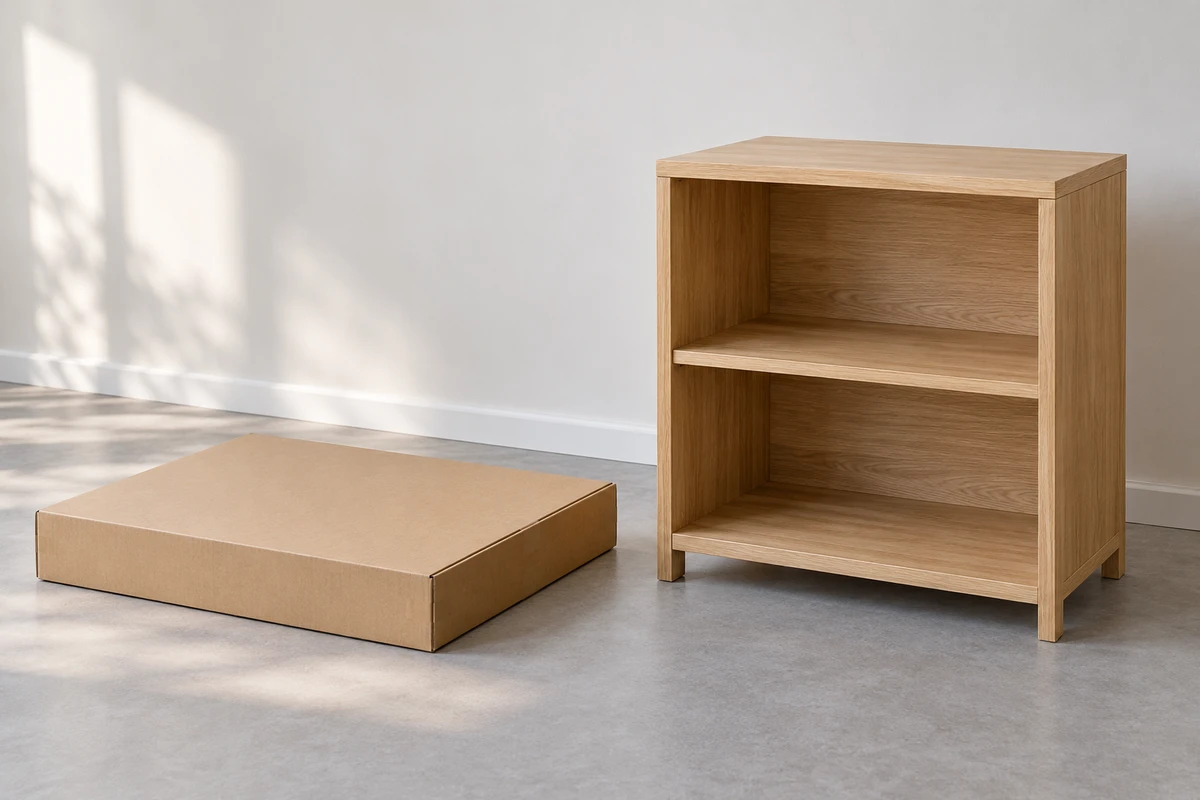
A flat-pack shelf delivered to a building is not yet the same purchase outcome as a complete shelf handed over in its intended room. Before comparing it with a ready-assembled option, price the work between those two stages. The missing task is often hidden between separate provider scopes.
Begin with a shelf configuration already selected for its intended use. Keep product, stability and installation approval with the responsible reviewers. This budget does not choose wall fixings, assess loads or provide assembly instructions.
Name the final handover in ordinary language
Specify the model, size, finish, shelf arrangement and unit quantity. Then describe where the completed units must be and what work must be finished. For example, the requirement might include placement in a named room, assembly under applicable instructions, any separately established installation work, and removal of the agreed packaging waste.
Do not describe a shelf as ready for use if a required installation step remains unresolved. Identify the person who decides when that step is complete. A commercial worksheet can assign and price work; it cannot supply the technical decision.
Check that the ready-assembled candidate provides the same final product. A different shelf arrangement or finish is a product alternative, not simply a change in delivery form. If the buyer accepts that difference, show it openly before comparing totals.
Read delivery and assembly as separate offers
Ask the delivery provider to name its actual stopping point. “At the address” might leave unanswered whether the cartons reach a lobby, receiving area or intended room. Describe access constraints accurately and ask the provider to assess the packed units. Do not improvise a carrying method from carton dimensions.
IKEA’s US delivery information distinguishes delivery outside or to a lobby from in-home room delivery. Its separate assembly page requires packages to be in the intended room and excludes packaging-waste removal. These are examples of defined service boundaries, not offers for a third-party imported shelf. IKEA delivery scope and IKEA assembly scope
For your order, ask a real assembler to confirm acceptance of the exact product, instructions, location and proposed work. An assembler’s general advertising is not a quote for an unfamiliar shelf. If the provider declines the product or required installation scope, keep that route unavailable until another suitable provider responds.
Find the work between the two contracts
Draw the sequence from the quoted delivery endpoint to the completed handover. For each transition, ask who has agreed to perform it. Moving cartons from lobby to room is one possible gap. Receiving and keeping matched cartons together, opening them at the required stage and dealing with packaging afterwards can create others.
The assembly offer should state its prerequisites: the relevant product information, complete packages and the conditions the provider needs confirmed. Ask what happens under its actual terms if work cannot be completed because parts or instructions are missing. Do not assume a return visit is included, or insert an invented fee into the budget.
For a ready-assembled alternative, repeat the exercise. Confirm its supplied state, final transport packing and permitted placement service. Assembly at origin does not automatically include destination installation or waste removal. Nor does a finished product’s room fit establish that its packed form can reach that room.
Use a completion-budget worksheet
Create one column for each available proposal. Every task should be included in an identified quote, separately quoted, explicitly accepted as buyer work, or marked unresolved.
| Task or input | Flat-pack proposal | Ready-assembled proposal |
|---|---|---|
| Final shelf | Exact approved model and units | Equivalent configuration or accepted difference |
| Transport units | Cartons per unit, dimensions and gross weights | Actual final packed units and measurements |
| Quoted delivery | Exact endpoint and included movement | Same endpoint, or priced gap to the common endpoint |
| Room placement | Provider, prerequisites and quote | Provider and included or separate scope |
| Assembly and required installation | Accepted product, applicable work and price | Work completed and any destination work still required |
| Packaging waste | What is collected, from where and by whom | Corresponding included or separate service |
| Handover responsibility | Who confirms the agreed work is finished | Same completion requirement |
The ITA describes a packing list as identifying package contents, weights and measurements. Use that limited principle to connect the transport quote to the shelf’s actual carton set; it is not a universal document rule. ITA packing-list guidance
Let CF and CR represent complete costs for the flat-pack and ready-assembled proposals. Build each from its actual goods and transport offer plus required, nonduplicated completion charges. Keep unresolved import amounts or local work visible. An incomplete CF cannot be ranked against a complete CR simply because its subtotal is lower.
Work through a fictional lobby delivery
Imagine two fictional shelves, each supplied in two matched cartons. The flat-pack transport offer ends in the lobby. The prospective assembler accepts the identified shelf in principle but requires all four cartons in the intended room and excludes waste removal. These counts and replies are invented; no provider availability or fee is established.
The buyer can now name two missing lines: lobby-to-room placement and the agreed waste task. Ask for actual providers and amounts, or for a revised combined service that expressly covers them. Do not move an unnamed “delivery included” amount into those rows.
If the buyer’s own team proposes doing one task, record its acceptance, capability review and any known associated cost. Do not silently price staff time as free. The team may choose not to monetize its time, but the responsibility and resource demand still belong beside the comparison.
Suppose the ready-assembled supplier has a quote to the same room but has not answered the installation or waste scope. That offer is incomplete too. The worked decision is to obtain those specific missing responses before choosing a purchase route. If one route cannot establish a necessary completion service, it is not a cheaper equivalent, whatever its transport subtotal says.
Close the gaps before committing
Record the selected shelf, packing references, provider scopes and outstanding prerequisites together. Confirm how the local work is arranged around the actual delivery, without assuming a completion date from a shipping estimate. Any later change to the product or endpoint returns the affected work for pricing.
See Homeware baskets and storage for category context. In a Homeware sourcing enquiry, describe the shelf, quantity and required handover, using a supported link or concise text. Ask which tasks are actually offered and which you must arrange locally. The useful comparison ends with the same completed shelf outcome on both sides.
Frequently asked questions
Does delivery of a flat-pack shelf include moving it into the room?
Only if the actual delivery offer includes that movement. Name where the delivery provider stops and where the assembler expects the packages to be. If those places differ, assign the intervening task and obtain an actual offer before calling the shelf budget complete. An address alone does not describe the handover.
Can an IKEA assembly service be assumed available for an imported shelf?
No. IKEA’s published service is used here only to illustrate how assembly prerequisites and waste exclusions can be stated. Ask an actual provider to accept the exact third-party product, destination and applicable instructions. Keep availability and price unresolved until that provider confirms its own scope.
How should missing parts or incomplete carton pairs affect the assembly budget?
Ask the assembler what it requires before attendance and what its actual terms say if the unit cannot be completed. Record who checks carton completeness and how unresolved parts are handled. Do not invent a second-visit charge or assume it is free; retain the supplier’s product-remedy obligations separately from local assembly work.
Is a ready-assembled shelf automatically cheaper once labour is included?
No. Compare equivalent products and the same placement, installation and waste endpoint. Ready-assembled supply may have different packed geometry and delivery requirements, while a flat-pack offer may leave local work unpriced. Select only after both real proposals cover the required outcome and the necessary product and installation reviews remain satisfied.
Sources
Discuss a sourcing request related to this article.Flat-Pack Shelf Costs: Budget the Work Between Delivery and Handover